
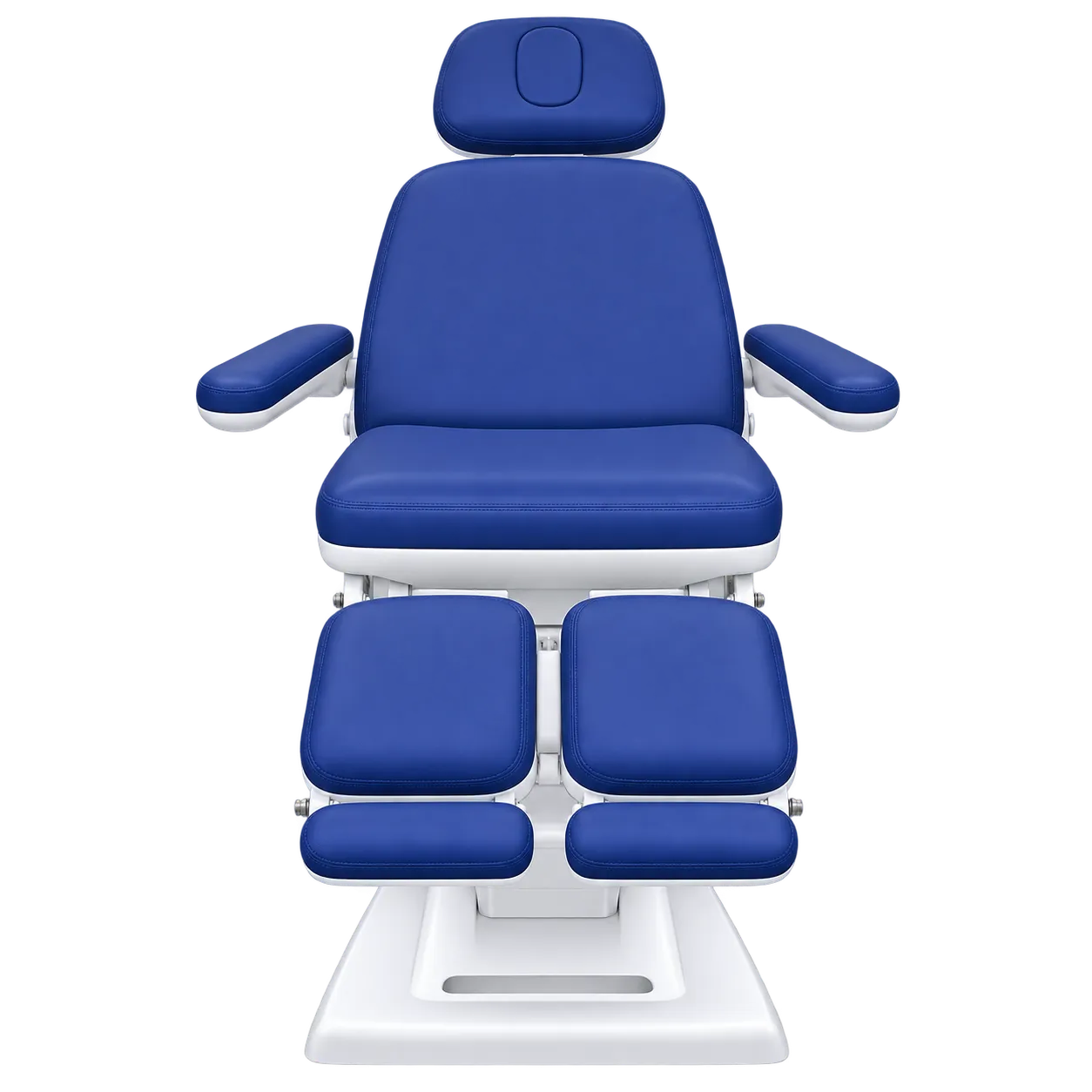


The Sonora-260 is laid out for podiatry nail surgery and verruca work, dermatology biopsies and excisions, and minor procedure and injection rooms. A patient gets on with both leg halves down, is raised and reclined by motor, and has one foot dropped for treatment while the other rests, with the head-down tilt held in reserve.
Fainting is the event that the sequence has to absorb. In a 2024 survey of 240 dermatologists, Erdogan and colleagues found that 53% had experienced an emergency during dermatological or surgical procedures, with vasovagal syncope most commonly reported at 58% and biopsies and intralesional injections as the usual setting. Over a quarter (27%) had no basic life support training. The answers were self-reported and recall-dependent, and the authors judged such complications not very common. NHS advice for someone who feels faint is to lie down with the legs raised, which on this chair means levelling both halves by hand before the motors flatten and tilt the top. The tilt is a positioning aid, and the clinic's own protocol decides when to use it.
Podiatrists using it are on the HCPC register, and the GMC and NMC regulate the doctors and nurses who share such rooms. In England, the CQC lists surgical procedures as a regulated activity; in Scotland, Wales, and Northern Ireland, Healthcare Improvement Scotland, Healthcare Inspectorate Wales, and the RQIA regulate them. Purchases through NHS procurement routes will require electrical safety evidence for three motors, the BS 7176 certificate, and a declaration of conformity; equivalent public procurement elsewhere requires time. The manufacturer issues the conformity documentation those procurement routes require, and the enquiry team shares it.