
- Routine eye examinations
- Refractive surgery screening (LASIK, PRK)
- Cataract surgery planning
- Premium IOL selection
- Keratoconus detection
- Contact lens fitting
- Visual quality assessment
- Pre- and post-operative comparison
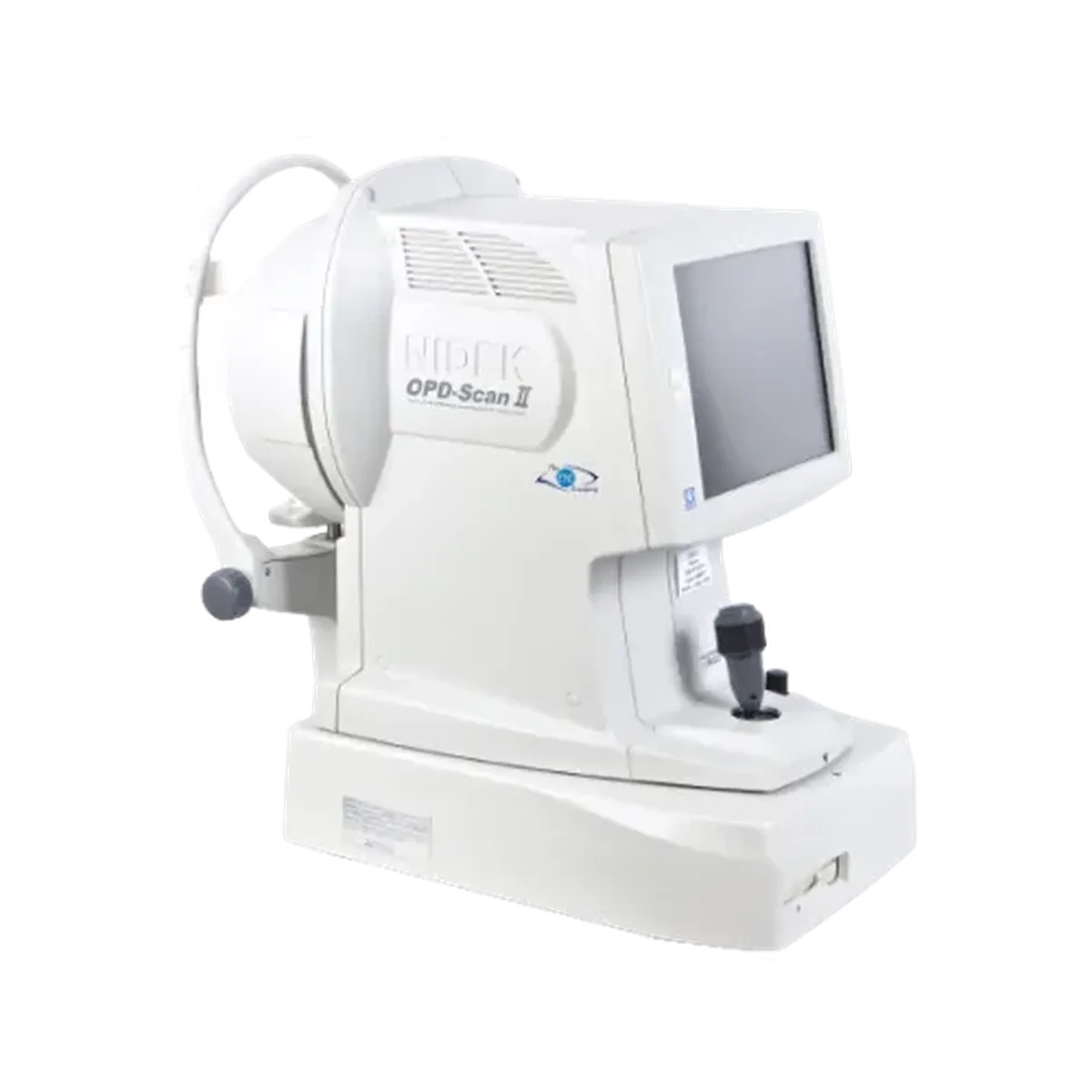
Complete eye analysis in one smart system.
The OPD-Scan II ARK-10000 is a multi-purpose eye diagnostic device that measures refraction, corneal curvature, topography, and optical aberrations. The 2010 model in good condition offers dependable performance for routine and advanced eye examinations.
A few quick details and you are done. Our projects team replies within one business day with availability, lead time and a quotation.
Nidek Auto refractor topographer OPD-Scan II ARK-10000 - Good Condition 2010
Product code: MDIE-ODE-799
The OPD-Scan II ARK-10000 is designed to provide a complete analysis of the eye’s optical system. It integrates four essential diagnostic functions into one compact platform:
This combination allows doctors to assess both lower-order and higher-order aberrations. It is especially useful for refractive surgery planning, cataract evaluation, and detailed visual quality assessment.
The system provides clear maps and easy-to-understand reports, which help doctors explain results to patients. Even though this is a 2010 model, it remains clinically effective and suitable for daily use in busy practices when properly maintained.
Key Features
1. What does the OPD-Scan II ARK-10000 measure?
It measures refraction, corneal curvature, corneal topography, pupil size, and optical aberrations.
2. Is this device suitable for refractive surgery clinics?
Yes, it is commonly used for LASIK and other refractive surgery assessments.
3. Can it detect higher-order aberrations?
Yes, the built-in wavefront aberrometer measures higher-order aberrations.
4. Is the 2010 model still reliable?
Yes, if properly maintained, it continues to provide accurate and dependable results.
5. Does it replace separate auto refractor and topographer devices?
Yes, it combines multiple functions into one system.
6. Is it useful for cataract patients?
Yes, it supports cataract evaluation and premium IOL planning.
7. Is it easy to operate?
Yes, the interface is simple and designed for smooth workflow in clinics.
8. Why choose a good-condition 2010 model?
It offers advanced diagnostic features at a lower investment cost.