
Heterophoria and Binocular Vision Assessment
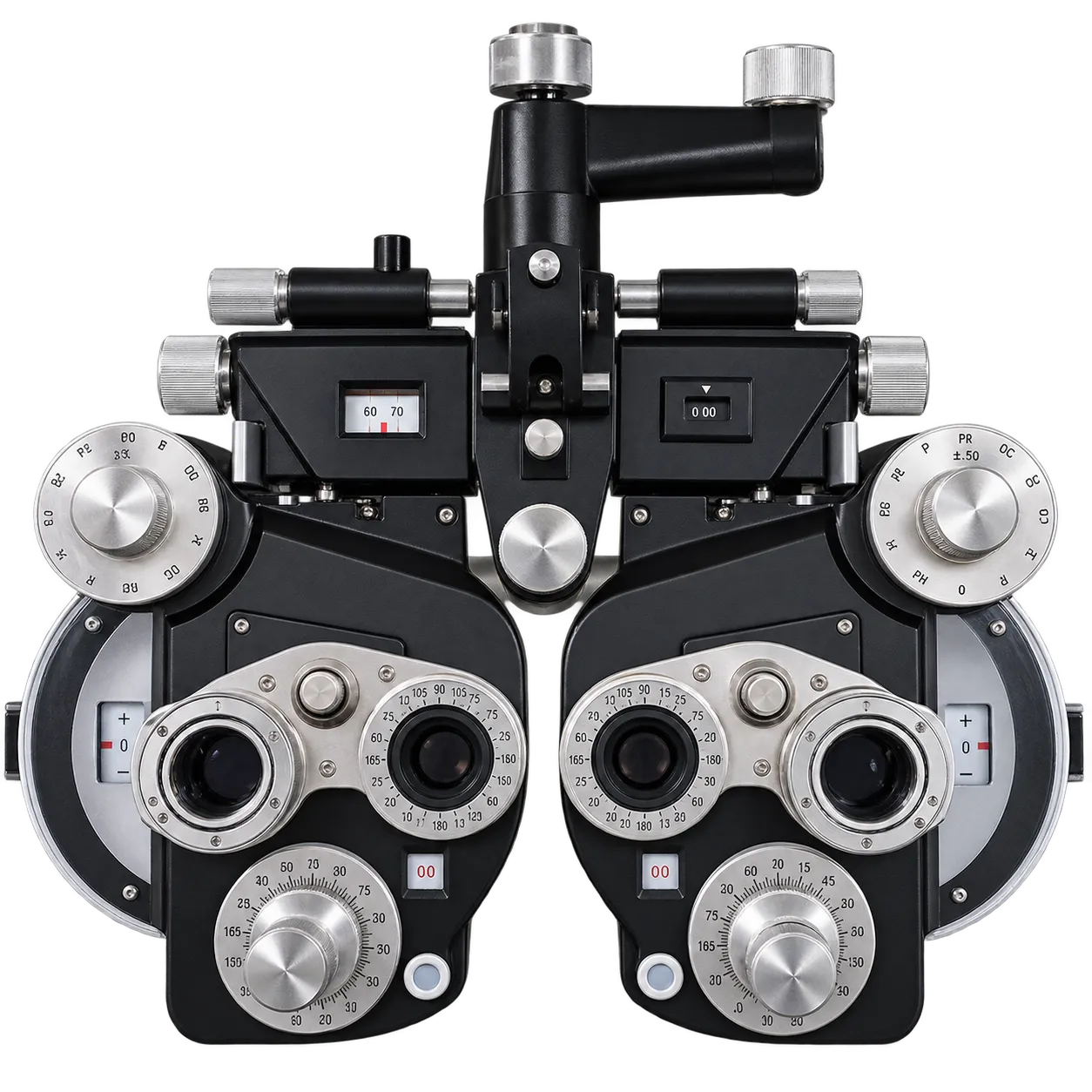
Maddox rods in both orientations, combined with rotary prism to 20 prism dioptres, allow horizontal and vertical phoria to be measured and quantified during the same appointment as the refraction. Patients presenting with headaches, intermittent diplopia or reading discomfort frequently have a binocular cause rather than an uncorrected refractive one, and an instrument carrying the necessary lenses makes that investigation a natural continuation of the sight test instead of a separate undertaking.
Dissociated and Polarised Testing
Polarising filters at 135 and 45 degrees support tests that present each eye a different image while both remain open. Binocular balance, fixation disparity and associated phoria work all depend on that dissociation. Having the filters built into the head means the sequence runs without interruption, which matters because the patient's binocular state is easily disturbed by the act of changing equipment mid test.
Duochrome and Retinoscopy Within One Head
Red and green lenses allow the spherical endpoint to be confirmed chromatically rather than by sharpness judgement alone, which is particularly useful with patients who find discriminating between similar presentations difficult. The plus 1.50D retinoscopy lens fitted as standard means objective retinoscopy can be performed at the working distance through the same head, before subjective refinement begins.
Routine Subjective Refraction
For everyday sight testing, spherical coverage from minus 19.00 to plus 16.75 and cylindrical power to minus 6.00D, both in quarter dioptre steps, handle the great majority of prescriptions. Three selectable cross cylinder powers let astigmatic refinement proceed at a step the patient can actually judge, and the plus 0.12D sphere allows finer spherical adjustment where a patient discriminates it.