
Rooms Requiring a Folding Mirror
Where a consulting room cannot offer the optical distance along a single sight line, a path folding mirror is the conventional solution, and it requires the chart to be displayed mirrored. Providing that as a function rather than an afterthought means the display works properly in the reversed arrangement instead of needing a workaround. For practices already committed to a mirror layout, this is the specification that determines whether a given screen can be used at all.
Clinical and Research Settings Using LogMAR
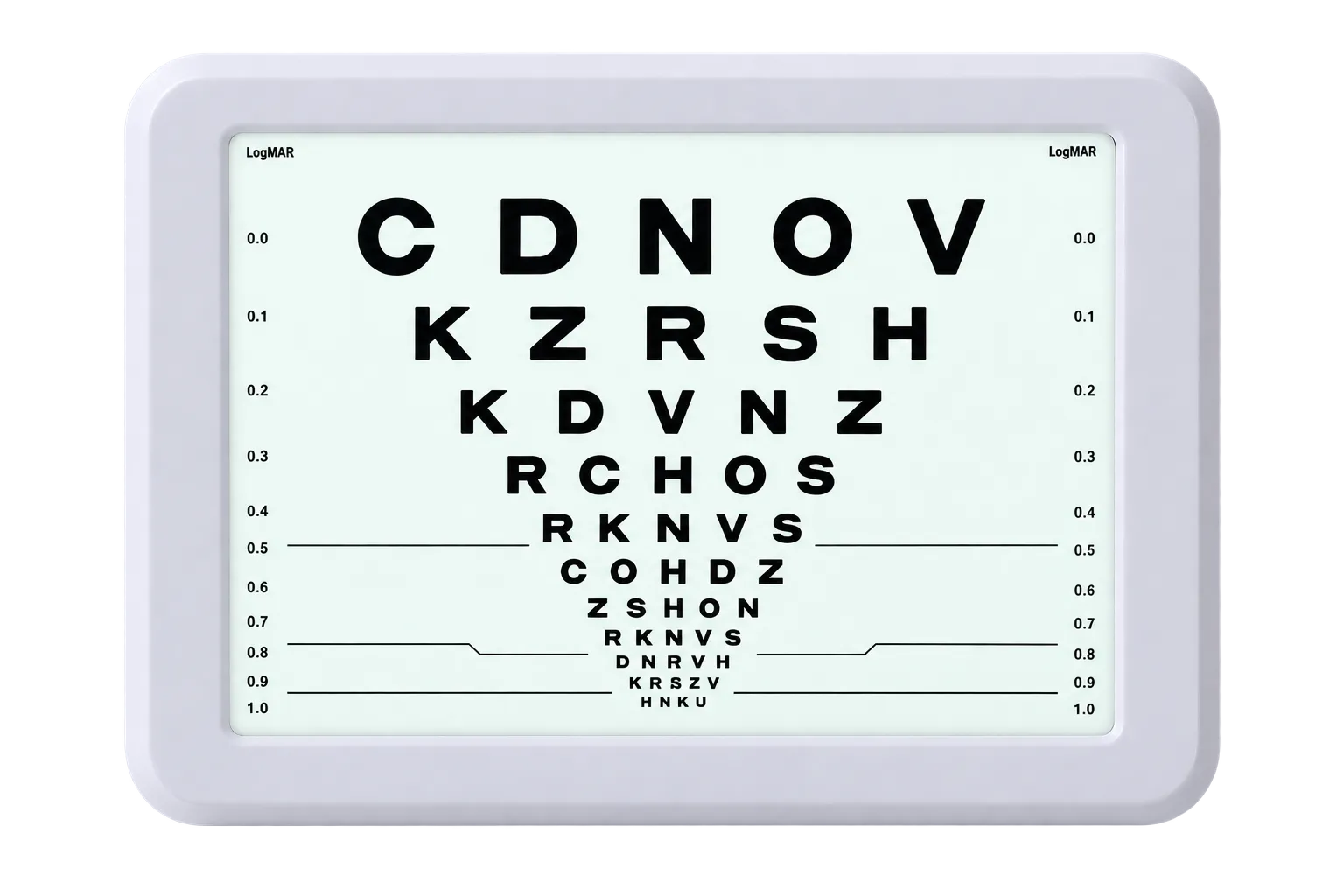
LogMAR is the scale used in clinical trials and increasingly in hospital ophthalmology, because its equal step sizes make it suited to statistical comparison in a way decimal and Snellen notations are not. A display carrying LogMAR alongside four other notations lets a practice record in whatever convention a referral, an audit or a study requires, without anyone converting figures by hand and introducing arithmetic error.
Repeat Testing and Screening Programmes
Randomised optotype display addresses a genuine problem in repeat testing. Patients seen frequently, children reading with one eye then the other, and anyone motivated to perform well can all memorise a fixed chart. Randomising the presentation means each reading measures vision rather than recall, which matters most in occupational screening and wherever a result carries consequences for the person sitting the examination.
Colour Vision and Binocular Assessment
Ishihara colour vision testing, traffic light presentation, Worth, Schober, coincidence and stereo tests sit alongside the acuity charts. Colour vision work in particular is often handled with separate printed plates, and having it within the same display keeps the examination continuous while ensuring the presentation conditions stay consistent between one patient and the next.