

Contrast Sensitivity Assessment
Sine wave grating charts allow contrast sensitivity to be measured rather than inferred. This matters because a patient can read a normal acuity line while still experiencing real functional difficulty, particularly with early cataract, certain retinal conditions and in low light driving. Acuity alone will not reveal that, and having the capability on the same screen as the standard charts makes investigating it a natural extension of the examination rather than a separate undertaking requiring different equipment.
Binocular Vision and Stereo Testing
Worth four dot, stereo, Maddox rod, cross grid and binocular balance charts sit alongside the acuity optotypes. Suppression, fusion and stereopsis can all be assessed without changing equipment or repositioning the patient, which keeps the binocular state undisturbed. The red green dissociation charts extend that further, and everything runs from the same wireless handset the acuity testing uses.
Paediatric and Low Vision Testing
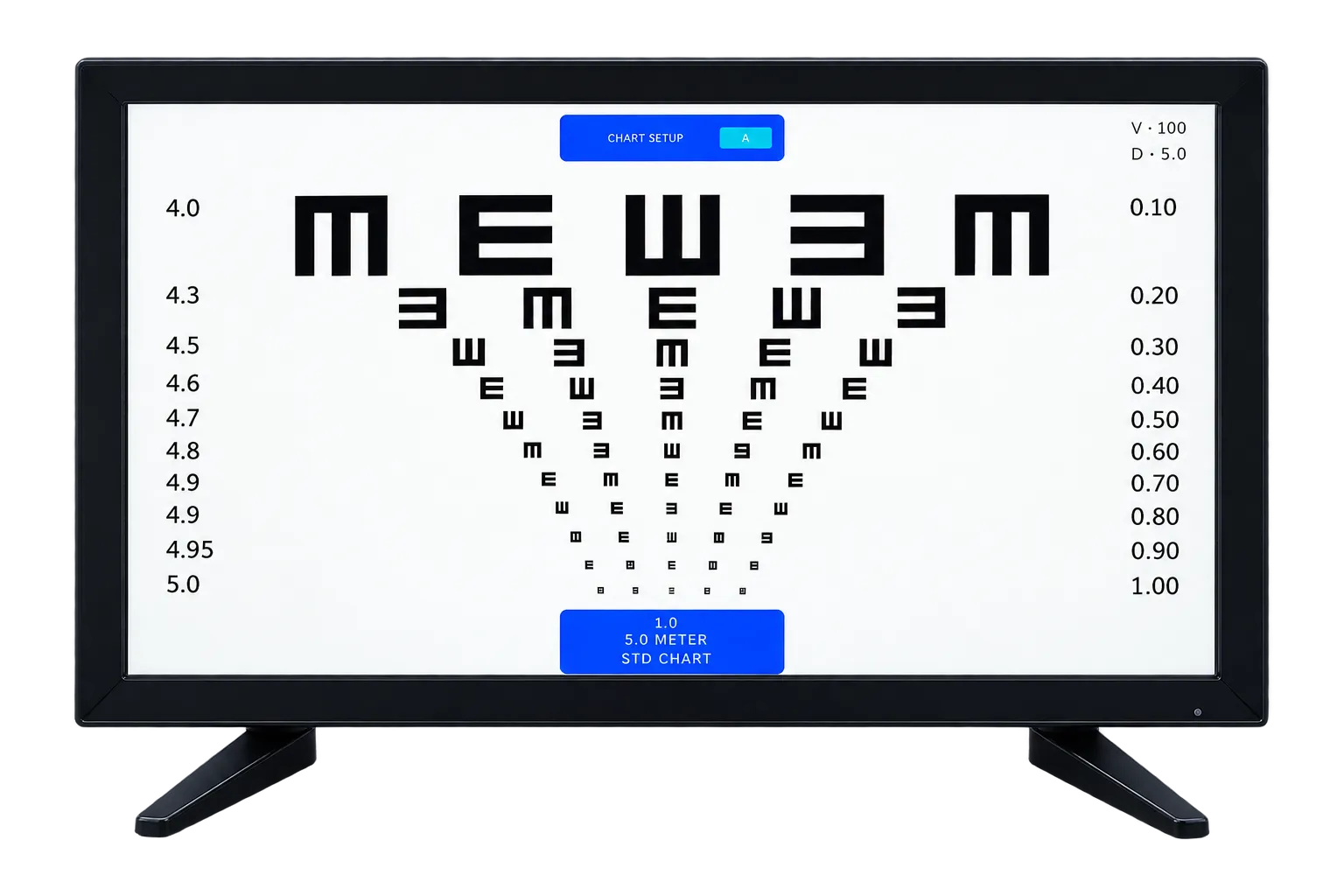
Paediatric optotypes, a low vision test mode for acuities of 4.0 and below, and ETDRS charts together cover patients at both ends of the ability range. Children who cannot read letters, and patients with substantially reduced vision who fall off the bottom of a conventional chart, are both accommodated on the same display without printed charts being fetched and held up by hand.
Rooms of Differing Size and Lighting
Working distance adjustable in 0.1 metre steps, combined with brightness from 80 to 320 candela per square metre, lets the display be calibrated to the room rather than the room being arranged around the display. Optotype sizing follows the configured distance, so a shorter consulting room still produces correctly scaled charts instead of approximately sized ones.