
Routine Verification With Minimal Handling
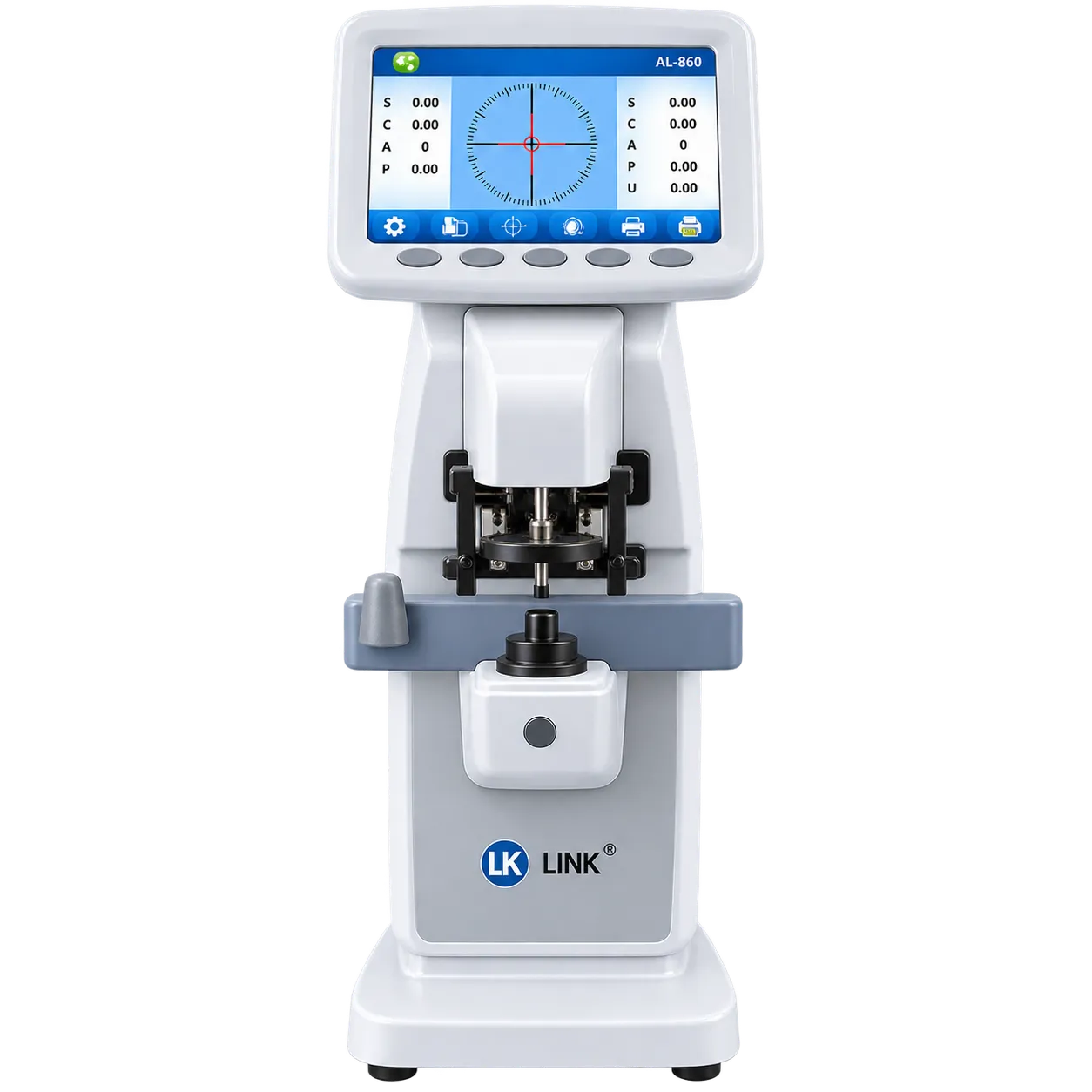
The automatic sequence suits practices working through volume. Because the instrument identifies the lens, measures it, reads the result and stores the data on its own, an operator can move steadily through a tray without configuring anything between lenses. That matters most where verification is delegated to staff whose main duties lie elsewhere, since the fewer decisions an instrument asks for, the less its accuracy depends on who happens to be operating it that afternoon.
Segmented and Multifocal Lens Checking
Bifocal and trifocal designs are explicitly within the measuring modes alongside progressive and single vision lenses. Segmented lenses remain in regular use among older patients and in occupational dispensing, and they are exactly the designs where an instrument that cannot handle them forces an awkward workaround. Automatic identification means the operator does not need to classify the lens correctly before measuring it.
High Prism Prescription Work
Prism measurement to 20 dioptres covers substantial prismatic corrections that fall outside ordinary dispensing. Patients managed for binocular vision anomalies may carry prescriptions with considerable prism, and being able to verify these in-house avoids treating them as special cases. Cartesian, polar and millimetre expression means the figures can be recorded in whichever convention the prescribing practitioner used.
Ultraviolet Performance and Patient Questions
Transmissivity testing gives staff a measured answer when patients ask about the protective properties of tinted or coated eyewear. A figure taken from the actual lens carries more weight at the counter than a general statement, and it also lets the practice satisfy itself that supplied coatings match what the order specified before the eyewear is handed over.