
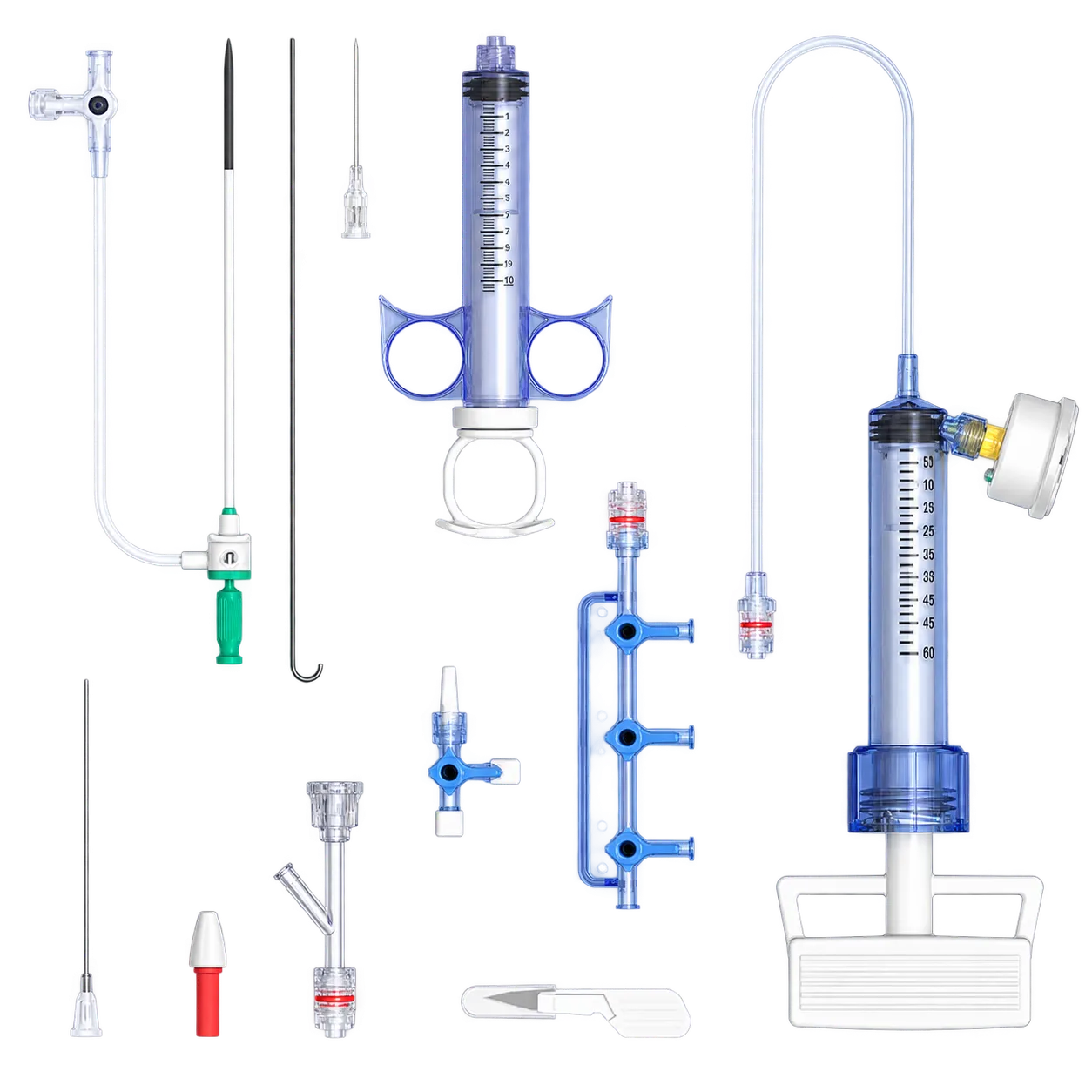
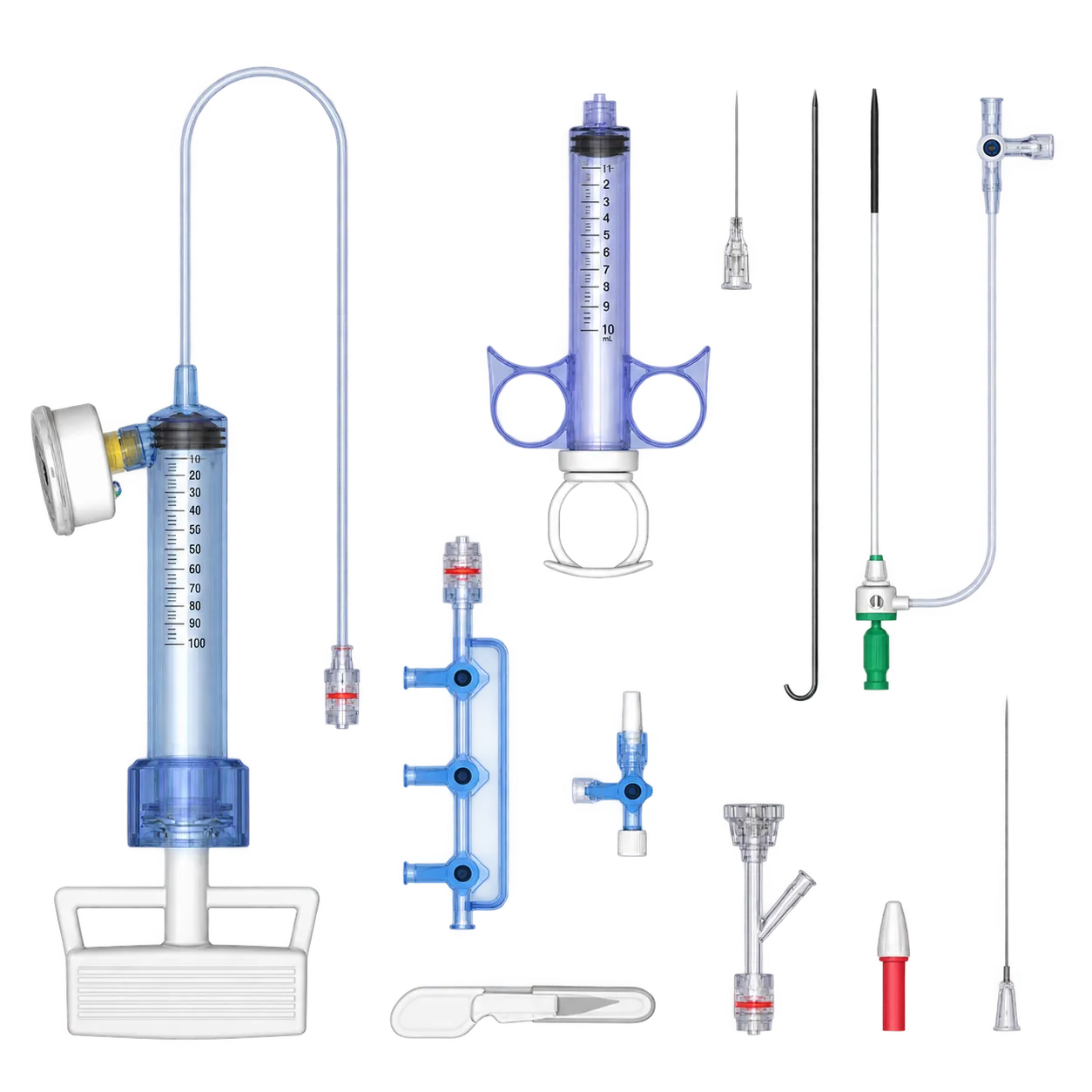
The INT-YX-001 series supports percutaneous vascular access and contrast delivery, placing it in the catheter laboratory, the interventional radiology suite, and any theatre running image-guided vascular work. The six components map onto one sequence: a skin nick with the scalpel, arterial puncture with the Seldinger needle, sheath placement from the introducer set, then contrast delivery through the syringe, the manifold and the extension tube.
The access route decides which references a service can use, and the sheet leaves that open. A radial-first laboratory works mainly at 6F, reaches for 7F on complex cases, and rarely goes beyond it, so that the 8F references may have no application there at all. A service doing femoral work uses the larger sizes routinely. Since neither the sheath outer diameter nor a wall statement is published, a radial service cannot determine from this datasheet which part of the range fits its practice.
Extension tube length maps onto room geometry rather than clinical need. The distance from the injector or the operator's hand to the sheath hub varies with table position, screen placement and whether the operator stands at the wrist or the groin, and 30 to 120 cm covers that spread. A department that standardises on one working length will use a narrow slice of the series and should say so at quotation rather than stocking all four.
Procurement runs through the usual routes. NHS Supply Chain, trust framework agreements, Integrated Care Boards and independent providers each apply their own standing financial instructions, and a procedure pack triggers a specific evidence request because the pack and its components are documented separately. The conformity documentation required by those procurement routes is issued by the manufacturer and provided by the seller.