

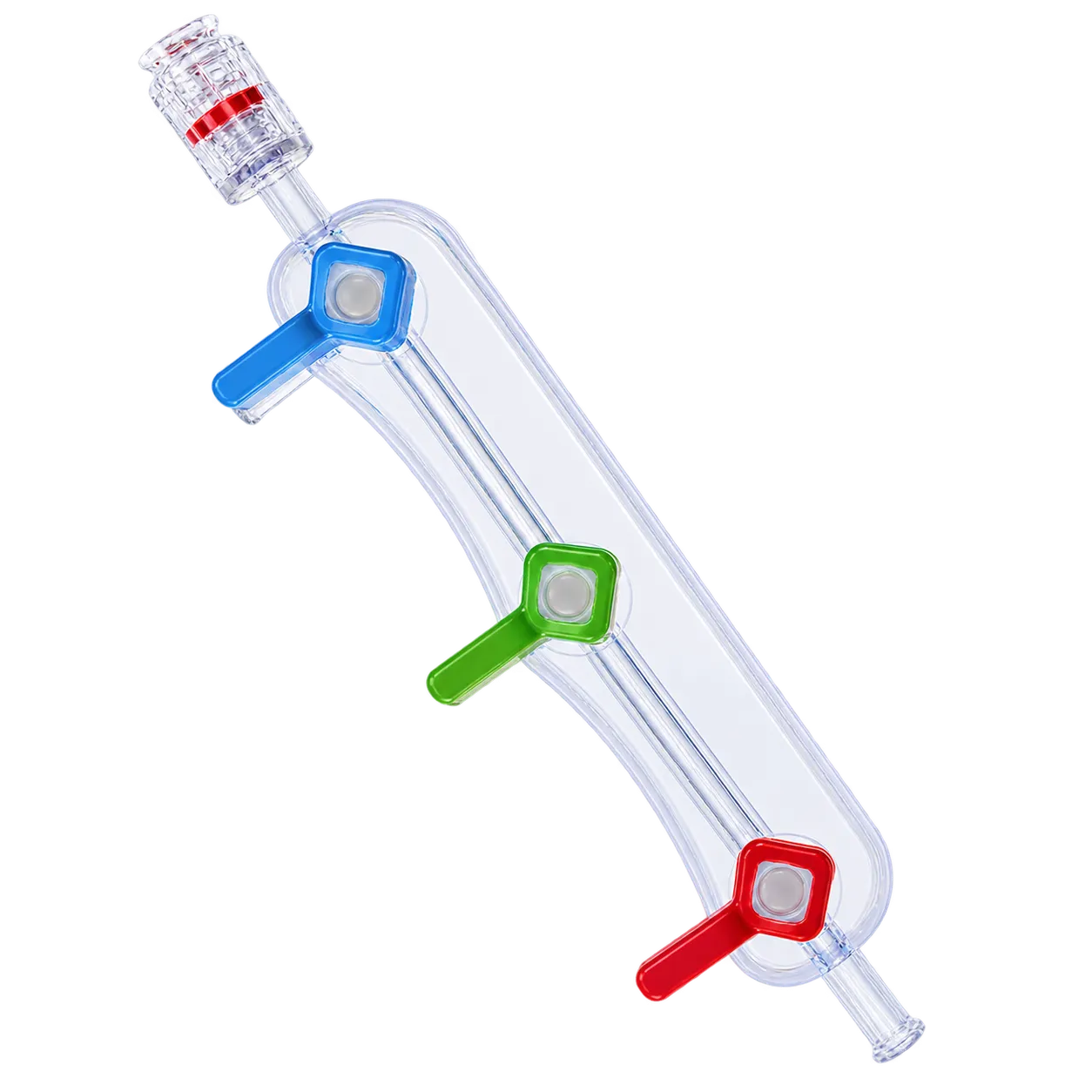
Angiographic and interventional cases run through the manifold. Contrast is injected for imaging. Saline is flushed to clear the catheter. Arterial pressure is read continuously. Medication sometimes goes through the same circuit. Selecting between them means turning a stopcock handle, and that happens repeatedly across a case.
Handle ergonomics matter for that reason. A manifold is not switched once but many times, often at speed, and often by an operator whose gloves carry saline or contrast. A grip that slips or a valve that needs excessive force introduces hesitation at the point of selecting a pathway. Selecting the wrong one wastes contrast at best and delays imaging at worst. Soft touch over-moulding addresses the grip. The extended lever addresses the force.
Colour differentiation across the handles addresses a third problem, which is identifying which valve is which. On a three-port manifold, the stopcocks sit close together, and under drapes and gloves they are distinguished mainly by position. Colour gives a faster and more reliable cue. Two ports suit diagnostic angiography needing contrast and flush alone. Three ports add a dedicated pressure monitoring channel for interventional work. Beyond the handle, the clinical role is unchanged from any angiographic manifold. Keeping the circuit closed reduces blood loss and limits the chance of air entering the system, and air reaching a coronary or cerebral artery can cause ischaemia. Continuous pressure monitoring warns of catheter tip obstruction through damping of the trace.
Peripheral interventional radiology uses the same manifolds. Medigear.uk supplies the instructions for use with every order.