

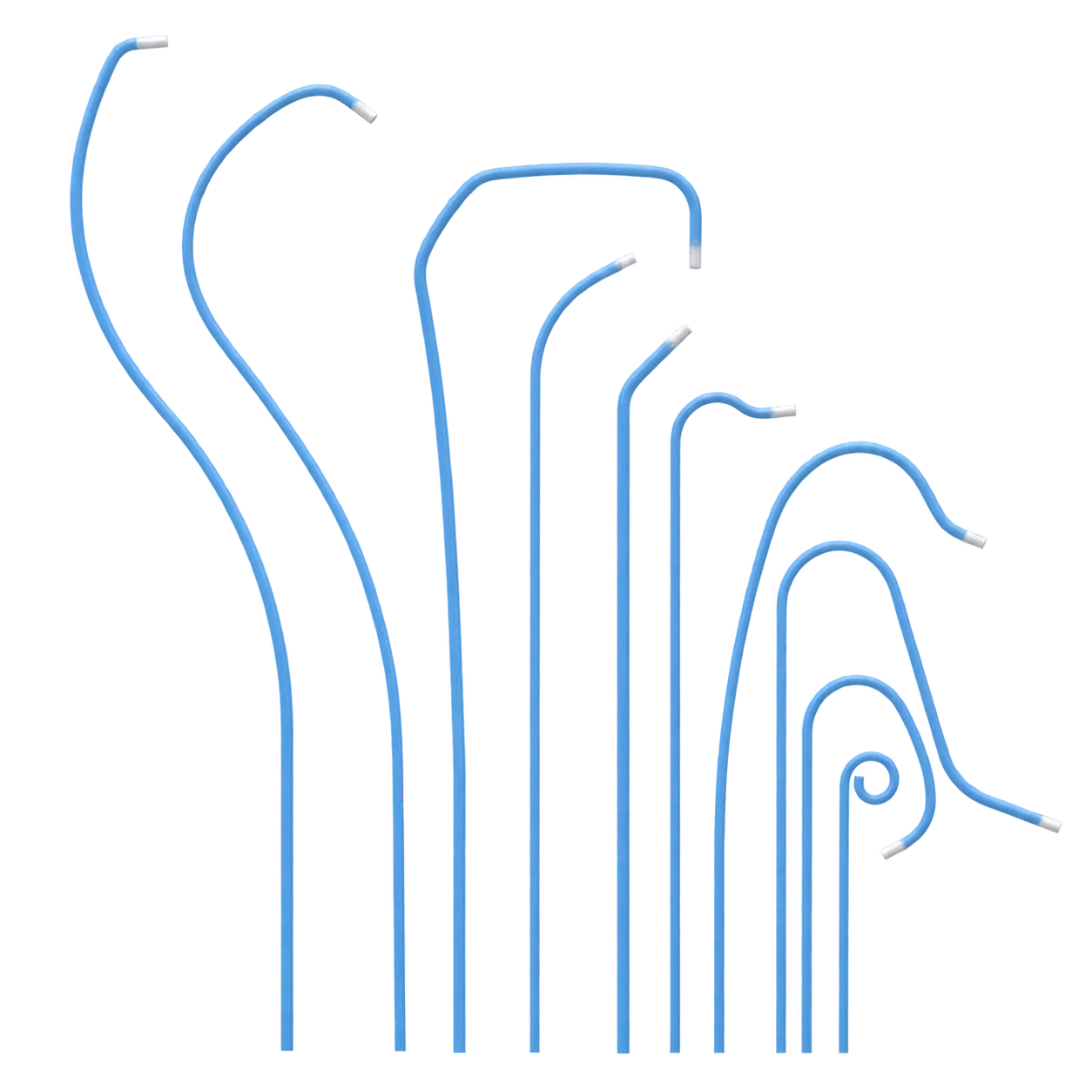
Diagnostic coronary angiography is the main use. A catheter is advanced from the access sheath to the aortic root over a guidewire. The wire comes out, and the catheter's preformed curve does the rest, seating the tip in a coronary ostium as the operator rotates and advances it. Contrast is then injected,d and the vessel is imaged.
Curve selection follows anatomy and access route. Judkins shapes are the workhorses, and the number reflects the distance between the primary and secondary curves. A larger curve suits a wider aortic root, so a dilated root generally calls for a bigger size than the standard. Access route matters too, since the path from the wrist differs from the path from the groin, and radial operators commonly choose half a size smaller for the left coronary. Amplatz curves sit differently and give more backup support, which helps where a Judkins shape will not engage or where a vessel arises unusually. Each change of curve means a catheter exchange over the wire, which adds both time and contrast to a case.
Pigtail catheters do a different job. The coiled tip keeps side holes away from the ventricular wall during a power injection, so contrast disperses rather than jetting into the endocardium. That makes them the shape for left ventriculography and aortography, and it is why the 1200 psi rating matters.
The 3DRC and TIG curves belong to radial practice, where a single catheter engaging both coronary ostia reduces exchanges and shortens the procedure. Medigear.uk supplies the instructions for use with every order.