

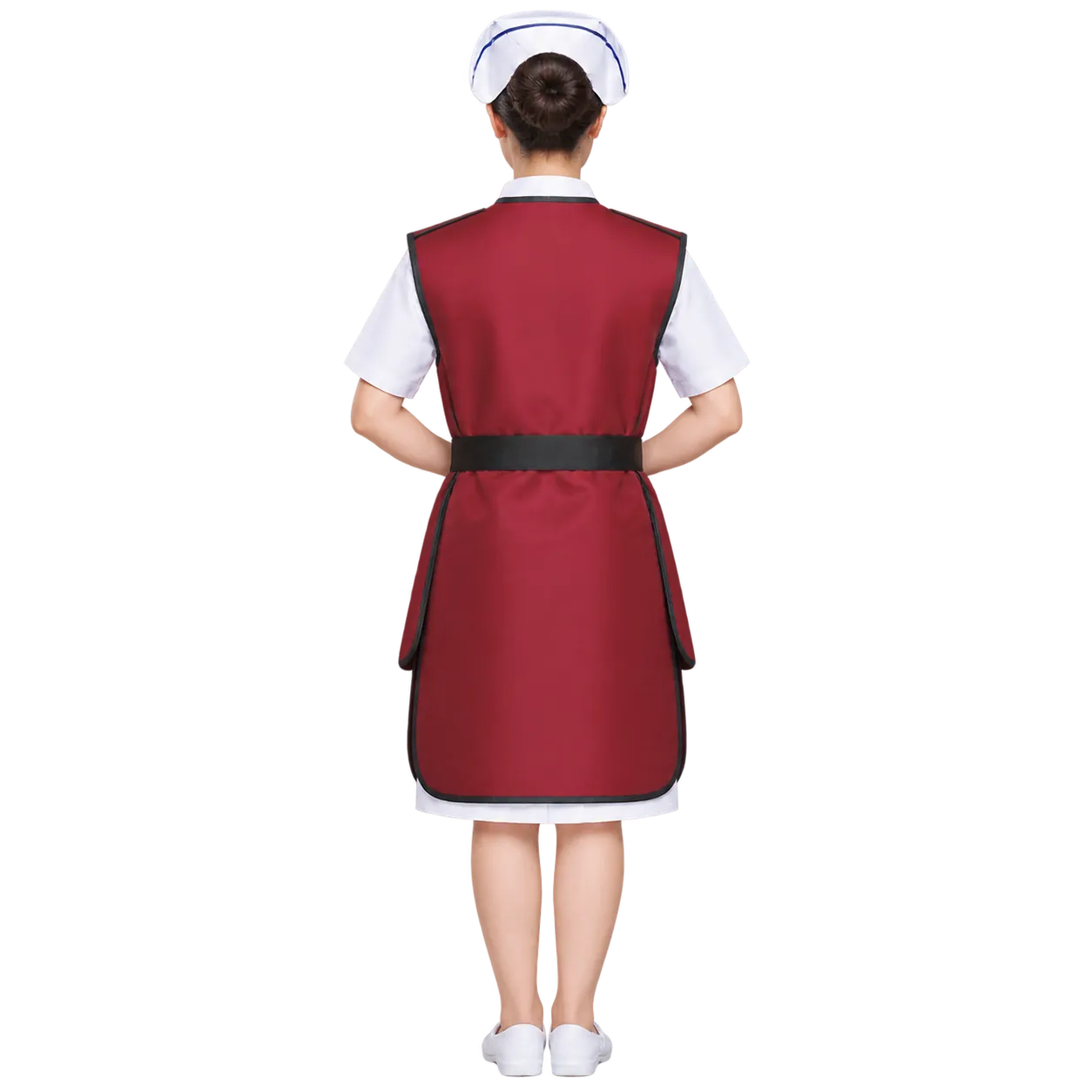
A protective garment is worn by the people who stay beside the patient: the radiographer holding a cassette, the surgeon working under the screen, the anaesthetist at the head of the table. A lead vest absorbs scattered radiation across the trunk, where the organs most sensitive to it sit, and it is worn for hours at a stretch rather than minutes at a time, which is why fit and weight matter as much as the material.
The pattern shown protects the front only, and that has consequences for how staff work. Facing the patient, the wearer is covered. Turning away to reach for equipment leaves the back exposed to whatever scatter is in the room, which is why wrap-around garments are preferred where people move around a table continuously. For a radiographer who faces the work throughout, a front lead vest is usually sufficient, and it weighs considerably less to wear through a shift.
Two habits protect the garment itself. It is hung on a proper rail rather than folded, because a crease will eventually crack,ck and the crack lets radiation straight through the material. And it is checked periodically under imaging, since damage inside a garment is invisible from outside; departments keep a register of each garment and retire anything that fails the check. Neither habit appears in the entry, nor does a hanger, nor a test certificate.
Medigear.uk is obtaining the protective figures, the sizes, and the care instructions from Blackstone so the garment can be entered into a department's records.