
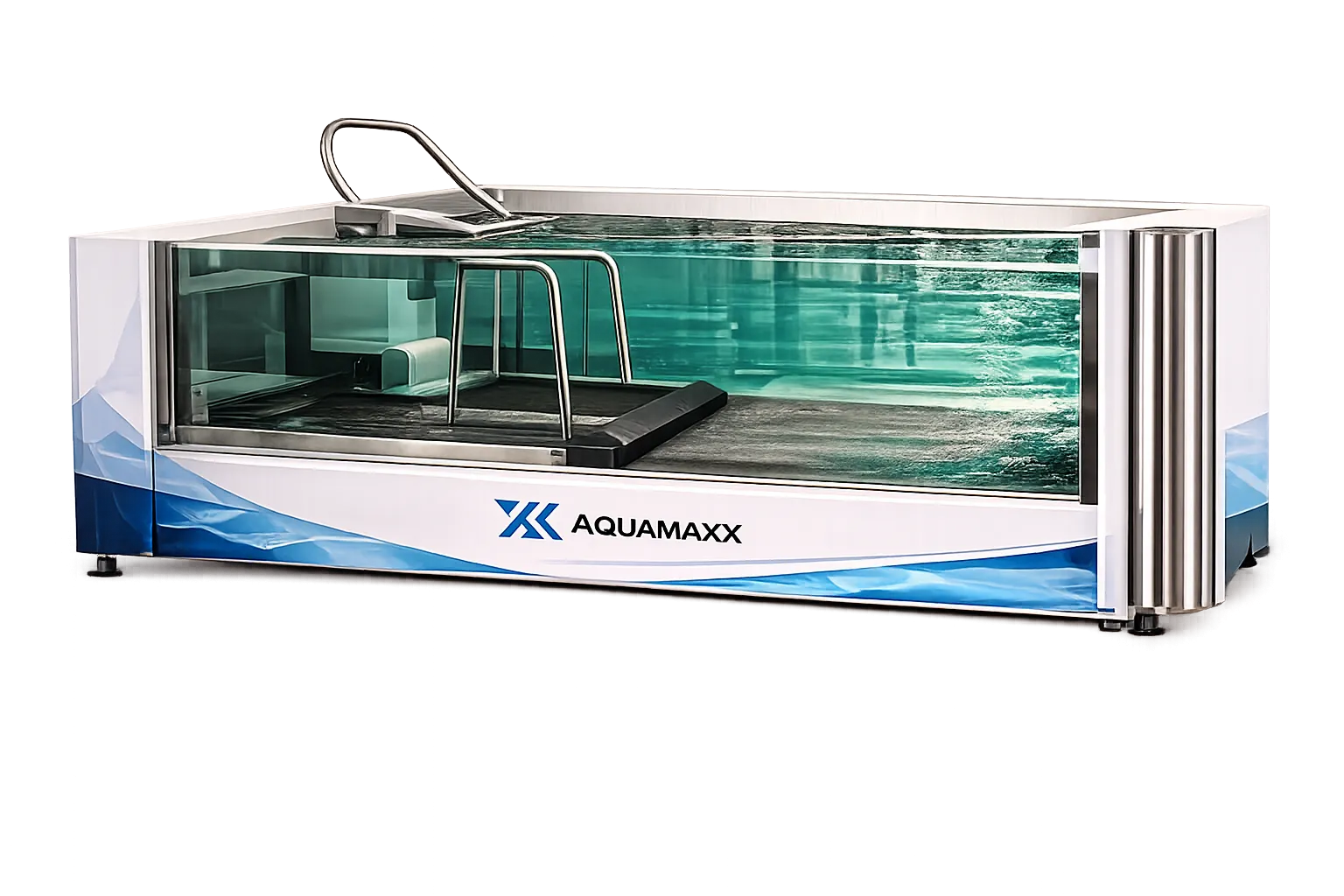
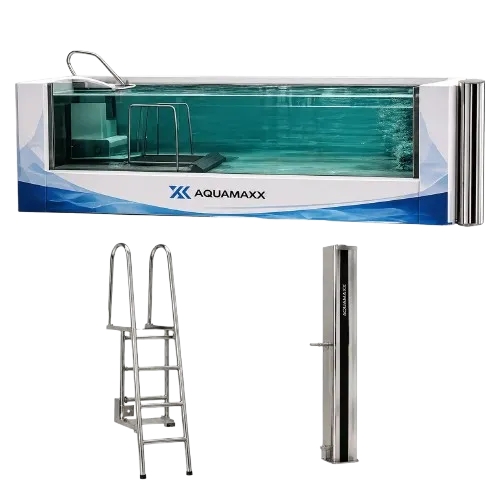
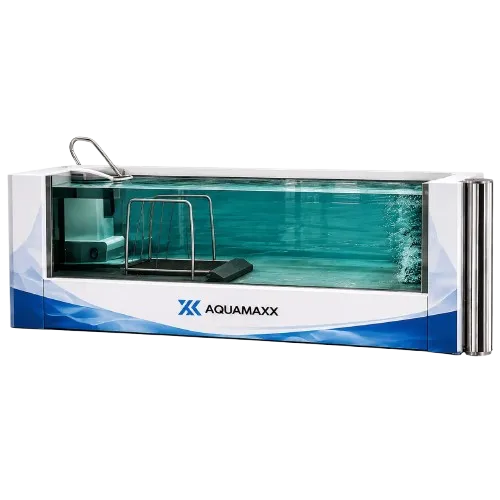
Physiotherapy departments are the manufacturer's stated setting for this device, which it describes as designed specifically for hydrotherapy rehabilitation and adjusting height to meet the needs of different patients. Because immersion depth governs how much body weight buoyancy supports, a platform that changes depth in seconds gives a practitioner direct, repeatable control over loading rather than having to work around a fixed water level. Medigear.uk supplies the platform on the basis that assessment, programme design and all clinical decision-making remain with the qualified practitioner. That load rating, travel range and lifting-equipment documentation are established before procurement rather than after installation.
Gait re-education and mobility work benefit from the observation that the exhibition reference shows: full-height transparent panels that provide a complete lateral view of stance and limb position from a dry position. Assessing the whole movement rather than a section of it changes what a practitioner can record and act on. Panel specification and glazing material are confirmed with the factory before order.
Musculoskeletal and orthopaedic services can use depth adjustment to progress loading in fine increments within a single session, moving a patient toward greater weight-bearing as tolerance allows, rather than between appointments. That requires knowledge of the platform's travel range and its available increments, which is why Medigear.uk obtains both in writing.
Services with a mixed caseload should treat load rating as a screening question rather than a footnote, since it determines who can be admitted to the equipment at all. Medigear.uk obtains the manufacturer's stated rating, together with any conditions attached to it, so that a service can assess suitability against its own patient population.