
IceCure ProSense Cryoablation Trial Enrols First US Patients
IceCure Medical has enrolled the first two patients in its US ChoICE study evaluating ProSense cryoablation for low-risk breast cancer. The FDA-cleared system uses freezing technology to destroy targeted tumour tissue. The study aims to recruit approximately 400 patients across up to 30 US clinical centres to gather real-world evidence on treatment outcomes.
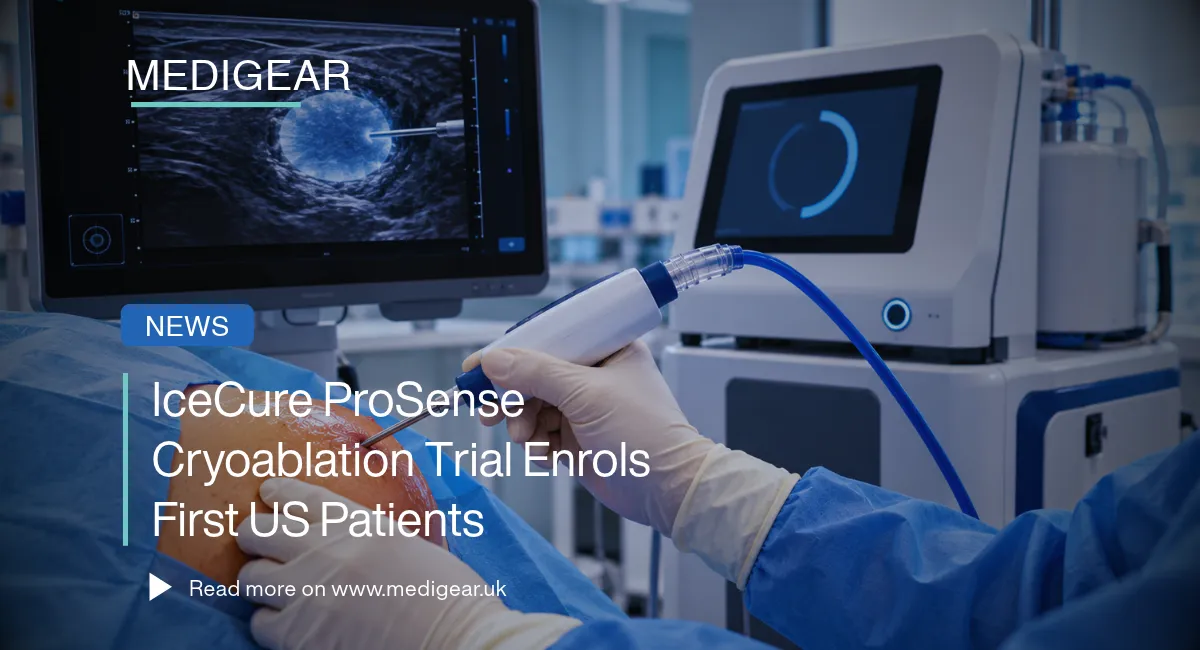
IceCure Medical has enrolled the first two patients in its US ChoICE study, evaluating ProSense cryoablation for low-risk breast cancer. The company announced the milestone on 20 October 2026, with enrolment taking place at two clinical centres. The IceCure ProSense cryoablation trial aims to gather real-world evidence following FDA clearance.
ChoICE study targets 400 patients across the US
The prospective, post-marketing study plans to recruit approximately 400 patients at up to 30 US clinical centres.
Researchers will assess ProSense within its existing indication cleared by the US Food and Drug Administration (FDA). The study will collect evidence on cryoablation treatment for eligible patients with low-risk breast cancer.
Participating hospitals will also function as commercial treatment centres. This arrangement allows them to provide ProSense therapy to qualifying patients outside the study.
First patients enrolled in Tennessee and California
The first patient joined the study at West Cancer Centre & Research Institute in Germantown, Tennessee.
Dr Richard Fine, director of the Margaret West Comprehensive Breast Centre and lead author of the ICE3 study, oversees the site's involvement. His previous research examined cryoablation for small, low-risk breast tumours.
The second patient enrolled at Adventist Health Glendale in California, where breast surgeon Dr Dennis Holmes leads the study.
Both centres completed site agreements and received institutional review board approval in August 2026.
IceCure has also expanded its network to include Legacy Health's Legacy Medical Group – Surgical Oncology at Good Samaritan Medical Centre in Portland, Oregon.
IceCure outlines post-marketing study plans
IceCure Medical CEO Eyal Shamir described the initial enrolments as progress in the company's post-market strategy.
“Enrolling the first patients marks continued progress in the execution of our post-market strategy for ProSense.”
He also highlighted plans to collect further clinical evidence while expanding access to minimally invasive cryoablation for eligible patients.
The study will assess ProSense use across participating US treatment centres following its regulatory clearance.
ProSense receives FDA clearance for selected patients
ProSense uses cryoablation to destroy targeted tumour tissue by freezing it rather than surgically removing it.
The system is the only FDA-cleared medical device specifically indicated for local treatment of biologically low-risk breast tumours measuring 1.5cm or smaller.
Its cleared patient population includes individuals aged 70 and older receiving adjuvant endocrine therapy, including those who cannot undergo surgery.
IceCure markets ProSense internationally across the US, Europe and Asia for its authorised indications.
European distribution and clinical expansion
In August 2026, IceCure signed an exclusive distribution agreement with Scovas Medical covering ProSense cryoablation systems in the Netherlands.
The agreement supports the company's European commercial activities alongside its ongoing US clinical programme.
For hospitals, oncology specialists and medical equipment distributors, the IceCure ProSense cryoablation trial will provide further evidence on treatment within its cleared indication. Medigear.uk follows the study as cryoablation technology gains wider clinical and commercial use.
Source: Medical Device Network
Sourcing medical equipment?
Tell us the model and destination — our sourcing team will respond within one business day.

Intuitive Surgical Shares Fall 8% on Revised 2026 Growth Outlook
Intuitive Surgical shares fell approximately 8% on 21 October 2026 after the company narrowed its fu…

Labcorp Myriad Prenatal Testing Deal Reaches $210M Agreement
Labcorp has agreed to acquire the prenatal health testing business of Myriad Genetics for $210 milli…
Medtronic Vitalis Pacemaker Portfolio Gains European CE Mark
Medtronic has secured European CE marking for its Vitalis pacemaker portfolio, which includes five d…
Medical device news, once a week.
Approvals, trials, recalls and market moves — the essentials for procurement and clinical teams.