
Actalent medtech cybersecurity talent is now a strategic issue
Actalent’s Luke Moran says cybersecurity is now the gating factor for medtech AI plans and the sector’s fastest growing talent need. Medigear.uk covers his argument.
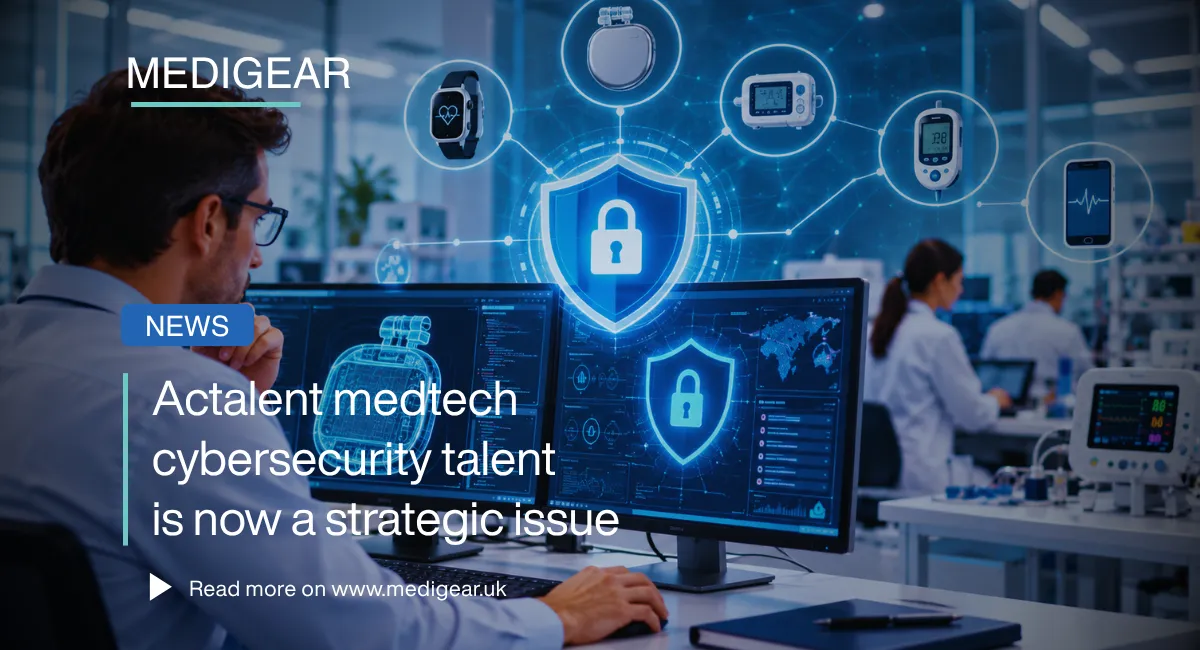
Actalent medtech cybersecurity talent is in short supply just as AI plans depend on secure data, says Luke Moran, managing director of life sciences at Actalent. Moran argues that device makers must treat cybersecurity as a strategic imperative. He made the case on 13 October 2026.
Why AI plans depend on security
Boards now expect an AI roadmap and press leaders on governance and risk. Moran says risk is where many plans stall. AI pulls in large volumes of data and links systems that once ran apart. Device makers hold patient records, and their systems touch products that people depend on.
A firm that cannot protect both cannot run AI at scale. Moran calls cybersecurity the gating factor for adoption. He also calls it the fastest growing talent need in medtech.
Connected products widen exposure
More wearables, cardiac implants, insulin pumps and glucose monitors now pair by Bluetooth with phone apps. Those apps feed cloud platforms used by clinicians and manufacturers. Each link adds value. Each link is also a possible way in for attackers.
Most manufacturers grew from engineering, clinical science, quality and regulatory work. Advanced security programmes are a stretch for them.
From IT concern to engineering task
Moran says security used to be an IT matter of firewalls and access controls. It now cuts across product development, quality, regulatory strategy and manufacturing. Teams must build it in from the start.
The Food and Drug Administration (FDA) expects makers of connected devices to cover cybersecurity in premarket submissions. That includes a software bill of materials and a plan to find and fix vulnerabilities after launch.
Moran names three habits of strategies that work. Teams set security needs at the design stage and model threats early. They keep documentation current as the product changes. They give monitoring after launch a named owner.
Partners and new factories
Risk reaches beyond the device. Contract research organisations hold large volumes of patient data. Moran says partners far from the core manufacturer are more likely entry points for an attack. New reshored plants add sensors, robotics and networked industrial control systems. Each one enlarges the attack surface.
The stakes and the talent gap
Moran lists the cases firms plan for. A remote surgeon could lose control of a robot mid procedure. A pacemaker could be compromised over Bluetooth. An attack on life sustaining equipment could take down a hospital system.
Few biomedical engineers know security, and few security specialists know the device life cycle. Consultants fill gaps for now, often at a premium. Moran favours training experienced engineers. He advises leaders to plan two timelines: fill critical needs this year and build in house skills over several more.
Why it matters
Actalent medtech cybersecurity talent is the constraint behind many device AI roadmaps, in Moran's view. Medigear.uk follows Actalent medtech cybersecurity talent and wider medtech security news.
Source: Medical Device Network
Sourcing medical equipment?
Tell us the model and destination — our sourcing team will respond within one business day.

Sequel Twist Type 2 clearance adds a new adult indication
The Food and Drug Administration (FDA) has issued the Sequel Twiist Type 2 clearance. It opens the T…

Masimo Radius VSM AFib detection gains FDA clearance
The Food and Drug Administration (FDA) has cleared Masimo Radius VSM AFib detection. The feature add…

Private equity hospital AI adoption matches nonprofits, study finds
Private equity hospital AI adoption runs far above that of other for profit hospitals, a study in He…
Medical device news, once a week.
Approvals, trials, recalls and market moves — the essentials for procurement and clinical teams.