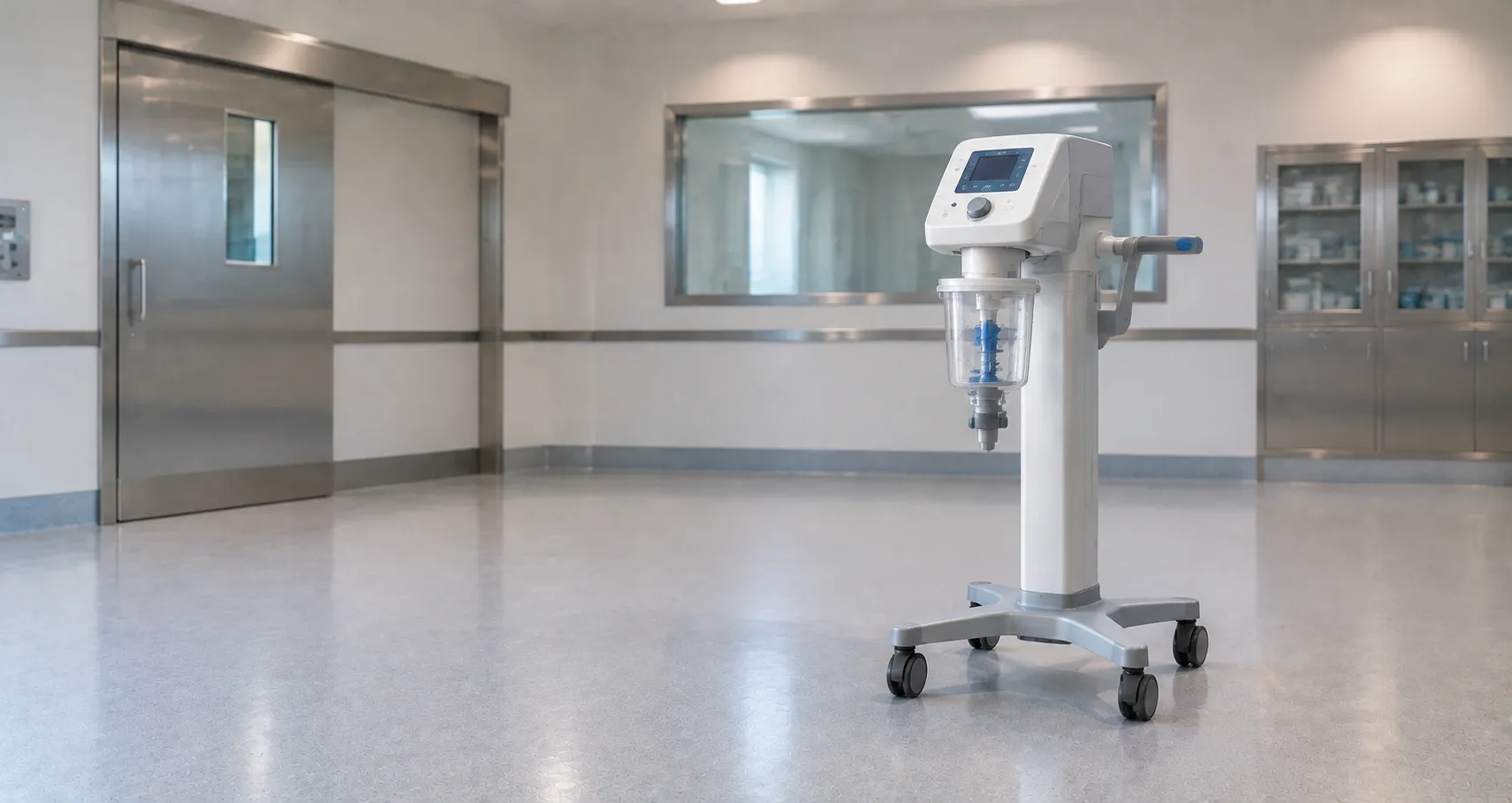

A surgical tourniquet is a pneumatic system that inflates a cuff around a limb to stop arterial inflow, creating a near-bloodless field for orthopaedic and hand surgery. A control unit regulates the cuff pressure and inflation time, and the surgeon works in a clear field while the device maintains occlusion. For a theatre buyer, the decision covers the pneumatic control unit, the cuff range, the pressure-regulation accuracy, and the safety features that guard against pressure and time errors.
The benefit is a clean operative field and reduced blood loss, which improves visibility for procedures on the hand, wrist, forearm, knee, ankle and foot. The unit supplies and holds the pressure; clinical judgement sets the cuff pressure, inflation time and any contraindications for the individual patient.
How a pneumatic tourniquet works
A modern surgical tourniquet is powered by a microprocessor-controlled pump, not a simple air bladder. The unit inflates the limb cuff to a set pressure measured in millimetres of mercury and then holds it precisely, compensating for small leaks and limb movement. A pressure transducer feeds back to the controller so the cuff stays at the target value, and a timer records how long the cuff has been inflated, with escalating alerts as time passes. Before inflation, the limb is usually exsanguinated by elevation or an elastic bandage to empty the venous blood, so the field is not just deprived of inflow but drained beforehand. Because the cuff also blocks venous return, exsanguination before inflation is what produces the pale, dry field surgeons rely on rather than a congested one. The controller runs from mains power with battery back-up, and better units log the pressure and inflation time so the figures can be transcribed into the operation record without relying on memory.
Cuff types and configurations
Cuffs are the part in contact with the patient and come in several forms. Straight cuffs suit cylindrical limbs, while contoured cuffs are shaped to fit the taper of a thigh and distribute pressure more evenly, often allowing a lower occlusion pressure. Cuffs are sized by length and width for adult, paediatric and bariatric limbs, and width matters because a wider cuff occludes at a lower pressure. Options include single-use cuffs that remove reprocessing and cross-infection concerns, and reusable cuffs that are cleaned to the manufacturer's method. Dual-bladder cuffs support techniques that shift occlusion along the limb during regional anaesthesia. The cuff connector must match the control unit.
Single versus dual channel control units
Control units are specified by the number of independent channels. A single-channel unit inflates one cuff and suits routine single-limb work. A dual-channel unit drives two cuffs independently, which is needed for bilateral procedures, for dual-bladder intravenous regional anaesthesia, or where a surgeon wants a second cuff ready. Many units offer limb-occlusion-pressure measurement, sensing the pressure at which arterial flow actually stops for that patient and setting the cuff pressure just above it, rather than applying a fixed high value. This personalisation lowers the pressure applied to the tissue and is increasingly expected in specifications. A dual-channel unit also lets a team keep a proximal and a distal cuff on the same limb, inflating one and then the other so the area under a single cuff is never occluded for the whole procedure, which is the basis of some regional-anaesthesia techniques. When comparing units, check that each channel can be set and alarmed independently, since a shared timer or pressure control undermines the point of having two channels.
Key specifications a buyer must check
Confirm the pressure range and regulation accuracy, and whether the unit measures limb occlusion pressure to set a patient-specific value. Check the number of channels, the cuff range and connector compatibility, and battery operation for transfers. Review the alarm set: over-pressure, under-pressure, leak detection, and a prominent inflation-time alarm. Look at the display clarity, the record of pressure and time for the operation note, and any interface to theatre systems. Confirm calibration requirements and how often the unit needs verification, and check the availability of matching cuffs across the sizes your surgeons use.
Safety, pressure and time limits
Tourniquet safety rests on using the lowest effective pressure for the shortest necessary time. Excessive pressure or prolonged inflation can injure nerves, muscle, and skin, so the device's time alarms and accurate pressure control are safety-critical, not conveniences. Measuring limb occlusion pressure lets the team set a value tailored to the patient rather than a blanket high pressure. Cuff application must avoid wrinkles and skin pinching, and skin protection under the cuff is standard practice. Confirm the unit meets IEC 60601-1 and its relevant particular standards, that alarms are audible and clear, and that battery back-up protects against mains interruption. Clinical protocols and the anaesthetic and surgical team, not the machine, decide safe pressure and duration for each case.
Use across settings and specialties.
Surgical tourniquets are used in trauma and orthopaedic theatres, hand-surgery units, plastic surgery and podiatric surgery, and dual-channel units support intravenous regional anaesthesia for the upper limb. A busy trauma unit may want dual-channel units with limb-occlusion-pressure sensing and a full cuff library, while a smaller elective service may need fewer channels. Because cuffs contact broken or intact skin near the operative field, infection-control preferences between single-use and reusable cuffs feed into the choice, and estates input on battery management and storage helps keep units ready for emergency lists.
Standards, regulation and maintenance
A surgical tourniquet system is an electrically powered medical device that must carry valid UKCA or CE marking with a declaration of conformity, and the supplier must be registered to place it on the Great Britain market; verify this via the MHRA. Pressure accuracy drifts over time, so units require scheduled calibration and electrical-safety testing by biomedical engineering or the manufacturer, with certificates kept for governance. Reusable cuffs and tubing are decontaminated to the validated method in the instructions for use and inspected for leaks and perished seals; single-use cuffs are discarded after one patient. A leaking cuff or drifting regulator undermines the safety case, so maintenance discipline is essential.
Consumables and total cost of ownership
The control unit is durable, so the recurring outlay is cuffs, tubing and periodic calibration. If you choose single-use cuffs, that per-case cost is the main variable and should be modelled at realistic list volumes; reusable cuffs shift the cost toward reprocessing labour and replacement as they wear. Include calibration contracts, battery replacement,t and spare connectors. Ask suppliers about the warranty, first-service inclusion, loan-unit availability during calibration, and long-term cuff supply and pricing, since cuffs are matched to the unit. The MediGear buyers team can compare tourniquet systems and cuff options, or contact us for lead times and support.
Procurement checklist
-
Confirm pressure range, regulation accuracy,y and limb-occlusion-pressure measurement.
-
Decide single- or dual-channel to suit bilateral work and regional anaesthesia.
-
Match cuff sizes, contoured and straight shapes, and connectors to your patients.
-
Check the alarm settings, especially the inflation-time alarm and leak detection.
-
Verify UKCA or CE marking, IEC 60601-1 compliance and MHRA registration.
-
Plan scheduled calibration, electrical-safety testing, and record-keeping
-
Choose single-use or reusable cuffs with infection-control input.
-
Model cost per case across cuffs, calibration and battery replacement.
Conclusion
A surgical tourniquet gives orthopaedic teams a clean, near-bloodless field, but its safety depends on accurate pressure control, patient-specific occlusion settings and disciplined time limits. Match the number of channels and cuff library to your caseload, insist on clear time and leak alarms, and keep calibration current so the pressure the unit shows is the pressure the limb receives. Comparing verified tourniquet systems through MediGear helps your theatre buy a reliable, safe, and well-supported bloodless-field system.
Disclaimer
This article is for informational purposes only. It is published by MediGear (medigear.uk) for general information and procurement guidance, and is not clinical, diagnostic, treatment, technical, engineering, legal or regulatory advice, nor a product endorsement, guarantee or substitute for professional assessment. MediGear does not provide medical consultations. Buyers should consult their clinical, biomedical, estates and regulatory contacts, and the manufacturer's documentation, and independently verify all specifications, certifications, compatibility and suitability before purchase. Specifications, certifications and availability are correct at the time of publication and may change without notice. MediGear is a medical-equipment distributor and does not sell medicines or pharmaceutical products.