
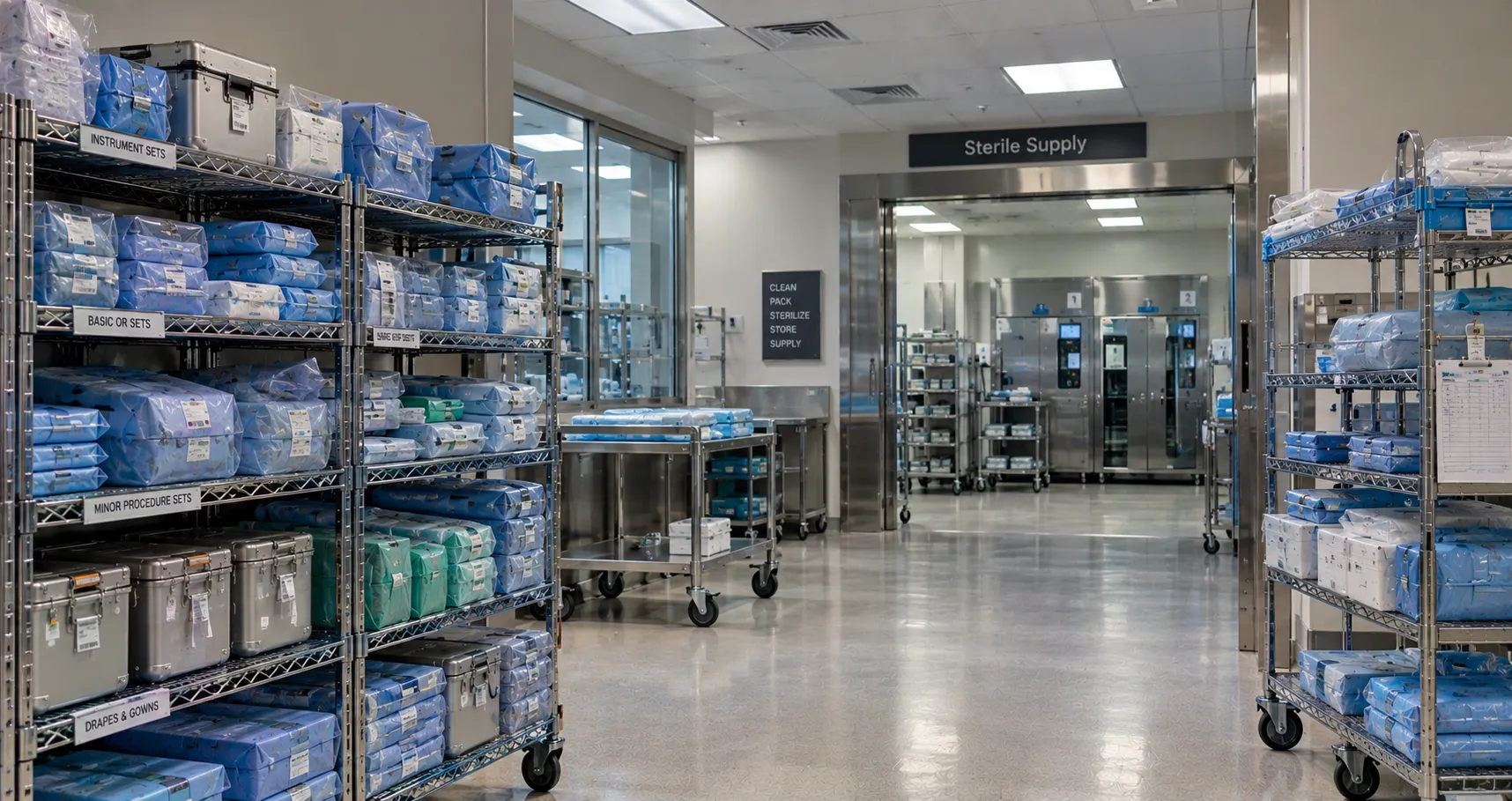
Sterile supply chain management is the end-to-end system that gets the right sterile item to the right point of use, in date and fully traceable, whenever it is needed. It spans two streams: single-use sterile consumables such as sutures, drapes, catheters and gloves that are bought and stored, and reusable instrument sets that are cleaned, packed and sterilised by the sterile services department (SSD or CSSD) before reissue. Managed well, it prevents both stockouts in theatre and the safety and cost problems of expired or untraceable stock.
For procurement, this is less about any single product and more about logistics, data and control across a closed loop.
The reprocessing loop
Reusable instruments move through a fixed cycle that the supply chain has to keep flowing. Used trays return dirty from theatre, are washed and thermally disinfected, inspected and reassembled against a set list under a tray management system, packed, sterilised, cooled, then stored and issued back to the point of use in closed transport carts. Any bottleneck - a washer down, a missing instrument, a delayed tray - ripples straight into the theatre schedule. Tray turnaround time is therefore a core operational metric, and loan-set handling for specialist procedures adds another layer that must be booked, tracked, decontaminated and returned. Because the same finite pool of sets cycles repeatedly, a delay at any stage effectively shrinks available stock, so buffer sets and washer capacity are as much a supply-chain decision as a clinical one.
Track-and-trace and unique identification
Traceability is the backbone of a modern sterile supply chain. Instrument sets and often individual instruments carry 2D data-matrix codes, and trays may use RFID, so a surgical instrument tracking system can trace each item from decontamination through to the patient it was used on. This is underpinned by GS1 barcode standards and Unique Device Identification (UDI), which the NHS eProcurement Strategy mandates alongside PEPPOL messaging for ordering. Full track-and-trace supports rapid, targeted recall if a decontamination failure or device defect is found, and it links sterile stock to procedure records for audit. The same barcode-driven traceability extends beyond instruments to specimen tracking for samples leaving theatre.
Stock rotation and sterility maintenance
Sterile consumables are rotated on a first-expiry-first-out basis, not simply first-in-first-out, so the shortest-dated stock is always used next. Two approaches to shelf life coexist: time-related sterility maintenance, where a pack carries a fixed expiry date, and event-related sterility maintenance, where the pack stays sterile until its packaging integrity is compromised by an event such as a tear, wetting or a dropped tray. Either way, storage conditions matter - packs kept off the floor, protected from moisture and handled to preserve the barrier, in line with decontamination guidance such as HTM 01-01.
Just-in-time and replenishment systems
To avoid both hoarding and shortages, wards and theatres increasingly run demand-led replenishment. Two-bin kanban systems trigger a reorder when the first bin empties; par-level top-ups restock to a set quantity; consignment and just-in-time arrangements shift stock-holding cost onto suppliers until items are used. Scanning at point of use captures consumption data that feeds both automatic reordering and cost-per-procedure reporting.
Storage, handling and transport
Sterility is only maintained if the physical chain protects it. Sterile stores are kept clean, dry and temperature- and humidity-stable, with stock off the floor and away from splash and direct handling, and separated clearly from clean-but-not-sterile and dirty areas to avoid cross-flow. Reprocessed sets travel back to theatres in closed, cleanable transport carts that keep sterile trays segregated from returning contaminated items, often on separate routes or at separate times. Damaged packaging, wet packs and dropped trays are removed from issue immediately under event-related sterility rules. These handling disciplines are unglamorous, but they are where a supply chain quietly succeeds or fails, well before any product reaches the operating table.
Metrics that show the chain is working
A sterile supply chain is managed by numbers, and the right system surfaces them. Stockout rate at point of use shows whether replenishment keeps pace with demand; expiry write-off value exposes overstocking and poor rotation; tray turnaround time from dirty return to available-for-issue reveals decontamination capacity constraints; and set accuracy - the proportion of trays presented complete and correct - flags packing quality that directly affects theatre time. Traceability completeness, the share of items scanned end to end, indicates how quickly a recall could be scoped. Reviewing these together month on month lets a trust rebalance par levels, add washer capacity,y or retrain packing staff before a shortage or a cancelled list forces the issue.
Standards and governance
Several frameworks shape a compliant sterile supply chain. HTM 01-01 governs decontamination of surgical instruments; ISO 11607 covers the packaging that maintains sterility of terminally sterilised devices; ISO 13485 sets the quality management system expected of decontamination units and suppliers; and UK medical device regulation, overseen by the MHRA, governs the devices themselves. The NHS eProcurement Strategy on GOV.UK drives adoption of GS1 and PEPPOL so that identification and ordering data flow consistently between trust and supplier.
Loan sets and single-use streams
Two flows test a supply chain more than routine stock. Loan or consignment instrument sets, such as orthopaedic implant sets brought in for specialist procedures, arrive from a supplier, must be decontaminated to the trust's own standard before use and reprocessed again before return, all within tight scheduling windows; mishandled, they cause last-minute cancellations and disputes over condition. Single-use sterile consumables carry the opposite risk profile - high volume, date-driven,n and prone to silent overstocking in ward cupboards where they expire unseen. A mature system tracks loan sets as booked, decontaminated and returned within one workflow, and manages consumables with point-of-use scanning that both replenishes and captures cost per procedure. Handling both streams under the same traceability and rotation rules is what stops either from becoming a source of waste or delay.
Specifying a track-and-trace and inventory system
-
Confirm GS1/UDI barcode support and PEPPOL messaging for compliant ordering and identification.
-
Check instrument-level and set-level traceability, including linkage from tray to patient record.
-
Assess integration with theatre scheduling, the electronic patient record and finance systems.
-
Look for first-expiry-first-out logic, par-level and two-bin replenishment, and consignment support.
-
Verify recall reporting that can isolate every set processed in a given load or period.
-
Review KPIs the system reports: stockout rate, expiry write-off, tray turnaround and set accuracy.
-
Ensure loan-set booking, decontamination status and return tracking are handled within one workflow.
Beyond the software licence
The real cost of a sterile supply chain sits in inventory carried, expiry write-offs, decontamination throughput and staff time, not the tracking software alone. Integration is often where value is won or lost: when the tracking system talks to theatre scheduling, the electronic patient record and finance, a scanned set updates stock, links to the patient and posts cost in one action, removing duplicate data entry and the errors it breeds. Tight rotation and demand-led replenishment cut waste and free cash tied up in overstock, while poor traceability risks costly, broad recalls instead of narrow ones. Consider the labelling hardware, scanners, RFID readers and ongoing data management, and the cost of integrating with existing systems. A well-run chain pays back through fewer cancelled procedures, lower write-offs and faster recall. To align consumable supply, replenishment and supplier onboarding, MediGear buyer accounts and our supplier network can consolidate sterile stock across departments.
Getting it right
A hospital sterile supply chain succeeds when logistics, traceability and stock control work as one loop: consumables rotated first-expiry-first-out, instrument sets tracked from wash to patient, and replenishment driven by real demand under GS1 and HTM governance. Build it around solid data and disciplined rotation, and it quietly keeps theatres running and audits clean. Plan your sterile stock and track-and-trace approach with MediGear.
Disclaimer
This article is for informational purposes only. It is published by MediGear (medigear.uk) for general information and procurement guidance, and is not clinical, diagnostic, treatment, technical, engineering, legal or regulatory advice, nor a product endorsement, guarantee or substitute for professional assessment. MediGear does not provide medical consultations. Buyers should consult their clinical, biomedical, estates and regulatory contacts, and the manufacturer's documentation, and independently verify all specifications, certifications, compatibility and suitability before purchase. Specifications, certifications and availability are correct at the time of publication and may change without notice. MediGear is a medical-equipment distributor and does not sell medicines or pharmaceutical products.