
Introduction
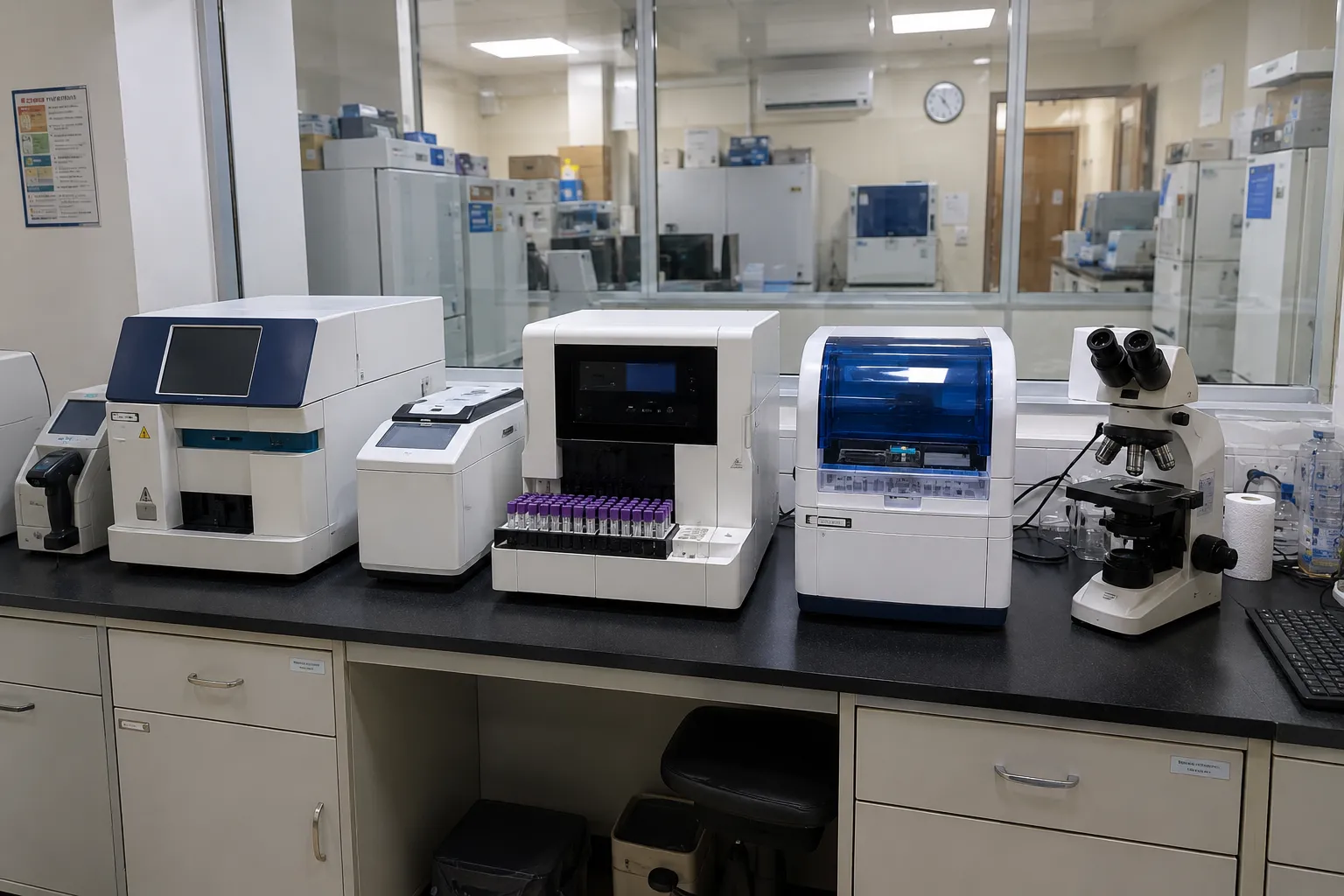
The hospital laboratory is a quiet engine room. Much of what a clinician decides depends on results produced there, yet the patient rarely sees the lab itself. Connecting laboratory equipment — the analysers, the tracking systems, the instruments — makes that engine room faster, more traceable and better linked to the rest of the hospital. This guide explains how IoT technology is used in laboratory equipment, how it improves performance, and what a hospital should consider.
What connection changes in the lab
A laboratory runs on volume and precision: many samples, each needing the right test, the right handling and the right result sent to the right place. Connected equipment supports all three. Analysers send results straight into the laboratory and hospital systems rather than onto paper. Samples can be tracked through each stage, so nothing is lost or confused. And instruments can report their own condition, so a fault is caught before it spoils a run. The lab's job does not change; connection removes the manual seams where delay and error creep in.
Where IoT helps laboratory equipment
-
Faster results. Findings flow to clinicians without a manual relay.
-
Sample traceability. Every sample can be followed through the process, reducing mix-ups.
-
Instrument health. Analysers flag their own problems before they affect results.
-
Quality evidence. Automatic records support the exacting standards labs must meet.
Quality is the lab's currency.
Laboratories work to demanding quality standards because the cost of a wrong result is high. Medical laboratory accreditation, assessed against the international standard for quality and competence and overseen in the UK by bodies such as UKAS through ISO 15189, sets the bar. Connected equipment supports that quality in a very practical way: it produces automatic, tamper-resistant records of what was done, maintains tight traceabilitymaintains tight traceability, and reduces the manual steps where errors can enter. In a setting where evidence of quality is as important as the result itself, connection is a natural ally.
Manual lab workflow versus connected lab
|
Manual laboratory |
Connected laboratory |
|---|---|
|
Results transcribed by hand |
Results flow to the record |
|
Samples tracked on paper |
Samples traced automatically |
|
Faults found after a bad run |
Faults flagged in advance |
|
Quality evidence assembled by hand |
Quality evidence recorded as you go |
Linking the lab to the hospital
A laboratory reaches its full value when its results flow cleanly into the systems clinicians use, which means the lab must share the same data standards as the rest of the hospital. Formats such as HL7 FHIR ensure that a result means the same thing wherever it lands, so a finding produced in the lab appears correctly in the patient's record. And, like all diagnostic and laboratory equipment, these systems must be reliable and comply with the UK medical device regulations. The connection is only as trustworthy as the instrument and the standards behind it.
What to weigh before you buy
-
Does it output to standards? Results should be provided in a format the hospital can read.
-
Is traceability built in? The lab's quality case depends on following every sample.
-
Does it support your accreditation? Automatic records should ease, not complicate, meeting standards.
-
Is it reliable and approved? A result is only as good as the instrument and process that produced it.
The bottom line
IoT in laboratory equipment sharpens the hospital's engine room: faster results, tighter sample traceability, instruments that watch their own health, and automatic evidence of the quality a lab must prove. The gains suit a setting where precision and accountability are everything. But they rest on the same foundations as any connected system — results that flow on shared standards, reliable and approved instruments, and traceability built in rather than bolted on. Get those right, and the quiet engine room runs faster and more surely, sending trustworthy findings to the clinicians who depend on them.
More from Business
-
Buyers — source approved, well-documented equipment.
-
Suppliers — list your equipment and reach buyers worldwide.
-
Advertise — promote your products and services to a clinical audience.
-
Business overview — explore everything MediGear offers healthcare organisations.
Disclaimer
This article is for general information only and does not constitute clinical, procurement, regulatory, security or legal advice. IoT in hospital laboratory equipment and the standards and rules that govern them are evolving, and requirements vary by market and change over time. Cybersecurity and interoperability requirements should always be confirmed with the relevant authorities. Always consult qualified clinical, biomedical engineering, information governance and security professionals for decisions specific to your organisation. medigear.uk accepts no liability for actions taken based on this content.
Equip the connected laboratory.
Genuine, approved, fully documented medical equipment — the reliable hardware a smart, connected hospital is built on, wherever you work.
Frequently Asked Questions
Connected laboratory equipment sends results straight into laboratory and hospital systems rather than onto paper, tracks samples through each stage so nothing is lost or confused, and lets instruments report their own condition so a fault is caught before it spoils a run. It removes the manual seams where delay and error creep into a high-volume, high-precision process.
Faster results that flow to clinicians without a manual relay, sample traceability that reduces mix-ups, instrument health monitoring that flags problems in advance, and automatic records that provide evidence of quality. Together, these support the speed and accountability a laboratory depends on.
Laboratories work to demanding quality standards, such as the international standard for medical laboratories, which is assessed through accreditation. Connected equipment produces automatic, tamper-resistant records, maintains tight traceability, and reduces manual steps where errors can enter — directly supporting the evidence of quality that accreditation requires.
Because a result is only useful when it reaches the clinician correctly, shared formats such as HL7 FHIR ensure that a finding means the same thing wherever it lands, so a result produced in the lab appears accurately in the patient's record. Without common standards, even fast analysers produce data the wider hospital cannot read cleanly.
Yes. Diagnostic and laboratory equipment must be reliable and comply with medical device regulations, because the cost of an incorrect result is high. Connection does not lower that bar; it adds duties around data flow and integrity on top of the accuracy the instrument must already provide.
Confirm the instrument outputs results in a standard format the hospital can read, that sample traceability is built in, that its automatic records ease rather than complicate meeting accreditation standards, and that the equipment is reliable and properly approved. A result is only as good as the instrument and process that produced it.