
Introduction
For most of medical history, a device kept its knowledge to itself. A monitor showed a number on its own screen. A pump recorded what it delivered in its own memory. If a clinician wanted that information somewhere else, they wrote it down and carried it. The smart hospital is what happens when those walls come down, and equipment starts sharing what it knows.
That single change — from isolated machines to connected ones — is quietly reshaping how hospitals work. This article looks at how smart hospitals are using connected medical devices. It covers what connection actually changes, where the real benefits lie, why security sits at the centre, and what a hospital should weigh before buying in. It's written for procurement, biomedical engineering and hospital IT teams across the UK, Europe, the US, the Gulf and South Africa.
What "connected" really means
-
Share — data that flows. Devices pass their readings to the record and to each other, not just to a screen.
-
Join — one picture. Scattered numbers become a single, current view a whole team can act on.
-
Guard — security first. Anything on a network must be secured, so protection is built in, not bolted on.
From a room of machines to a system
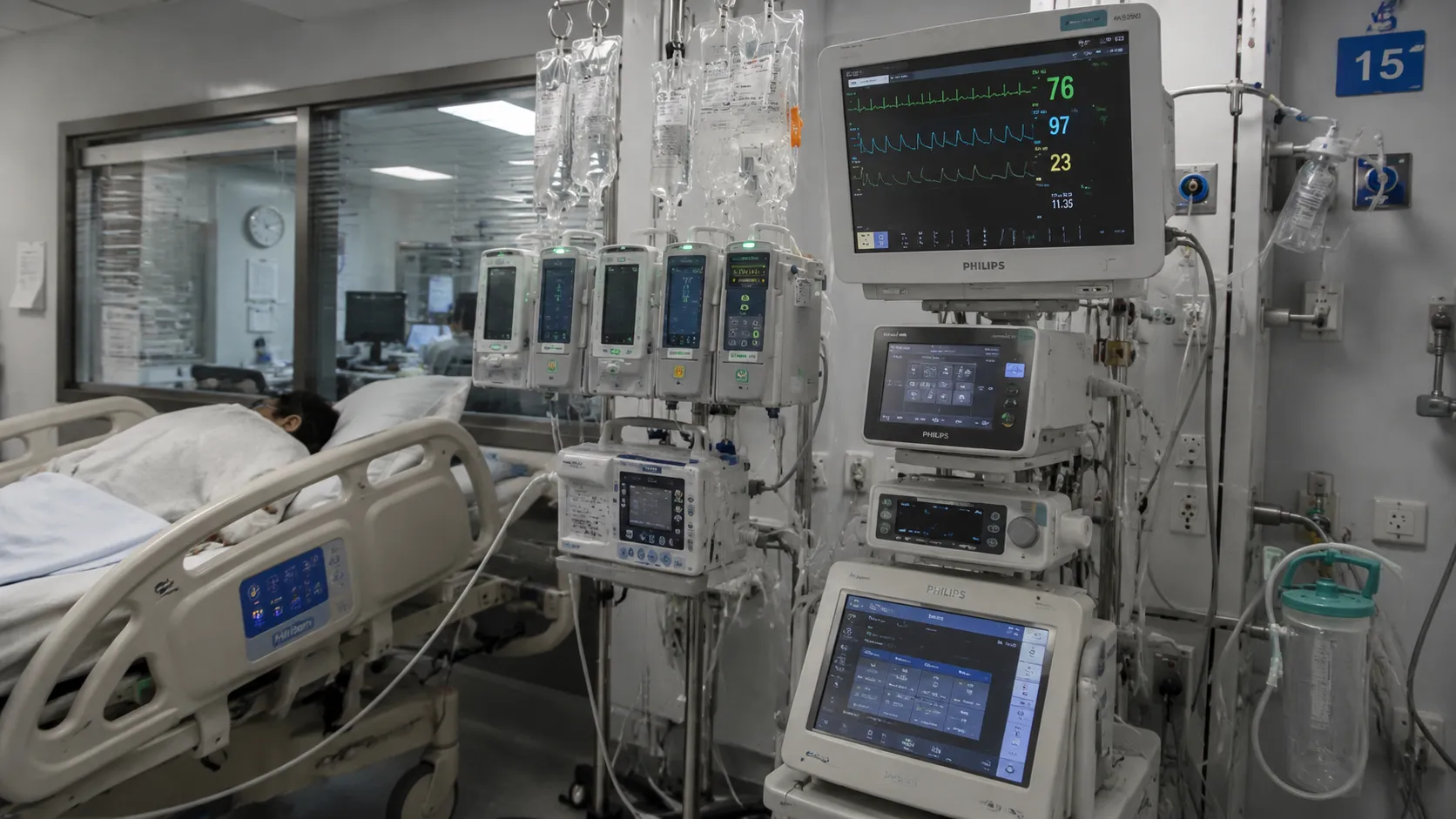
Picture a ward before connection. A monitor beeps by one bed, an infusion pump hums by another, and a nurse walks between them, reading screens and noting figures on a chart. Each device does its job well, but each is an island. The knowledge they hold only moves as fast as a person can carry it. Mistakes creep in at every handwritten step, and no one has the full picture in one place.
Now connect them. The monitor sends its readings straight into the patient record. The pump confirms what it gave and when. A change at the bedside can raise an alert at the nurses' station down the corridor. Nothing about the individual devices has changed, yet the ward now behaves like a single system rather than a set of parts. That shift, repeated across a hospital, is the heart of what "smart" means. As NHS England describes connected digital systems, the aim is for systems to talk to each other so that data flows between them across settings.
The effect builds quietly. One connected monitor spares a few minutes of admin. A ward of connected devices changes how a shift runs. A whole hospital of them changes what the organisation can see about itself in real time.
None of this asks the individual machines to be cleverer. It asks them to share. That is a lower bar than it sounds, and a more powerful one, because the value grows with every device that joins the conversation rather than sitting apart from it.
What connection actually delivers
-
Fewer errors. Data moves without hand copying, so transcription errors simply disappear.
-
A fuller picture. Clinicians see the whole record in one place, not scattered across screens.
-
Wider monitoring. Continuous watching can extend beyond critical care to the ward and the home.
-
Smoother flow. Information follows the patient between departments instead of stopping at the door.
The catch nobody can ignore: security
Here is the honest tension at the centre of the smart hospital. The very thing that makes a device useful — its connection to a network — is also what exposes it. A machine joined to a hospital's systems is, in principle, a door into those systems, and in healthcare the stakes of an open door are unusually high. This is not a reason to retreat from connection, but it is a reason to treat security as a first-class concern rather than an afterthought.
Regulators have moved firmly in this direction. The FDA now treats cybersecurity as part of a medical device's safety, expecting protection to be built in and maintained throughout a device's entire life. In the UK, connected tools are assessed against clear criteria covering clinical safety, data protection, security and interoperability, as set out in NHS England's approach to medical devices and digital tools. For a hospital, the message is consistent: connection and security are two sides of the same decision, and a device that cannot be kept secure does not belong on the network.
Why interoperability decides everything
|
Without it |
With it |
|---|---|
|
Devices trapped as islands |
Data flows between systems |
|
Numbers copied by hand |
Records update themselves |
|
One maker, one silo |
Mixed equipment works together |
|
Dead-end purchases |
Investments that keep fitting |
A device that can't connect is a dead end
All of this rests on one unglamorous idea: interoperability, the ability of different systems and devices to talk to each other. It sounds technical, but it decides whether a smart hospital is possible at all. A brilliant device that cannot share its data in a standard way becomes an island again, no matter how connected everything around it is. That is why health systems increasingly insist on recognised standards, so equipment from different makers can work together rather than locking a hospital into one supplier.
The stakes reach beyond any single building. Connection is now a global health priority, with the World Health Organisation's work on digital health pushing for systems that connect across entire regions. For a hospital buyer, the practical lesson is simple and important. A device's ability to connect on open, recognised standards is not a nice extra; it is what keeps today's purchase useful tomorrow.
What to weigh before you connect
-
Does it meet the standards? Recognised interoperability standards determine whether a device integrates with your systems or becomes an island.
-
Can it be kept secure? Look for robust protection and a clear commitment to updates throughout the device's entire life.
-
Where does its data go? Understand how readings reach the record, and what governance you need around that flow.
-
What support comes with it? Connection is ongoing, so maintenance, updates and help matter as much as day-one capability.
-
Is the hardware sound? The cleverest network still needs reliable, approved physical equipment producing the data.
The bottom line for a smarter hospital
The smart hospital is not a distant vision or a matter of buying the flashiest kit. It is the steady result of thoughtfully connecting sound equipment so that information flows safely to the people who need it. The gains are real: fewer errors, a clearer picture, wider monitoring, and care that follows the patient rather than stopping at a door. The risks are real, too, and they centre on security and the discipline to manage it.
What ties it together is a simple truth that survives all the technology. A hospital gets smarter not by owning connected devices, but by choosing equipment that connects on open standards, can be kept secure, and rests on reliable hardware underneath. Get those three right, and connection quietly transforms how a hospital works. Ignore them, and a network of clever devices becomes an unusable tangle. As ever, the technology is only as good as the equipment, the standards and the care behind it.
More from Business
-
Buyers — source approved, well-documented equipment.
-
Suppliers — list your equipment and reach buyers worldwide.
-
Advertise — promote your products and services to a clinical audience.
-
Business overview — explore everything MediGear offers healthcare organisations.
Disclaimer
This article is for general information only and does not constitute clinical, procurement, regulatory, security or legal advice. Connected medical devices and the standards and rules that govern them are evolving, and requirements vary by market and change over time. Cybersecurity and interoperability requirements should always be confirmed with the relevant authorities. Always consult qualified clinical, biomedical engineering, information governance and security professionals for decisions specific to your organisation. medigear.uk accepts no liability for actions taken on the basis of this content.
Equip the connected hospital.
Genuine, approved, fully documented medical equipment — the reliable hardware a smart, connected hospital is built on, wherever you work.
Frequently Asked Questions
A A smart hospital is one where equipment, records, and systems are connected, so information moves between them rather than staying trapped in a single machine. A monitor feeds readings straight into the record; a pump confirms what it delivered; a scanner sends images where they are needed. The point is not the gadgets but the joined-up flow of information, which lets clinical teams see more, act sooner, and coordinate care across a building or an entire organisation.
Connected medical devices are pieces of clinical equipment that can share the data they produce over a network, rather than showing it only on their own screen. A connected monitor, infusion pump, or imaging system can transmit its data to the patient record, other devices, or a clinical team elsewhere. This connection turns a room full of separate machines into a coordinated system and is the foundation of a smart hospital.
The main benefits are visibility, coordination and time. When devices share data, clinicians see a fuller picture without copying numbers by hand, thereby reducing errors and freeing staff for care. Continuous monitoring can reach beyond critical care, and information can follow a patient across departments. Data can also support planning and maintenance. Used well, connection helps a hospital run more smoothly and respond to patients faster.
Connection brings genuine benefits, but anything joined to a network can be a target, so security is central rather than optional. Regulators now treat cybersecurity as part of a device's safety and expect protections throughout its entire life cycle. For a hospital, that means choosing devices with robust security, keeping them up to date, and managing them within a sound framework. The risk is real but manageable, and it is a reason to buy and run devices carefully, not to avoid connection.
Interoperability is the ability of different systems and devices to communicate with each other so that data flows accurately between them. It matters because a smart hospital only works if its parts can share information reliably; devices that cannot connect become isolated islands. Health systems increasingly set interoperability standards so that equipment from different makers can work together. For buyers, checking that a device meets recognised standards is essential to avoid dead ends.
Look beyond the device's clinical function to how it connects. Check that it meets recognised interoperability standards so it can join your systems, and confirm its cybersecurity and update commitments. Consider how its data reaches the record, what security and governance you need around it, and what support comes with it over time. A connected device is part of a wider system, so the right questions are about fit, security and support as much as clinical performance.