
Introduction
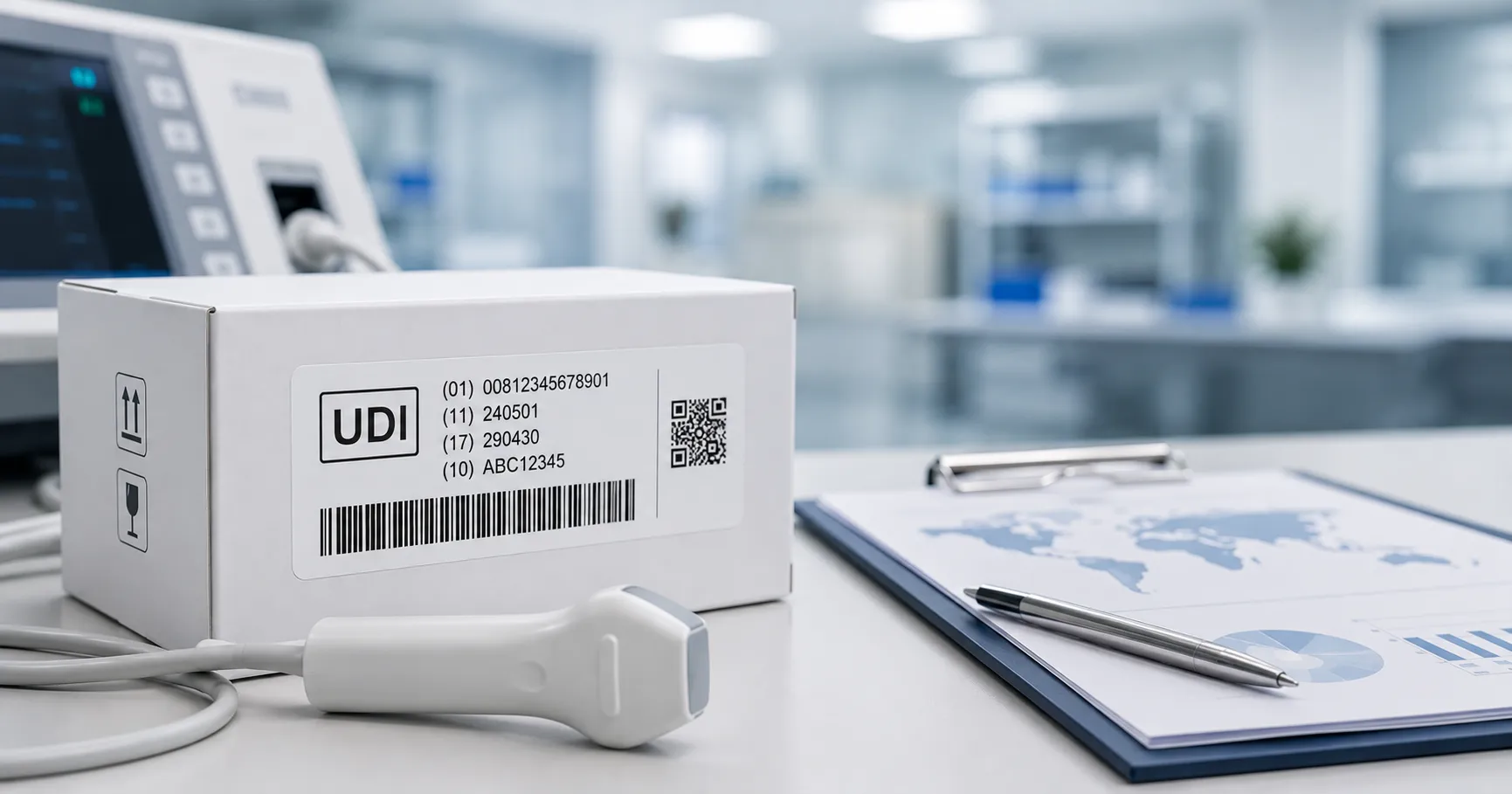
The Unique Device Identifier is a structured code that uniquely identifies a specific medical device and its production unit, enabling traceability from the manufacturer to the patient. It sits on the device label, is registered in regulatory databases, and can be scanned at any point in the supply chain — by the distributor, the hospital, and increasingly the clinical team at the point of care. Its purpose is to make medical device recalls faster, adverse event reports more accurate, and supply chains more transparent.
This guide explains what the Unique Device Identifier is, how it is structured, what it must show on a label, how it is used in regulatory databases, and what buyers and procurement teams need to understand about UDI requirements across the UK, the EU, the US, the Gulf states and South Africa.
UDI in three components
Every Unique Device Identifier has three elements — understanding each one clarifies what UDI information on a label means.
-
UDI-DI — Device Identifier identifies the specific device model, version and configuration. The Basic UDI-DI is registered in regulatory databases. The same UDI-DI appears on every unit of a given device model.
-
UDI-PI — Production Identifier — identifies the specific production unit: the lot number, the serial number for individually serialised devices, and the manufacturing or expiry date. Unique to each unit or batch.
-
AIDC and HRI, the UDI is presented in two formats on the label: AIDC for machine reading — typically a barcode or 2D DataMatrix — and HRI — the text version — for human verification.
How UDI works in practice
-
UDI on the device label: The UDI must appear on the device label in both HRI and AIDC formats. For implantable devices, it must appear on the device packaging at each level of packaging.
-
Registration in regulatory databases: The UDI-DI must be registered in the relevant regulatory database before the device is placed on the market — EUDAMED for the EU, FDA GUDID for the US.
-
Assignment-issuing entity UDIs are issued through an FDA-recognised or EU-designated issuing entity — GS1, using GTIN, HIBCC, or ICCBBA for blood and tissue products — to ensure global uniqueness.
-
Device-level UDIs must appear at the level of the individual unit, the inner packaging, and the outer packaging, each with the appropriate UDI for that line.
-
UDI in hos,pUDI scanning is being implemented at the point of care, linking devices used on patients to their medical records to support recare response and adverse event documentation.
-
Direct Part Marking for reusable devices and surgical instruments: the UDI must be directly marked on the device using laser etching, electrochemical marking, or other permanent methods.
-
Electronic IFU: where markets permit, the UDI is associated with the electronic IFU, enabling users to scan the code and access the current instructions digitally.
-
Recall and traceability: the primary purpose of UDI is to enable faster, more accurate recalls — identifying which specific lots or units are affected and where they are in the supply chain.
UDI requirements by market
UDI implementation is at different stages in each major market.
|
Market |
Mandatory? |
Database |
Issuing entity |
|
EU |
Yes — by device class (MDR timeline) |
EUDAMED |
GS1, HIBCC, ICCBBA |
|
UK |
Phased — MHRA implementing |
MHRA register (developing) |
GS1, HIBCC, ICCBBA |
|
US |
Yes — all device classes (FDA) |
FDA GUDID |
GS1, HIBCC, ICCBBA |
|
Gulf (KSA) |
Developing — SFDA implementing |
SFDA system (developing) |
GS1 typically |
|
South Africa |
Developing — SAHPRA implementing |
Not yet mandated |
GS1 typically |
The EU and the US have the most advanced UDI requirements. For devices sold in both markets, a single UDI system based on GS1 GTIN is the most widely adopted approach, registered in both EUDAMED and FDA GUDID.
Need help with UDI compliance for procurement?
We can confirm the UDI for any device we supply and provide the relevant database registration information. Tell us the device and market — we will include UDI documentation as part of the compliance pack.
No pressure, no obligation. → Talk to the team
Why UDI matters for procurement teams
UDI has practical implications for procurement, inventory management and patient safety beyond regulatory compliance.
-
Accurate goods receipt scanning of the UDI barcode confirms the exact device model, version, and batch received against the purchase order, reducing receiving errors.
-
Inventory management: UDI-based inventory systems link each device unit to its location, intended use and stock rotation, improving asset management and reducing waste from expired stock.
-
Recall response: When a field safety notice is issued for a specific lot. UDI records enable immediate identification of affected units in your inventory without manual cross-checking.
-
Adverse event documentation: the UDI on the device label provides precise identification for adverse event reports, enabling the manufacturer and regulator to link the report to the exact device unit involved.
-
Database cross-reference: procurement teams can use the UDI-DI to look up device registration in EUDAMED or FDA GUDID, providing independent verification of the device's regulatory status.
Healthcare organisations implementing UDI scanning at goods receipt and at the point of care are better positioned to respond to recalls, support adverse event reporting and demonstrate regulatory compliance in inspections.
How to use UDI in your organisation
Start with these steps to build UDI into your procurement and inventory processes.
-
Capture the UDI at goods receipt, implement scanning or manual recording of the UDI from device labels. Record the UDI-DI, lot number and expiry date in your inventory system.
-
Verify the UDI in the regulatory database; use the UDI-DI to look up the device in EUDAMED or the FDA GUDID to confirm registration and verify that the device details match what was delivered.
-
Include the UDI in procurement records, and add the Basic UDI-DI to your procurement file for each device, along with the Declaration of Conformity and certification documents.
-
Link UDI to patient records where applicable for devices implanted or used at the point of care, and implement UDI scanning to link the device to the patient record.
-
Use UDI in recall responses when a recall notice is received. Use your UDI records to quickly identify affected units by lot number, device model, or date range.
-
Train procurement and warehouse staff to ensure that staff at goods receipt understand what UDI is, why it is recorded and how to handle discrepancies between the UDI on the label and the purchase order.
UDI implementation does not need to be perfect from day one. Start with goods receipt scanning for new devices and work towards a complete system over time. The priority is that UDI data exists and is usable for recall response.
Common UDI compliance mistakes
These errors occur frequently as organisations implement UDI requirements.
-
Missing AIDC on the label; HRI text alone is not sufficient in markets where the AIDC format is required. Confirm both HRI and a barcode or DataMatrix are present.
-
UDI not registered in the correct database: the UDI-DI must be registered in EUDAMED for EU devices and FDA GUDID for US devices before placement on the market. Unregistered UDIs cannot be verified.
-
UDI not present on reusable device itself for reusable devices; Direct Part Marking on the device is required — not just on packaging. The absence of a UDI constitutes a compliance failure for reusable surgical instruments.
-
Not scanning UDI at goods receipt organisations that do not capture UDI on receipt means they have no UDI records to use in a recall response, making recall management significantly harder.
-
Confusing Basic UDI-DI with UDI-DI; the Basic UDI-DI is registered in the database. The UDI-DI on the label identifies the specific configuration. They are related but distinct — understand which is which when searching databases.
UDI implementation by region
UDI is at different stages of mandatory implementation across the world's main markets.
|
Region |
Regulator |
UDI status |
|
United Kingdom |
Phased implementation; MHRA developing the register; GS1 standard used |
|
|
European Union |
Mandatory under EU MDR by class; EUDAMED database; GS1/HIBCC/ICCBBA |
|
|
United States |
Mandatory for all device classes; FDA GUDID database; GS1/HIBCC/ICCBBA |
|
|
Gulf (GCC) |
SFDA & GCC bodies |
SFDA is developing UDI requirements; the 1D barcode is widely used in practice |
|
South Africa |
Not yet fully mandated; SAHPRA developing implementation roadmap |
Manufacturers with GS1 GTIN-based UDI systems are well-positioned to meet all current and emerging UDI requirements globally. When sourcing devices, ask whether the UDI is registered in EUDAMED and FDA GUDID as a standard qualification question.
More from Business
-
Buyers — source medical equipment with full UDI labelling and database registration for your market.
-
Suppliers — list your UDI-registered devices and demonstrate traceability to buyers worldwide.
-
Advertise — promote your products and services to a clinical audience.
-
Business overview — explore everything MediGear offers healthcare organisations.
Disclaimer
This article is for general information only and does not constitute legal, regulatory, procurement or clinical advice. UDI requirements, implementation timelines and databases change over time and vary by device class and country. Always verify current requirements with the relevant regulatory authority and consult a qualified regulatory affairs professional for advice specific to your device and market. medigear.uk accepts no liability for actions taken based on this content.
Need UDI documentation for a device?
We supply medical equipment with full UDI documentation and labelling. Tell us the device and the market — we will confirm UDI compliance status and provide the relevant information for your procurement records.
Frequently Asked Questions
A Unique Device Identifier is a structured numeric or alphanumeric code that uniquely identifies a specific medical device model and its production unit. It appears on the device label in human-readable text and machine-readable barcode format. The UDI-DI identifies the device type and is registered in regulatory databases such as EUDAMED and FDA GUDID. The UDI-PI identifies the specific batch, lot, serial number or expiry date for the unit.
UDI was introduced to improve medical device traceability — enabling faster, more accurate recalls, better adverse event reporting and improved supply chain visibility. When a recall is issued, UDI allows manufacturers and hospitals to identify the exact lots affected and locate them quickly. At the point of care, UDI links the device to the patient record, supporting patient safety and post-market surveillance data collection.
The UDI must appear on the device label in two formats: HRI — the text code readable by a person — and AIDC — a barcode or 2D DataMatrix scannable by a machine. For reusable devices, the UDI must also be directly marked on the device itself using a permanent method such as laser etching. It must appear at each level of packaging.
The UDI-DI is the fixed part that identifies the specific device model, version, and configuration. It is the same across all units of a given device and is registered in regulatory databases such as EUDAMED and FDA GUDID. The UDI-PI is the variable part that identifies the specific production unit — lot number, serial number, manufacturing date, or expiry date — and changes from batch to batch.
Search the FDA GUDID database for US devices or EUDAMED for EU devices using the UDI-DI from the device label. The database will show registered device information, including manufacturer, device name, device class and UDI issuing entity. If the UDI-DI does not appear in the relevant database, the device may not be properly registered.
In the US, UDI is mandatory for all device classes, phased in with the highest-risk devices first. In the EU, UDI is being phased in by device class under the EU MDR timeline, with Class III and implantable Class IIb devices required first. In the UK, the MHRA is implementing UDI requirements aligned with the EU approach. In the Gulf and South Africa, UDI requirements are developing.