
Introduction
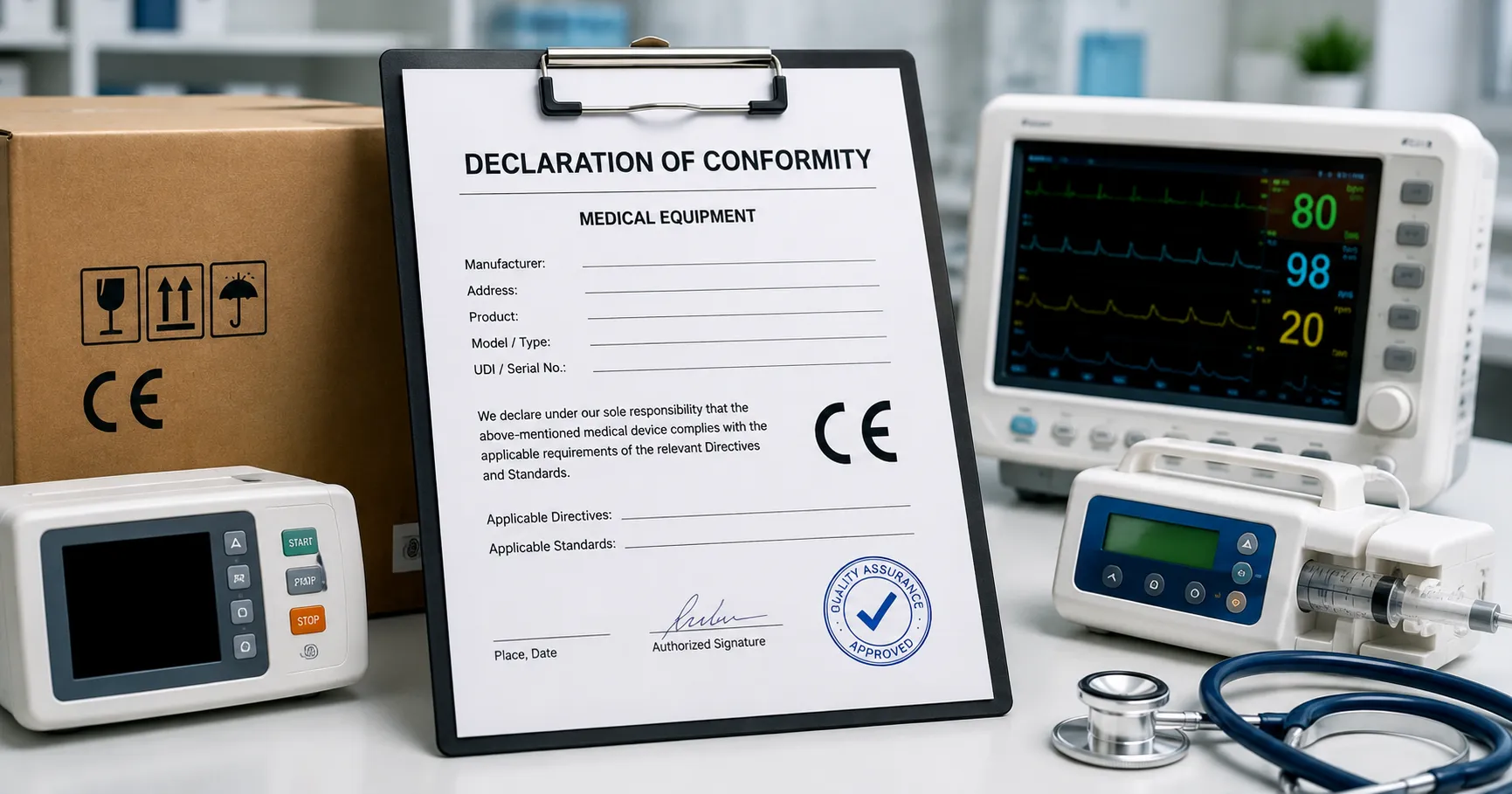
A Declaration of Conformity is a legal document signed by the manufacturer stating that their medical device meets the requirements of the applicable regulations — EU MDR, UK MDR 2002, or equivalent. It is not a certification issued by a third party. It is a manufacturer's own declaration of compliance, and the manufacturer bears full legal responsibility for its accuracy. For buyers, it is the primary document that links a device to its regulatory framework and confirms it has been assessed against the required standards.
This guide explains what a Declaration of Conformity contains, how to read and verify one, what to look for and what the red flags are — across the UK, the EU, the US, the Gulf (GCC) states and South Africa.
Three things the Declaration of Conformity tells you
A well-prepared Declaration of Conformity tells buyers three essential things about a device's regulatory status.
-
Which regulations apply? The DoC identifies the specific legislation or regulatory framework against which the device has been assessed — EU MDR, UK MDR 2002, or an equivalent — making clear which rules the manufacturer claims to have met.
-
Which standards were applied? The DoC lists the harmonised or designated standards the manufacturer relied on — IEC 60601, ISO 14971, ISO 10993 — giving buyers insight into the safety and quality assessments carried out.
-
Who was involved? The DoC identifies the notified body or approved body involved in the conformity assessment, where one was required, and names the authorised representative for the market.
What a Declaration of Conformity must contain. The manufacturer's
-
Enter the manufacturer's name and full address, the manufacturer's legal name and registered address, matching the device label and all other regulatory documentation exactly.
-
Device identification: a clear description of the device, including model numbers, product names and any variants covered by the declaration. The DoC must cover the exact device you are buying.
-
Applicable legislation for the E is the EU MDR (Regulation 2017/745) or the IVDR (2017/746). For the UK, the UK MDR 2002 as amended. For other markets, the equivalent national regulation.
-
List of harmonised or designated standards applied in the conformity assessment, with standard number and edition — for example, ISO 14971:2019, IEC 60601-1:2005+A1:2012.
-
Notified or approved body details where a third-party conformity assessment was required: the name and identification number of the notified body (for the EUU) or the approved body (for the UK), and the certificate reference.
-
Authorised representative details for non-EU or non-UK manufacturers: the name and address of the EU Authorised Representative or UK Responsible Person, as applicable.
-
Signatory details: the name, position and signature of the person legally authorised to sign on behalf of the manufacturer, with the date of issue.
-
UDI-DI: Where applicable in markets that require UDI, the device's Basic UDI-DI should be referenced in the DoC.
Declaration of Conformity requirements by the market
DoC requirements are broadly similar across markets but differ in the legislation referenced and the required fields.
|
Market |
Legislation referenced |
Authorised rep. required? |
Third-party body? |
|
EU |
EU MDR 2017/745 or IVDR 2017/746 |
Yes (EU Authorised Representative) |
Yes for Class IIa and above |
|
UK |
UK MDR 2002 (as amended) |
Yes (UK Responsible Person) |
Yes for Class IIa and above |
|
US |
No DoC equivalent; FDA clearance letter used |
No direct equivalent |
FDA review for 510(k)/PMA |
|
Gulf (KSA) |
SFDA references the EU/FDA DoC as a supporting document |
Local SFDA agent |
Depends on the reliance pathway |
|
South Africa |
SAHPRA references the EU/FDA DoC as a supporting document |
Local SAHPRA agent |
Depends on the licence class |
The US does not have a Declaration of Conformity in the same form; the equivalent is the FDA clearance decision letter for 510(k) submissions. For Gulf and South African markets, the EU or UK DoC is commonly submitted as supporting documentation in the registration process.
Reviewing a DoC and not sure what you are looking at?
We provide a complete compliance documentation pack with every device we supply, including the Declaration of Conformity, applicable certificates and test reports. Tell us the device and market — we will send the documents and help you interpret them.
No pressure, no obligation. → Talk to the team
How to read and verify a Declaration of Conformity
A genuine and accurate DoC has clear, consistent information throughout. Here is how to work through one.
-
Check that the manufacturer's name on the label matches the manufacturer's name and address on the DoC; the manufacturer's name and address on the DoC must match the label on the device and the information on any other certificates. Discrepancies are a red flag.
-
Confirm the device description covers your exact model. Read the device identification carefully. A DoC for a product family may or may not cover the specific model number you are purchasing — confirm explicitly.
-
Check that the regulation is current for EU devices, and confirm that the DoC references the EU MDR (2017/745), not the old MDD (93/42/EEC), unless the device is within a valid MDD transitional period. For the UK, confirm that the UK MDR 2002 is referenced.
-
Verify that the listed standards are current, revised editions. A DoC listing withdrawn or superseded standard editions may indicate the technical file has not been kept up to date.
-
Confirm the notified body number for EU certificates; it should be listed in the NANDO database. Cross-check the certificate reference number against the NB's own registry if possible.
-
Check the date of issue. A DoC should be dated. Very old documents — more than five years — may need re-evaluation, particularly if the device has been updated or the regulatory framework has changed.
If the DoC is vague, undated, missing fields, or references regulations or standards that do not apply to the device type, ask the manufacturer to provide a complete, current document before proceeding.
How to use the DoC in procurement
The Declaration of Conformity should be part of every medical device procurement documentation pack. Use it this way.
-
Request the DoC before purchases and make it a required document at the quotation or tender stage. A supplier unable to provide one promptly is a concern.
-
Cross-reference the CE or UKCA certificate, the notified body certificate, and the DoC — they should be consistent — same device, same NB, same regulation. Inconsistencies between them need explanation.
-
Archive the DoC alongside the CE or UKCA certificate, ISO 13485 certificate, and test reports in the procurement file for the device. This is the compliance documentation set.
-
Up to the renewal at each significant contract. Request an updated DoC to ensure it remains current for the device version you are purchasing.
-
Use it in post-market monitoring if a field safety notice is issued; the DoC helps you confirm which standards and regulatory framework applied to the device at the time of purchase — useful for incident investigation.
-
Check it at goods receipt, and confirm the device delivered matches the DoC on file before accepting the goods. If the model number or manufacturer details differ, resolve the discrepancy before putting the device into service.
The DoC is a legal document, and the manufacturer carries legal responsibility for its accuracy. If you subsequently discover that a DoC was false or materially incorrect, it is grounds for legal action and should be reported to the relevant regulator.
Common Declaration of Conformity mistakes
These are the most common problems found in DoC documents or in how buyers use them.
-
Old MDD reference instead of EU MDR: a DoC referencing the old Medical Devices Directive (93/42/EEC) may not be valid under EU MDR unless the device is within a specific transitional period. Check current transition rules for the device class.
-
Missing authorised representative for the EU and UK; the authorised representative must be named. A DoC without this information is incomplete for devices from non-EU or non-UK manufacturers.
-
A vague device description in a DoC that covers a broad product family without specific model numbers leaves ambiguity about which devices are actually included. Request a device-specific DoC.
-
Outdated standards listed in the DoC should be current editions. Obsolete standard references suggest the technical file has not been maintained, and the device may not meet current requirements.
-
Not cross-referencing with the certificate,e the DoC should be consistent with the notified body certificate. Discrepancies in device scope, NB details or standard references need explanation before proceeding.
Declaration of Conformity by region
The DoC is a primarily EU and UK concept, but equivalent or related documents are used across markets.
|
Region |
Regulator |
Equivalent document or role |
|
United Kingdom |
UK Declaration of Conformity; UK MDR 2002 referenced; UK RP named |
|
|
European Union |
EU Declaration of Conformity; EU MDR/IVDR referenced; EU AR named |
|
|
United States |
FDAThe The |
FDA clearance decision letter serves a similar purpose; no formal DoC |
|
Gulf (GCC) |
SFDA & GCC bodies |
EU or UK DoC submitted as supporting evidence for SFDA registration |
|
South Africa |
EU or UK DoC accepted as supporting documentation for SAHPRA licensing |
When supplying to Gulf or South African markets, provide the full EU or UK DoC as part of the registration documentation. These regulators use it as evidence of the device's compliance history in other markets.
More from Business
-
Buyers — source medical equipment with complete Declaration of Conformity documentation provided as standard.
-
Suppliers — list your devices with compliance documentation ready for buyers to review.
-
Advertise — promote your products and services to a clinical audience.
-
Business overview — explore everything MediGear offers healthcare organisations.
Disclaimer
This article is for general information only and does not constitute legal, regulatory, procurement or clinical advice. Declaration of Conformity requirements, applicable regulations and standards change over time and vary by device type, risk class and country. Always verify documentation with the relevant regulatory authority and consult a qualified regulatory affairs professional for advice specific to your device and market. medigear.uk accepts no liability for actions taken based on this content.
Need the DoC for a device?
We provide the Declaration of Conformity for every device we supply, along with supporting certification documentation. Tell us the device and the market — we will send the complete compliance documentation pack.
Frequently Asked Questions
A Declaration of Conformity is a legal document signed by the manufacturer stating that their medical device meets the requirements of the applicable regulations, such as the EU MDR or the UK MDR 2002. It identifies the device, the applicable legislation, the standards applied, the notified body involved, where required, and the authorised representative. The manufacturer bears full legal responsibility for the accuracy of the declaration.
No. The Declaration of Conformity is a manufacturer's own declaration of compliance with the applicable regulations. A CE certificate is issued by a third-party notified body confirming it has independently assessed the manufacturer's quality management system and technical documentation. For Class IIa and above, both are required — the DoC is always the manufacturer's document, wwhile theNB issues the ccertificate
Do not proceed with the purchase. A legitimate manufacturer of a regulated medical device is legally required to have and provide a Declaration of Conformity. Inability to provide one — or providing one with missing fields, incorrect regulatory references, or a vague device description — is a serious compliance concern that should be escalated before any order is placed.
The DoC itself does not have a fixed expiry date. Still, it may become invalid if the device changes, if the regulatory framework changes, or if the notified body certificate it references expires. In practice, a DoC should be reviewed and reissued whenever there is a significant change to the device or its regulatory status. Buyers should request an updated DoC at each major contract renewal.
The EU Authorised Representative is a legal entity based in the EU that acts on behalf of a non-EU manufacturer and takes responsibility for the device's compliance in the EU market. For devices from manufacturers outside the EU — including UK manufacturers since Brexit — the EU AR's name and address must appear on the device label and in the Declaration of Conformity. Without an AR, a non-EU manufacturer cannot legally place devices on the EU market.
A genuine DoC is specific, complete and consistent with other documents. Cross-check the manufacturer's details against the device label, the notified body certificate, and the NB's own register on NANDO. Verify that the listed standards are current editions. Check that the regulation referenced is appropriate — EU MDR 2017/745 for general devices, not the old MDD. A vague, undated, or internally inconsistent DoC is a warning sign that the document has not been properly prepared.