
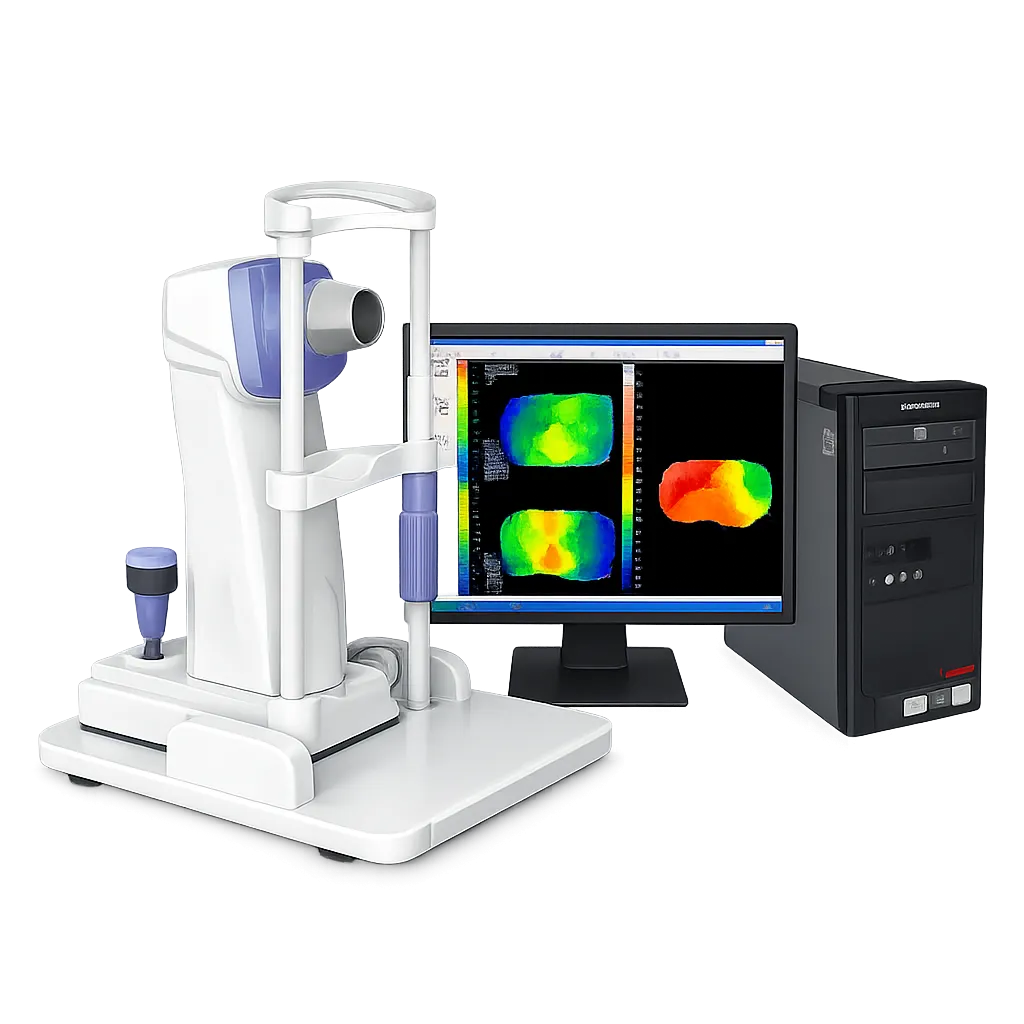
Placido Cone with 31 Rings
The measuring method is a Placido cone carrying 31 rings. Projecting a dense ring pattern is what allows the software to read curvature from the way the reflection distorts.
7936 Measurement Points
A total of 7936 points is sampled across the cornea. Dense sampling is what separates a smooth astigmatic surface from a genuinely irregular one on the resulting map.
Coverage of 10.91mm Diameter
Measurement coverage is stated at 10.91mm in diameter, which takes the map well beyond the central optical zone and out toward the periphery where irregularity often first appears.
Curvature and Dioptre Range
Curvature radius is listed from 5.5mm to 10.0mm and the dioptre range from 33.75D to 61.36D, a span that reaches both the steep and the flat ends of what a clinic encounters.
Precision of 0.02mm
Stated precision is plus or minus 0.02mm. Repeatability at that level is what makes comparison between visits meaningful when a clinician is watching for change.
Five Map Displays
Axial curvature, tangential curvature, elevation, imitated keratoscope and three dimensional cornea maps are all listed, with curvature shown either as data or through colour.
Named Clinical Functions
A cornea contact lens fitting function and a keratoconus detecting function are both listed as present on the instrument rather than offered as separate additions.
Patient Alignment and Output
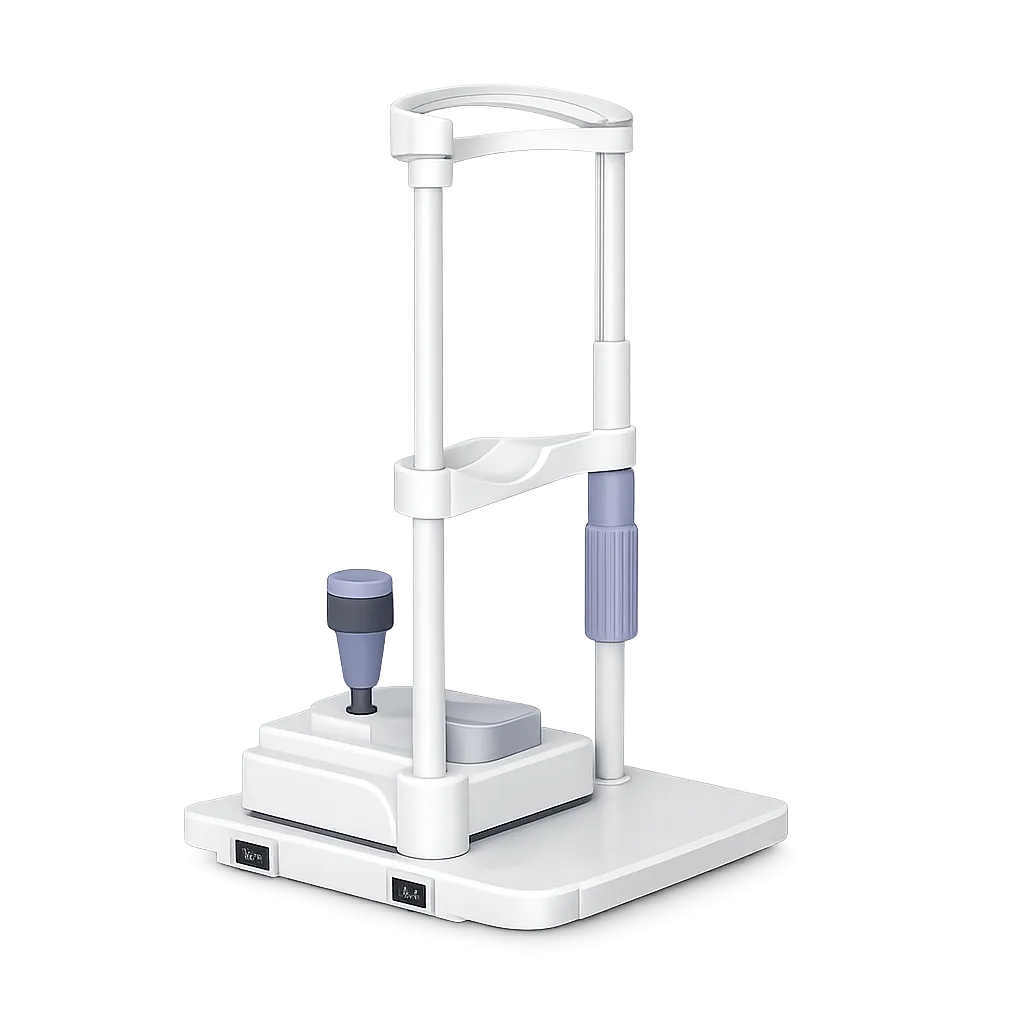
Adjustment covers 86mm left to right, 40mm forward and backward and 30mm up and down, with 5mm of chinrest travel. Image output goes to a high quality colour inkjet printer.