
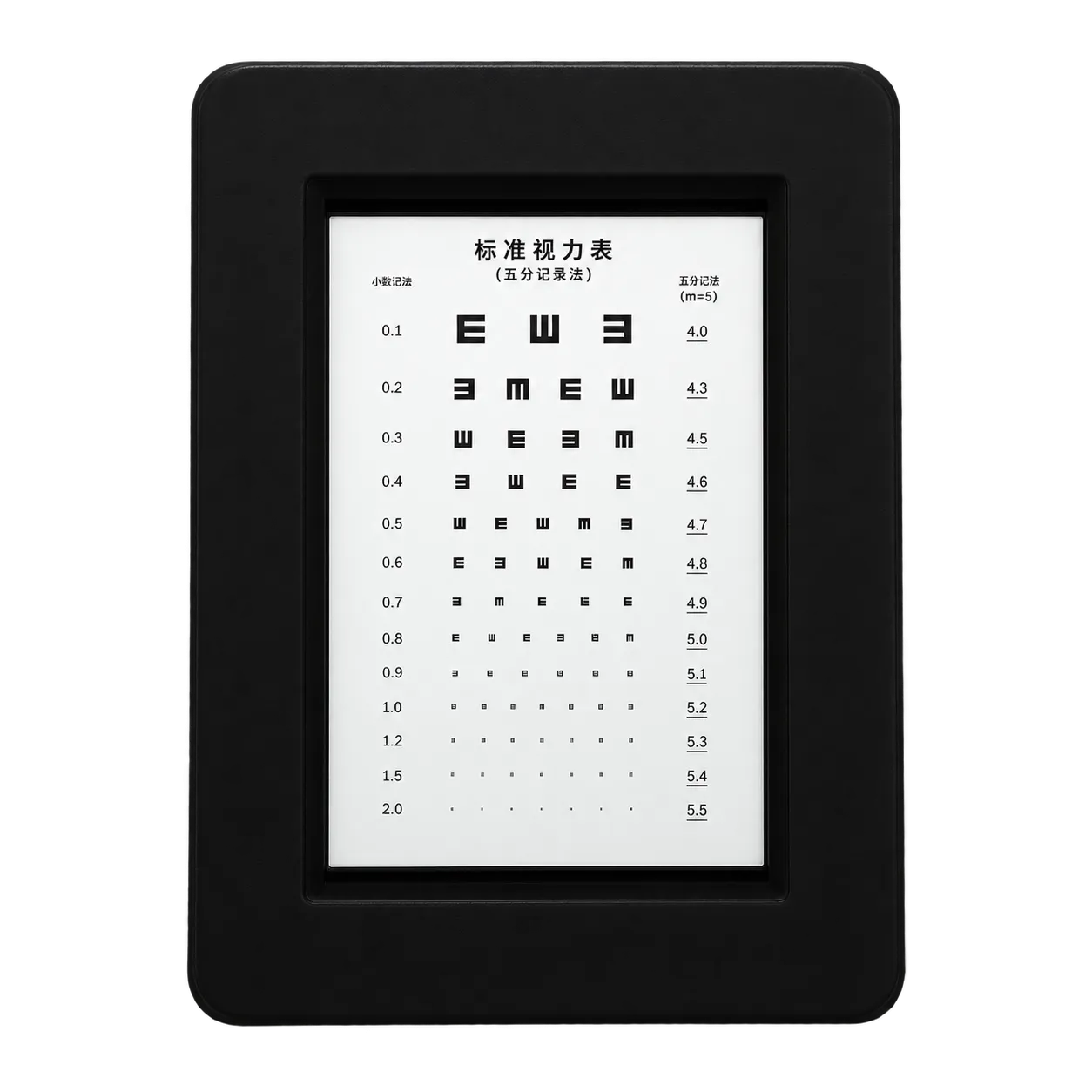
Routine near acuity measurement is the everyday use, and controlled illumination is what raises it above a printed card. Near acuity is sensitive to how the target is lit, and a card read under a lamp someone positioned at some point in the past introduces a variable that never reaches the record. Backlighting fixes the illumination at a consistent level, which makes a near result taken today comparable with one taken at the previous visit and with one taken in a different room. For practices monitoring near function over time — cataract progression, macular disease, presbyopic change — that comparability is the point.
Domiciliary and care setting work benefits disproportionately. A care home lounge, a bedside or a day room offers whatever light it offers, frequently poor and rarely adjustable, and a printed near card in those conditions measures the room as much as the patient. A self-illuminated chart at half a kilo removes that dependence entirely and is light enough to carry through a full visiting list.
Patients who struggle to hold a target steady are served by the weight. Elderly patients, those with tremor and anyone with upper limb weakness will shake a heavier unit, and the reading degrades for reasons unrelated to vision. Half a kilo is comfortably held for the duration of a near assessment.
Two points belong in the decision. The 30 cm distance must be measured rather than estimated, since near acuity notation is distance-dependent and arm's length varies considerably. And the unpublished list is substantial for a chart of this simplicity — acuity range, notation system, power supply, luminance and unit dimensions are all absent, and the acuity range in particular should be obtained in writing before ordering.