
Amblyopia assessment and monitoring is where the mask complement earns its place. Comparing a patient's acuity on the full chart, on a single line and on an isolated letter gives three data points rather than two, and the pattern across them describes how vision degrades under crowding rather than simply confirming that it does. An amblyopic eye characteristically loses more to contour interaction than a normal one, and tracking that difference across occlusion or atropine therapy shows whether the crowding disadvantage is reducing as acuity improves.
Reading difficulty and field loss assessment use the vertical column masks. A patient who resolves letters well but reads a line badly may have a tracking or scanning problem rather than a resolution one, and presenting a column instead of a row separates the two directly. Patients with hemianopic field loss following stroke show this pattern characteristically, and community optometrists are often the first to encounter it.
Subjective refraction without objective data benefits from the astigmatic fan and clock dials. Where no autorefractor reading is available — a broken instrument, a domiciliary visit, a patient who cannot be reliably measured objectively — the dial gives a starting axis from the patient's own report of which meridian appears blackest, which is considerably better than beginning from nothing.
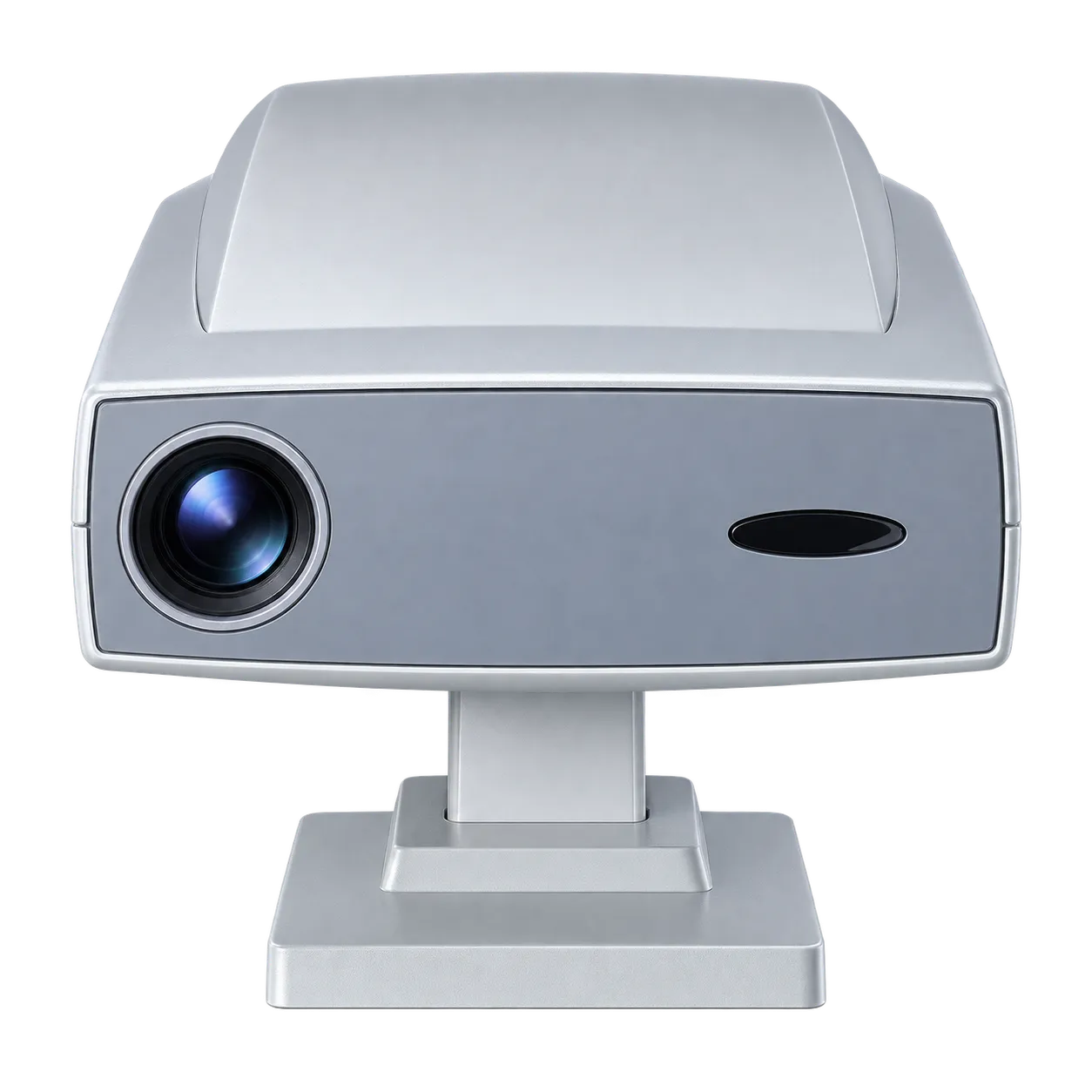
Routine community refraction is covered throughout: 30 chart patterns, 0.03-second switching, two programmable 30-step sequences for consistency across clinicians, a polarised screen and glasses for binocular balance and muscle imbalance, and a 1.5 to 6 metre throw suiting mirrored and direct lanes alike. Two decisions belong at order. The chart variant must be confirmed as carrying optotypes appropriate to UK acuity notation, and a mounting solution must be specified since floor and wall stands are chargeable extras rather than standard supply.