
Introduction
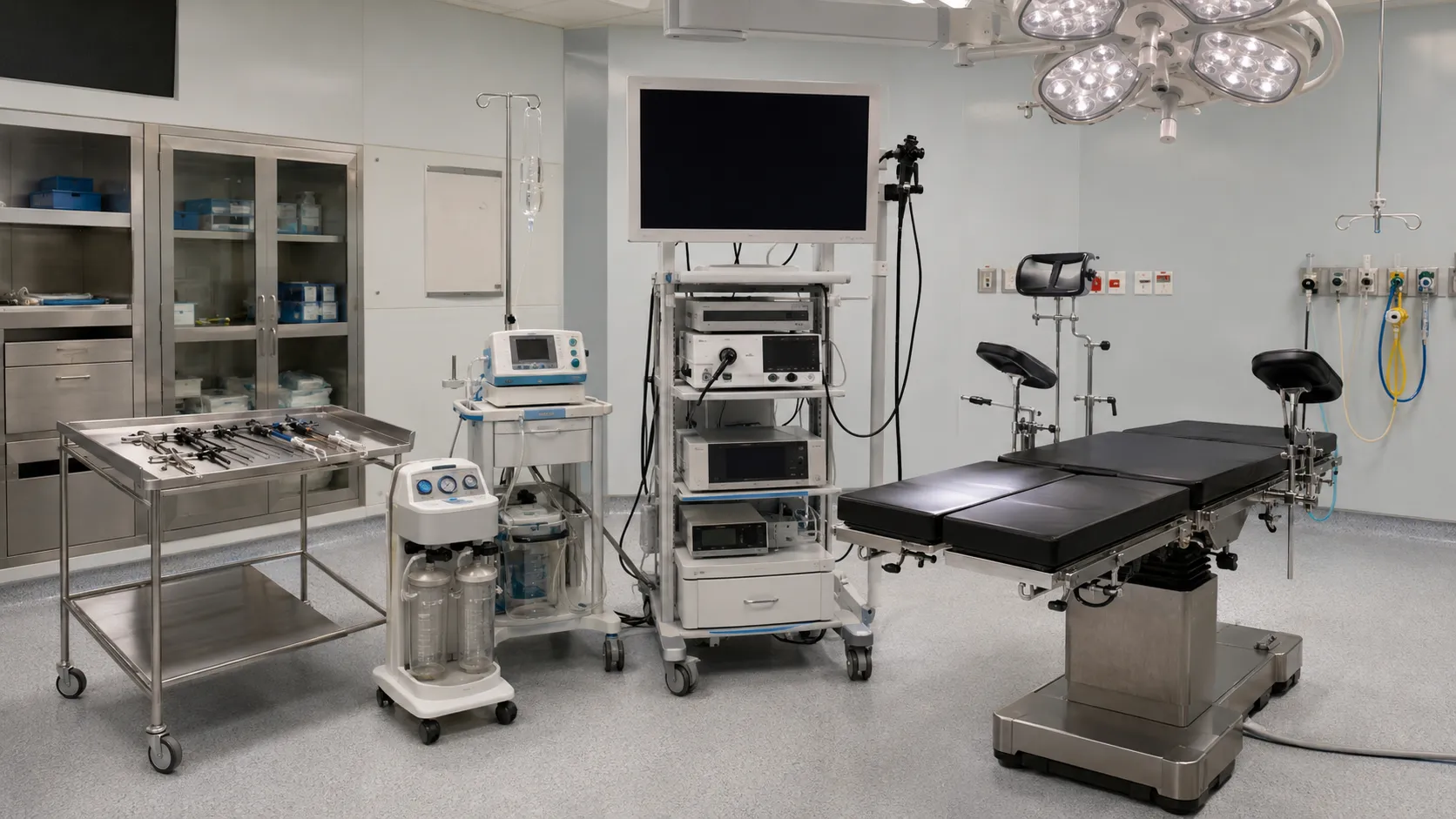
Urology treats the urinary tract and the male reproductive system, and it is one of the most endoscopic surgical specialities. A great deal of urological work is done by passing scopes and instruments along natural passages — into the bladder, up the ureters and to the kidney — rather than through incisions. That makes rigid and flexible endoscopy the heart of a urology theatre, with lasers, resection and irrigation built around it.
Equipping the theatre well means getting these systems to work together: endoscopes matched to their cameras and stacks, a laser suited to stone and prostate work, resectoscopes with dependable irrigation, and imaging for X-ray-guided procedures. This urology equipment buyer guide explains what the theatre needs, how the endoscopic and energy systems fit together, and the compliance and support points to settle early. It is written for urology teams, theatre managers, biomedical engineering and procurement across the UK, Europe, the US, the Gulf and South Africa.
An endoscopic speciality — the short version
-
Endoscopy at the centre. Rigid and flexible cystoscopes and ureteroscopes with imaging stacks.
-
Energy for stones and prostate. A laser for stone fragmentation and prostate surgery, plus resection.
-
Irrigation and imaging. Reliable irrigation for endoscopic work and fluoroscopy where procedures need it.
Start with the endoscopy system.m
The endoscopic platform is the core decision. A urology theatre needs rigid endoscopes such as cystoscopes and resectoscopes, and flexible endoscopes such as flexible ureteroscopeto reachng the upper urinary tract, all matched to a camera, light source, stack and displays. Flexible scopes are delicate and heavily used, so their durability, reprocessing and repair support matter as much as their image quality. Choosing the endoscopy system first sets the cameras, stacks and instruments that follow.
Irrigation is the quiet essential that runs alongside. Endoscopic urology depends on a continuous, controlled flow of fluid to keep the field clear, and reliable irrigation with proper management is fundamental to procedures such as transurethral resection. It is planned as core equipment, not an accessory.
What a urology theatre needs
-
Rigid endoscopes. Cystoscopes and resectoscopes for bladder and prostate work.
-
Flexible endoscopes. Flexible ureteroscopes and cystoscopes for the upper and lower tract.
-
Imaging stack. Camera, light source, stack and displays matched to the scopes.
-
Laser. A urology laser for stone fragmentation and prostate surgery, with its safety provisions.
-
Resection and irrigation. Resectoscopes with reliable, well-managed irrigation.
-
Fluoroscopy. A C-arm for stone and upper-tract procedures guided by X-ray.
-
Stone-retrieval accessories. Baskets, guidewires and consumables for endourology.
-
Monitoring and anaesthesia. Full provision for theatre procedures.
Equipment at a glance
| Category | What it covers and what to check |
|---|---|
| Endoscopy | Rigid and flexible scopes with imaging; check durability, reprocessing and repair support. |
| Laser | Stone fragmentation and prostate surgery; confirm laser safety provision and fibres. |
| Resection and irrigation | Resectoscopes with reliable irrigation; core to transurethral work. |
| Imaging | C-arm fluoroscopy for stone and upper-tract procedures; confirm dose management. |
| Endourology accessories | Baskets, guidewires and consumables; confirm consistent resupply. |
Lasers do the heavy lifting.g
Modern urology relies heavily on laser energy, particularly for breaking up stones and for prostate surgery. A urology laser is a significant, safety-sensitive piece of equipment: it needs the right fibres, the correct laser-safety measures in the theatre, and stafftrained to use ite. Buyers weigh the laser as carefully as the endoscopy system, and confirm that fibre supply and safety provision come with it rather than being sourced separately later.
Flexible scopes need a repair plan.
Flexible ureteroscopes are among the most delicate and hardest-used items in the theatre, and they will need repair. A urology service plans for that from the start: it confirms how repairs are handled, how quickly scopes are turned around, and whether loan scopes are available so a list is not cancelled when one is out of service. Treating flexible-scope support as part of the purchase, not an afterthought, keeps the service running.
Compliance and documentation
Every device must be approved for the market where it is used — UKCA, CE marking under the EU MDR, FDA clearance or the relevant national approval — with complete, current documentation. Lasers, energy devices and endoscopic systems are higher-risk and carry stricter requirements, and imaging brings radiation duties. Ask suppliers for certification mapped to your market, confirm ISO quality standards sit behind manufacturing, review relevant NICE guidance, and check current requirements with the MHRA or your national authority before committing.
Support keeps the theatre running.g
-
Downtime cancels lists. A laser or flexible scope out of service stops the theatre, so support must be reliable.
-
Response times, in writing. Ask what fault response the supplier commits to and whether engineers cover your region.
-
Consumable supply. Confirm consistent supply of laser fibres, baskets, guidewires and irrigation consumables.
-
Scope repair and loans. Confirm turnaround and whether loan scopes are available.
-
Training included. Surgical and nursing staff need it, especially for laser safety, as teams change.
Settle each of these before you commit, and get the answers in writing rather than as verbal assurances.
More from Business
-
Buyers — source compliant, fully documented equipment.
-
Suppliers — list your equipment and reach buyers worldwide.
-
Advertise — promote your products and services to a clinical audience.
-
Business overview — explore everything MediGear offers healthcare organisations.
Disclaimer
This article is for general information only. It does not constitute clinical, procurement, legal or regulatory advice. Equipment requirements for urology vary by service, facility, country and market, and change over time. Always confirm current requirements with the relevant authorities, and consult qualified clinical, anaesthetic, biomedical engineering, procurement and regulatory professionals for decisions specific to your organisation. medigear.uk accepts no liability for actionstaken based onf this content.
"Endoscopy, lasers, stone work" A theatre that does it all.
We supply medical equipment to healthcare organisations across the UK, Europe, the US, the Gulf and South Africa. Everything is genuine, documented and supported, so your urology theatre handles endoscopic, laser and stone work reliably.
Frequently Asked Questions
A urology theatre needs rigid endoscopes such as cystoscopes and resectoscopes, flexible endoscopes such as flexible ureteroscopes, an imaging stack with a camera, light source and displays, a urology laser for stone fragmentation and prostate surgery, resectoscopes with reliable irrigation, C-arm fluoroscopy for stone and upper-tract work, stone-retrieval accessories such as baskets and guidewires, and full monitoring and anaesthesia.
Much of urology is performed by passing scopes and instruments along natural passages — into the bladder, up the ureters and to the kidney — rather than through incisions. That makes rigid and flexible endoscopy the heart of the theatre, with lasers, resection and irrigation built around it, so the endoscopy system is the first equipment decision.
A urology laser is used mainly to break up stones and for prostate surgery. It is a significant, safety-sensitive piece of equipment that needs the right fibres, correct laser-safety measures in the theatre and trained staff. Buyers weigh it as carefully as the endoscopy system and confirm that fibre supply and safety provision come with it.
Flexible ureteroscopes are delicate and heavily used so that they will need repair. A urology service confirms from the start how repairs are handled, how quickly scopes are turned around, and whether loan scopes are available, so a list is not cancelled when one is out of service. Scope support is treated as part of the purchase, not an afterthought.
Endoscopic urology depends on a continuous, controlled flow of fluid to keep the surgical field clear, and reliable irrigation with proper management is fundamental to procedures such as transurethral resection. It is planned as core equipment alongside the endoscopes and resectoscopes rather than treated as an accessory.
Yes. Every device must be approved for the market where it is used, correctly classified and fully documented. Lasers, energy devices, and endoscopic systems are higher risk and carry stricter requirements, and imaging adds radiation duties. Confirm current requirements with the relevant national authority before committing to any purchase.