
Introduction
Orthopaedic surgery repairs and replaces the musculoskeletal system — bones, joints and the hardware that fixes them. It is among the most equipment-intensive specialities because much of the work is mechanical: cutting, shaping, and drilling bone, then securing implants and fixation devices with precision. From joint replacement to fracture fixation and arthroscopy, the tools do much of the surgical work, and their quality shows directly in outcomes.
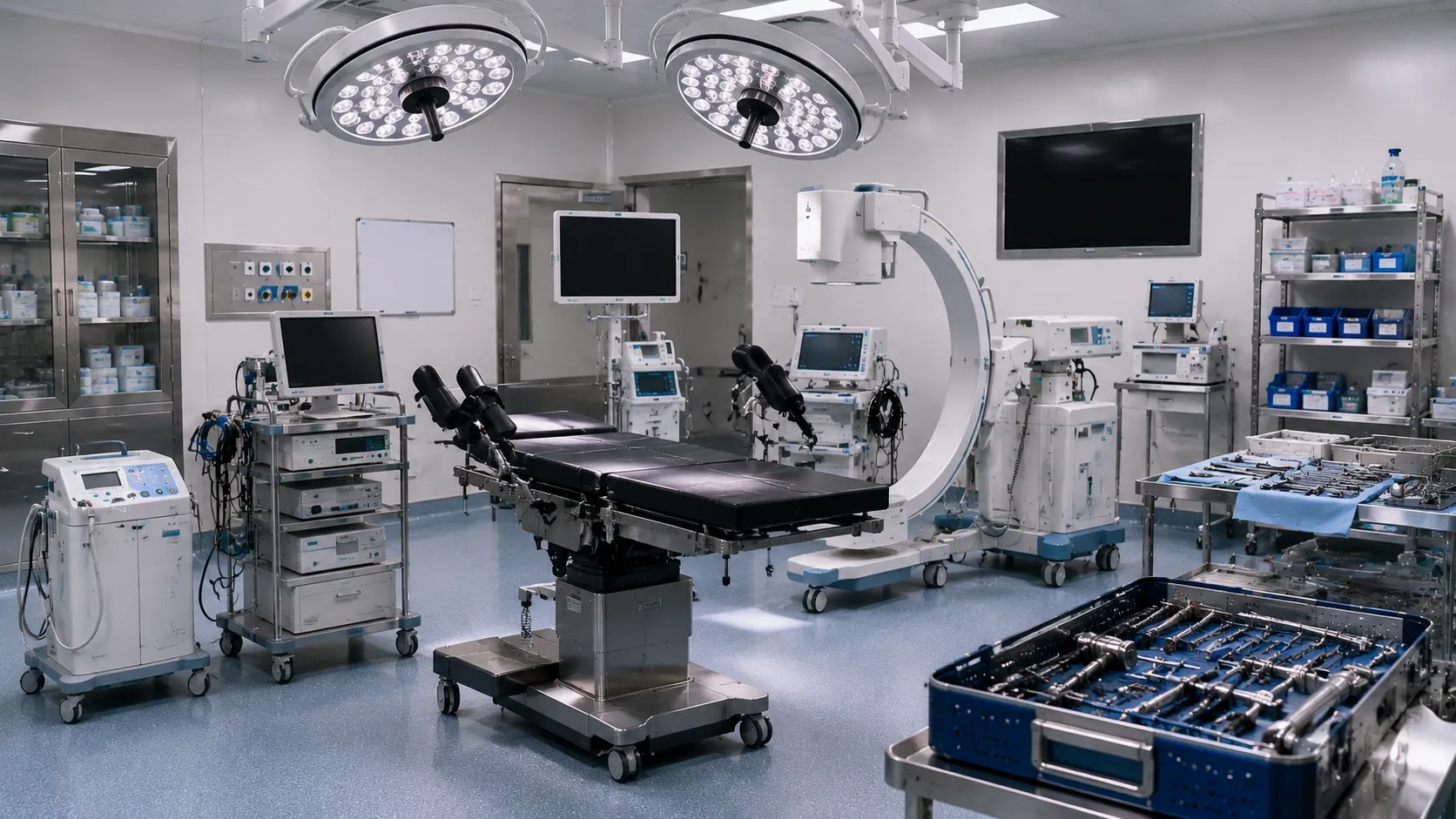
Equipping an orthopaedic service means covering powered instruments, implant and fixation systems, imaging, specialist tables and, critically, a clean-air environment that protects against the deep infection an implant can harbour. This orthopaedic surgery equipment buyer guide sets out what a service needs, the order in which to build it, and the compliance and traceability questions to settle early. It is written for orthopaedic surgeons, theatre teams, biomedical engineering and procurement across the UK, Europe, the US, the Gulf and South Africa.
What orthopaedic surgery needs — the short version
-
Powered instruments — drills, saws and reamers — matched to implant and fixation systems.
-
Implant and fracture-fixation ranges, with imaging and specialist tables to place them accurately.
-
A clean-air (laminar-flow) theatre with tourniquets and infection-control discipline.
Start with power tools and the clean-air theatre.
Two foundations underpin orthopaedic surgery. The first is a reliable powered instrument system: battery or pneumatic drills, saws and reamers with the appropriate attachments, because almost every case involves preparing bone. Power, control, sterilisation and the breadth of attachments all matter, since the same platform serves arthroplasty, trauma and spinal work.
The second is the theatre environment. Joint replacement introduces a large implant into the body, and a deep infection around it is a serious complication, so many orthopaedic theatres use laminar-flow, ultra-clean ventilation, sometimes with body-exhaust gowns, to reduce airborne contamination. Because the clean-air environment and the powered platform shape everything that follows, they are planned first, with implants, imaging and tables matched to them rather than the reverse.
What orthopaedic surgery needs
-
Powered instrument system. Battery or pneumatic drills, saws and reamers with a full attachment range.
-
Arthroplasty implant systems. Hip, knee and other joint replacement ranges with matched instrumentation.
-
Fracture-fixation systems. Plates, screws, intramedullary nails and associated instrument sets.
-
Fracture and traction tabl—aA specialist table for reduction, positioning and imaging access.
-
Mobile imaging. A mobile C-arm for intraoperative fracture and implant positioning.
-
Tourniquet systems. Pneumatic tourniquets for a bloodless field in limb surgery.
-
Clean-air ventilation. Laminar-flow theatre provision, with body-exhaust gowns where used.
-
Arthroscopy stack. Camera, light source, shaver and pump for minimally invasive joint work.
-
Bone-cement and sterile storage. Cement preparation, plus secure storage and handling of implants and loan sets.
The equipment checklist
|
Equipment |
Role in the theatre |
Key selection point |
|
Powered instruments |
Bone preparation |
Power; control; attachment range; sterilisation |
|
Arthroplasty implants |
Joint replacement |
Range; matched instruments; traceability |
|
Fixation systems |
Fracture repair |
Plate, screw and nail breadth; loan logistics |
|
Fracture/traction table |
Positioning and reduction |
Imaging access; attachment range |
|
Mobile C-arm |
Intraoperative imaging |
Image quality; manoeuvrability; dose control |
|
Tourniquet system |
Bloodless field |
Pressure control; cuff range; safety features |
|
Laminar-flow ventilation |
Infection control |
Air quality; validation; gown compatibility |
Implants and the logistics behind them
Orthopaedic implants are not a single purchase but an ongoing system. Arthroplasty and fixation ranges come with their own dedicated instruments, sizing trials, and often loan-set logistics, where a supplier provides implant and instrument kits for specific cases. Managing that flow — the right implants and instruments available, sterile and traceable, for each list — is as much a part of equipping a service as the theatre itself. Every implanted device must be recorded so it can be traced to the patient, which makes documentation a standing requirement rather than a one-off.
Imaging and precision
Getting an implant or fixation device in exactly the right position is central to orthopaedic outcomes, and imaging is how the team confirms it during surgery. A mobile C-arm lets the surgeon check reduction and hardware placement in real time, on a fracture table configured for the necessary views. That intraoperative imaging brings ionising radiation into the theatre, so protection, dosimetry and training sit alongside the technical choice of image quality and manoeuvrability.
Compliance and documentation
Orthopaedic equipment must be genuine, current and fully documented. In the UK, the MHRA regulates devices, with clinical guidance from NICE. Intraoperative imaging brings ionising-radiation duties under HSE ionising-radiation frameworks (HSE). Implant traceability is essential, and requirements vary by country and market. Confirm current obligations with the relevant authorities before you buy.
Support keeps an orthopaedic service runnin..g
-
Installation, commissioning and familiarisation for powered instruments, imaging and tables.
-
Preventive maintenance and calibration for power tools, tourniquets and C-arms.
-
Reliable supply of consumables — blades, burrs, cement, tourniquet cuffs and fixation components.
-
Support for implant and loan-set logistics so lists run without gaps.
-
Clear documentation and implant traceability to support governance and audit.
More from Business
-
Buyers — source compliant, fully documented equipment.
-
Suppliers — list your equipment and reach buyers worldwide.
-
Advertise — promote your products and services to a clinical audience.
-
Business overview — explore everything MediGear offers healthcare organisations.
Disclaimer
This article is for general information only. It does not constitute clinical, procurement, legal or regulatory advice. Equipment requirements for orthopaedic surgery vary by service, facility, country and market, and change over time. Radiation practice is separately regulated in most countries and requires specialist input. Always confirm current requirements with the relevant authorities, and consult qualified clinical, medical physics, biomedical engineering, procurement and regulatory professionals for decisions specific to your organisation. medigear.uk accepts no liability for actions takbased on of this content.
"Built to fit, made to last" A theatre equipped for every joint.
We supply medical equipment to healthcare organisations across the UK, Europe, the US, the Gulf and South Africa. Everything is genuine, documented and supported, so your orthopaedic service operates cleanly and reliably.
Frequently Asked Questions
Orthopaedic surgery needs a powered instrument system — drills, saws and reamers with attachments — plus arthroplasty implant ranges and fracture-fixation systems with matched instruments. It also needs a fracture or traction table, a mobile C-arm for intraoperative imaging, pneumatic tourniquets, and often laminar-flow clean-air ventilation to reduce infection risk around implants. Arthroscopy stacks, bone-cement handling and secure implant and loan-set storage complete a typical service.
Joint replacement introduces a large implant into the body, and deep infection around that implant is a serious complication. Laminar-flow, ultra-clean ventilation, sometimes combined with body-exhaust gowns, reduces airborne contamination over the surgical field. Because this clean-air environment shapes the whole theatre, it is planned as a foundational element, with implants, imaging and tables matched to it.
Implants are an ongoing system rather than a single item. Arthroplasty and fixation ranges come with dedicated instruments, sizing trials and often loan-set logistics, where kits arrive for specific cases. Managing that flow — sterile, traceable implants and instruments available for each list — is a core part of running a service. Every implanted device must be recorded so it can be traced to the patient.
Accurate positioning of implants and fixation devices is central to outcomes, and a mobile C-arm lets the surgeon confirm reduction and hardware placement during surgery, often on a fracture table set up for the right views. Because this uses ionising radiation, protection, dosimetry and training accompany the technical choices of image quality and manoeuvrability.
Yes, where intraoperative imaging is used. A mobile C-arm produces ionising radiation, bringing duties under HSE ionising-radiation and IR(ME)R frameworks, including protection, dosimetry and training. Devices are regulated by the MHRA, with clinical guidance from NICE. Implant traceability is essential and requirements vary by country and market, so confirm current obligations with the relevant authorities.
Yes. MediGear supplies medical equipment to healthcare organisations across the UK, Europe, the US, the Gulf and South Africa. As a distributor we provide genuine, documented and supported equipment, from powered instruments and imaging to tables, tourniquets and consumables. Requirements differ by service and market, so we work with your team to match equipment to your caseload and regulatory setting.