
Introduction
Nephrology looks after patients with kidney disease, and for many of them the equipment is not an accessory to care — it is the treatment. Haemodialysis, peritoneal dialysis and continuous renal replacement therapy each replace kidney function in different settings, and every one of them depends on machines, water and consumables working together without fail. A renal unit that cannot guarantee a session cannot guarantee care, so reliability and water quality sit at the heart of every purchasing decision.
Equipping a nephrology service is broader than the dialysis floor alone. It spans water treatment and distribution, the dialysis machines themselves, the critical-care variant used in intensive care, peritoneal dialysis for home and ward, and the vascular access work that makes it all possible. This nephrology equipment buyer guide sets out what each part needs, the order to plan in, and the water and traceability questions to settle first. It is written for nephrologists, renal nurses, dialysis technicians, and procurement teams across the UK, Europe, the US, the Gulf, and South Africa.
What a renal unit needs — the short version
-
Water treatment and haemodialysis machines — togethe, theyr define whether the unit can run at all.
-
A CRRT option for critically ill patients who cannot tolerate conventional dialysis in intensive care.
-
Peritoneal dialysis and vascular access provision, plus ultrasound to place and assess access.
Start with water treatment.
Before a single dialysis machine matters, the water does. Haemodialysis exposes a patient's blood to hundreds of litres of water each week across a thin membrane, so the water mustmeeto a demanding purity standard. A treatment plant — pre-filtration, softening, reverse osmosis and a monitored distribution loop — is the foundation the whole unit is built on, and it is sized to the number of stations and their running hours.
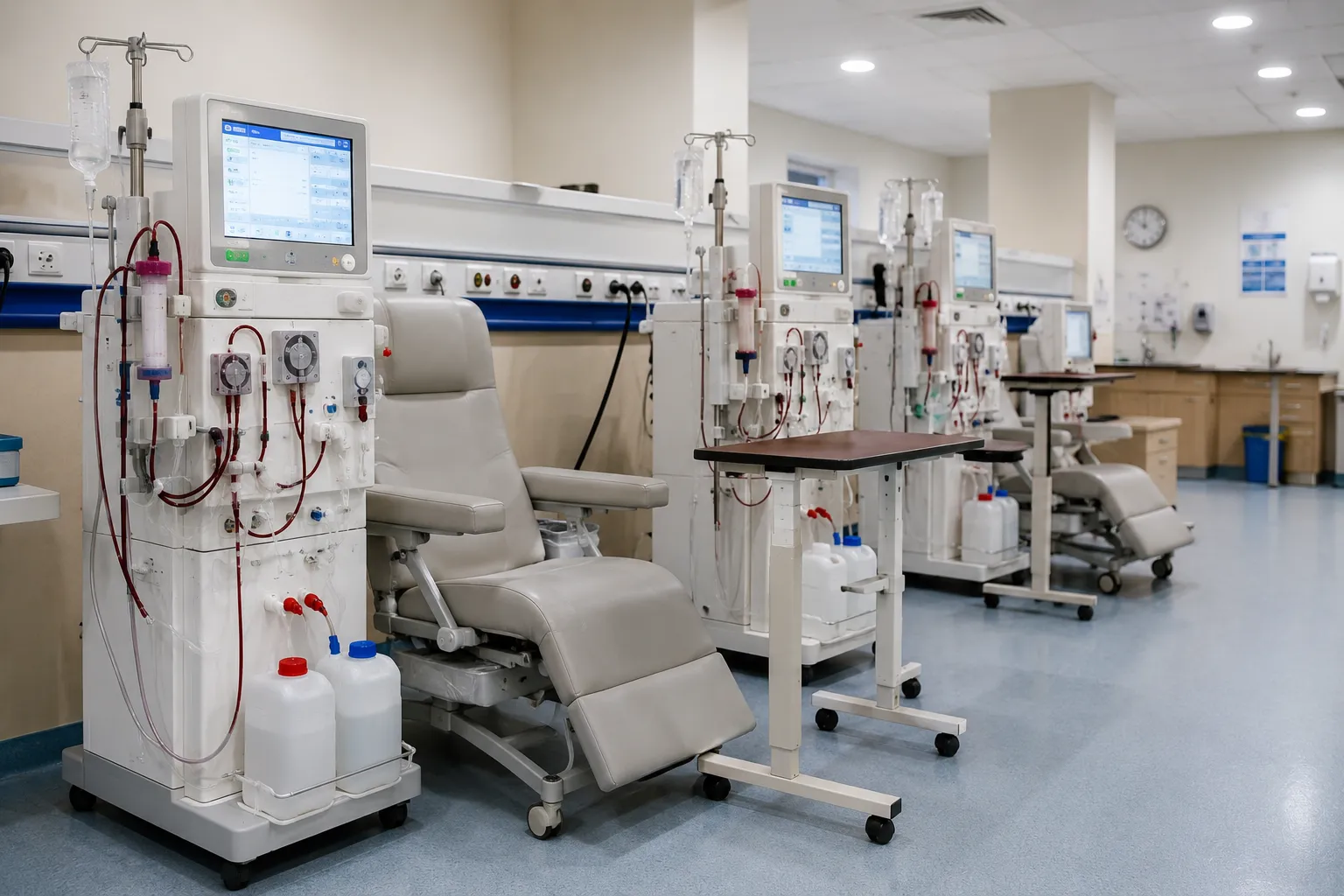
Because water treatment underpins every station, it is planned first and matched to the unit's capacity and layout. The machines are then chosen to match that capacity — single-patient dialysis systems with the monitoring, disinfection, and data features the unit needs. Dialysers, bloodlines, concentrates and needles follow as the recurring consumable stream, so supply continuity is designed in from the start rather than chased later.
What nephrology needs
-
Water treatment plant. Pre-treatment, reverse osmosis and a monitored ring main delivering water to every dialysis station.
-
Haemodialysis machin—single-patientnt systems with volumetric control, monitoring, heat or chemical disinfection and data capture.
-
Dialysers and consumables. Membranes, bloodlines, concentrates, needles and connectors matched to the machine platform.
-
CRRT systems. Continuous therapy for haemodynamically unstable patients on intensive care.
-
Peritoneal dialysis. Automated cyclers and manual exchange provision for ward and home therapy.
-
Vascular access support. Ultrasound-guided placement of catheters and assessment of fistulae and grafts.
-
Dialysis chairs and station—comfortablee, cleanable, reclining stations for long treatment sessions.
-
Point-of-care testing. Rapid electrolyte and blood-gas measurement to guide prescription and safety.
The equipment checklist
|
Equipment |
Role in the unit |
Key selection point |
|
Water treatment plant |
Purified water supply |
Capacity; monitoring; disinfection loop |
|
Haemodialysis machine |
In-centre dialysis |
Monitoring; disinfection; data capture |
|
CRRT system |
Critical care therapy |
Modalities; ease of use on ICU |
|
PD cycler |
Peritoneal dialysis |
Home suitability; connectivity |
|
Access ultrasound |
Vascular access |
Probe range; portability |
|
Dialysis station |
Patient position |
Comfort; cleanability; weight range |
|
Blood-gas analyser |
Point-of-care testing |
Turnaround; assay panel |
Water quality is a continuous responsibility
Water treatment is not a one-off purchase but an ongoing programme. The plant must be monitored, disinfected and tested on a routine schedule, because contamination or drift in purity carries real clinical risk across every patient dialysing that day. That makes the service contract, testing regime and consumable supply for the water plant just as important as the machines it feeds. Units plan disinfection windows, redundancy and alarms so that a fault at one point does not close the whole floor.
One service, several therapies
A modern renal service rarely runs a single modality. In-centre haemodialysis, home haemodialysis, automated peritoneal dialysis, and CRRT in intensive care all sit under nephrology, and each has its own equipment, training, and consumable pattern. Planning them together — rather than as separate purchases — keeps platforms compatible, simplifies training and makes consumable supply more predictable. Vascular access provision ties them together, since dependable accessenabless any blood-based therapy to run.
Compliance and documentation
Nephrology equipment must be genuine, current and fully documented, and water treatment carries its own quality obligations. In the UK, the MHRA regulates medical devices, and NICE publishes clinical guidance. ISO maintains international standards for medical devices and dialysis water. Requirements vary by country and market, so confirm current obligations with the relevant authorities before you buy.
Support keeps a renal unit running.
-
Installation and commissioning of water treatment and dialysis machines, with clinical familiarisation.
-
Preventive maintenance, disinfection support and water testing that keep every station usable.
-
Reliable consumable supply — dialysers, bloodlines, concentrates, PD fluids and access kit.
-
Rapid technical response, because a machine or water fault can affect a whole session list.
-
Clear documentation and traceability for machines, water quality records and consumables.
More from Business
-
Buyers — source compliant, fully documented equipment.
-
Suppliers — list your equipment and reach buyers worldwide.
-
Advertise — promote your products and services to a clinical audience.
-
Business overview — explore everything MediGear offers healthcare organisations.
Disclaimer
This article is for general information only. It does not constitute clinical, procurement, legal or regulatory advice. Equipment and water-treatment requirements for nephrology vary by unit, therapy, facility, country and market, and change over time. Dialysis water quality is separately governed and requires specialist input. Always confirm current requirements with the relevant authorities, and consult qualified clinical, renal technical, biomedical engineering, procurement and regulatory professionals for decisions specific to your organisation. medigear.uk accepts no liability for actions takenbased onf this content.
"Clean water, reliable dialysis." A renal unit equipped to run every session.
We supply medical equipment to healthcare organisations across the UK, Europe, the US, the Gulf and South Africa. Everything is genuine, documented and supported, so your renal service dialyses safely, session after session.
Frequently Asked Questions
A renal unit needs a water treatment plant supplying purified water to every station, haemodialysis machines with monitoring and disinfection, and the dialysers, bloodlines and concentrates they consume. Most services also need a CRRT option for intensive care, peritoneal dialysis provision for ward and home, ultrasound for vascular access, comfortable dialysis stations and point-of-care testing for electrolytes and blood gases.
Haemodialysis exposes a patient's blood to large volumes of water each week across a thin membrane, so the water must reach a demanding purity standard. A treatment plant with pre-filtration, reverse osmosis and a monitored distribution loop delivers that water to every station. Because contamination affects everyone dialysing that day, the plant is monitored, disinfected and tested on a continuous, documented schedule.
Conventional haemodialysis runs intermittent sessions on a dialysis unit and needs treated water and a stable patient. Continuous renal replacement therapy runs slowly and continuously in intensive care, using pre-packaged fluids rather than a water plant, and suits patients who are too unstable for standard dialysis. Many hospitals need both, so they are planned together to keep platforms and training compatible.
Usually, yes. Peritoneal dialysis uses the lining of the abdomen as a membrane and is often delivered at home using an automated cycler, with manual exchanges as an alternative. It reduces reliance on in-centre stations for suitable patients. Planning it alongside haemodialysis keeps training, consumables and clinical pathways coherent across the whole service.
Yes. Machines, water treatment and consumables should be genuine, current and traceable, with water quality records kept to schedule. In the UK, the MHRA regulates devices, NICE provides clinical guidance, and ISO maintains international device and dialysis-water standards. Requirements vary by country and market, so confirm current obligations with the relevant authorities before purchasing.
Yes. MediGear supplies medical equipment to healthcare organisations across the UK, Europe, the US, the Gulf and South Africa. As a distributor,, we provide genuine, documente,d and supported equipment, from water treatment and dialysis machines to CRRT, PD cycler,s and consumables. Requirements differ by unit and market, so we work with your team to match equipment to your service and its regulatory setting.