
Introduction
Neonatal surgery operates on newborns, including premature and very low birth-weight babies, and it sits at the most demanding end of surgical practice. These patients are tiny and physiologically fragile: they lose heat in minutes, tolerate almost no fluid error, and need instruments and airways scaled far below anything used in older children. Equipment that is merely small is not enough — neonatal work needs a kit designed specifically for it.
Because the margins are so fine, the equipment set is dominated by two themes: keeping the baby warm and stable, and working at micro-scale with total precision. This neonatal surgery equipment buyer guide explains what the service needs, why thermoregulation and monitoring lead every decision, and the compliance and support points to settle early. It is written for neonatal and paediatric surgical teams, theatre and unit managers, biomedical engineering and procurement across the UK, Europe, the US, the Gulf and South Africa.
Working at the edge — the short version
-
Thermoregulation first. Radiant warmers, warmed theatres and warmed fluids, because newborns lose heat fast.
-
Micro-scale surgery. Micro-instruments and fine sutures for structures measured in millimetres.
-
Precision support. Neonatal ventilation, exact fluid control and fine-resolution monitoring.
Start with thermoregulation and transport.
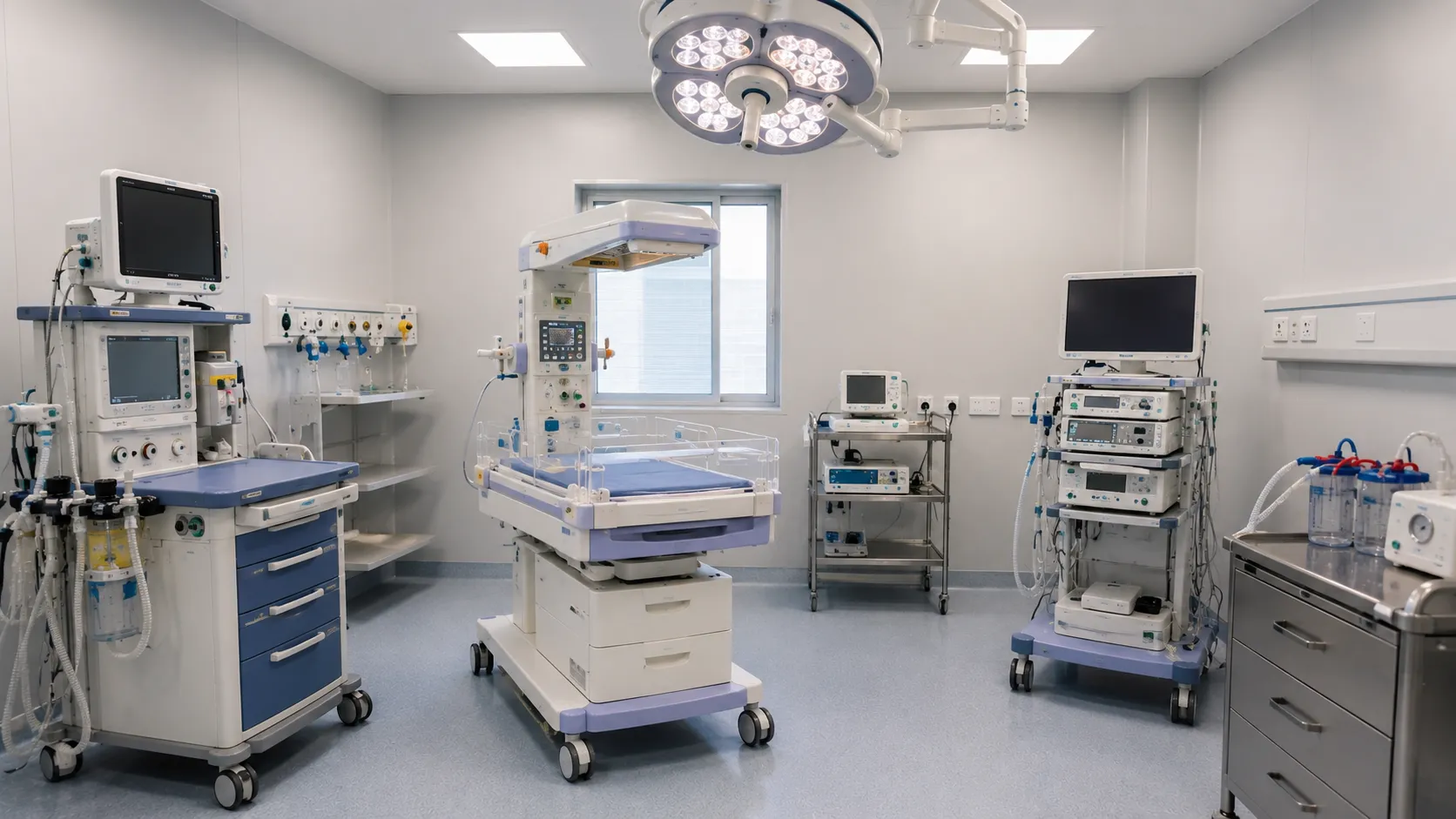
For a newborn, staying warm is a survival issue, so thermoregulation leads the equipment plan. The service needs radiant warmers over the operating surface, the ability to run the theatre warm, and warmed intravenous and irrigation fluids. Getting the baby to theatre safely matters as much. Hence, a transport incubator that maintains temperature, oxygen and monitoring in transit is part of the set, not a separate concern.
These babies also have almost no physiological reserve, which places extraordinary weight on monitoring and fluid control. Every millilitre counts, so infusion devices must be accurate at the smallest volumes, and monitoring has to resolve the fine changes that matter in a patient this small. The service plans warming, monitoring and fluid control together, as one system.
What a neonatal surgical service needs
-
Radiant warmers. Over the operating surface, to hold temperature during surgery.
-
Transport incubator. Maintains temperature, oxygen and monitoring on the way to theatre.
-
Neonatal ventilation. An anaesthetic and ventilation setup suited to newborn lungs and tiny volumes.
-
Neonatal airway range. The smallest masks, laryngoscopes and tubes, complete across sizes.
-
Micro-instruments. Fine surgical instruments and fine sutures for millimetre-scale structures.
-
Precise infusion. Devices accurate at the smallest volumes for exact fluid delivery.
-
Fine-resolution monitoring. Neonatal probes, cuffs and electrodes that resolve small changes.
-
Warmed fluids and a warm theatre. Every source of heat loss addressed.
Equipment at a glance
| Category | What it covers and what to check |
|---|---|
| Warming | Radiant warmers, warmed fluids and theatre heating; the leading priority for newborns. |
| Transport | Incubator maintaining temperature, oxygen and monitoring in transit; part of the set. |
| Ventilation and airway | Neonatal ventilation and the smallest airway range, complete across sizes. |
| Micro-surgery | Fine instruments and sutures for millimetre-scale work; confirm quality and resupply. |
| Infusion and monitoring | Accuracy at the smallest volumes and probes that resolve fine change. |
Why neonatal is not just smaller paediatrics
It is tempting to treat neonatal work as the bottom of the paediatric size range, but the difference is one of kind, not just degree. A premature baby's physiology, heat loss and fluid tolerance are unlike an older child's, and the equipment reflects that: radiant warming rather than forced-air alone, micro-instruments rather than small instruments, infusion accurate to fractions of a millilitre. Buyers who plan neonatal provision as its own category, rather than an extension of paediatrics, get it right.
Precision is the whole discipline.
Everything in neonatal surgery comes back to precision under fragility. There is little room to correct a fluid error, a temperature drop or a ventilation problem, so the equipment has to perform reliably at the extremes of small. That is why accuracy at low volumes, completeness of the smallest airway sizes, and dependable warming are the points buyers weigh most heavily. They are the difference between equipment that copes with a newborn and equipment that only nearly does.
Compliance and documentation
Every device must be approved for the market where it is used — UKCA, CE marking under the EU MDR, FDA clearance or the relevant national approval — with complete, current documentation. Ventilation, warming and infusion devices are higher-risk, and neonatal use carries the strictest expectations around accuracy and safety. Ask suppliers for certification mapped to your market, confirm ISO quality standards sit behind manufacturing, review relevant NICE guidance, and check current requirements with the MHRA or your national authority before committing.
Support keeps the service running.g
-
Downtime is critical. A radiant warmer, ventilator or transport incubator out of service stops neonatal surgery, so support must be dependable.
-
Response times, in writing. Ask what fault response the supplier commits to and whether engineers cover your region.
-
Consumable supply. Confirm consistent supply of the smallest airway sizes, micro-sutures and infusion consumables.
-
Training included. Surgical, neonatal and nursing staff need it, and teams change.
-
Calibration and parts. Confirm calibration support and how long spares for warming and ventilation will be available.
Settle each of these before you commit, and get the answers in writing rather than as verbal assurances.
More from Business
-
Buyers — source compliant, fully documented equipment.
-
Suppliers — list your equipment and reach buyers worldwide.
-
Advertise — promote your products and services to a clinical audience.
-
Business overview — explore everything MediGear offers healthcare organisations.
Disclaimer
This article is for general information only. It does not constitute clinical, procurement, legal or regulatory advice. Equipment requirements for neonatal surgery vary by service, facility, country and market, and change over time. Always confirm current requirements with the relevant authorities, and consult qualified clinical, neonatal, biomedical engineering, procurement and regulatory professionals for decisions specific to your organisation. medigear.uk accepts no liability for actions taken based on this content.
"Every degree, every millilitre" Precision for newborns.
We supply medical equipment to healthcare organisations across the UK, Europe, the US, the Gulf and South Africa. Everything is genuine, documented and supported, so your neonatal surgery service works with the precision newborns demand.
Frequently Asked Questions
Neonatal surgery needs radiant warmers over the operating surface. This transport incubator maintains temperature, oxygen and monitoring in transit, neonatal ventilation and the smallest airway range, micro-instruments and fine sutures for millimetre-scale work, infusion devices accurate at the smallest volumes, fine-resolution neonatal monitoring, and warmed fluids with a warm theatre to prevent heat loss.
Newborns, especially premature babies, lose heat within minutes and have almost no reserve to recover, so staying warm is a survival issue. Radiant warmers, a warm theatre, warmed fluids and a temperature-maintaining transport incubator are therefore planned first and treated as core equipment rather than as supporting extras.
It differs in kind, not just size. A premature baby's physiology, heat loss, and fluid tolerance are unlike an older child's, so neonatal work needs radiant warming, micro-instruments, and infusion accuracy to fractions of a millilitre. Planning neonatal provision as its own category, rather than the bottom of the paediatric range, is what gets it right.
Newborns tolerate almost no fluid error, so every millilitre counts. Infusion devices must be accurate at the smallest volumes to deliver exact fluids and medications, because there is little room to correct a mistake. Accuracy at low volumes is one of the points buyers weigh most heavily.
Getting a fragile newborn to theatre safely matters as much as the surgery itself. A transport incubator maintains temperature, oxygen and monitoring during transfer, so the baby arrives stable. Because heat and stability cannoo lapse in transit, the incubator is considered part of the neonatal surgical set rather than a separate concern.
Yes. Every device must be approved for the market where it is used, correctly classified and fully documented. Ventilation, warming, and infusion devices are higher risk, and neonatal use carries the strictest expectations for accuracy and safety. Confirm current requirements with the relevant national authority before committing to any purchase.