
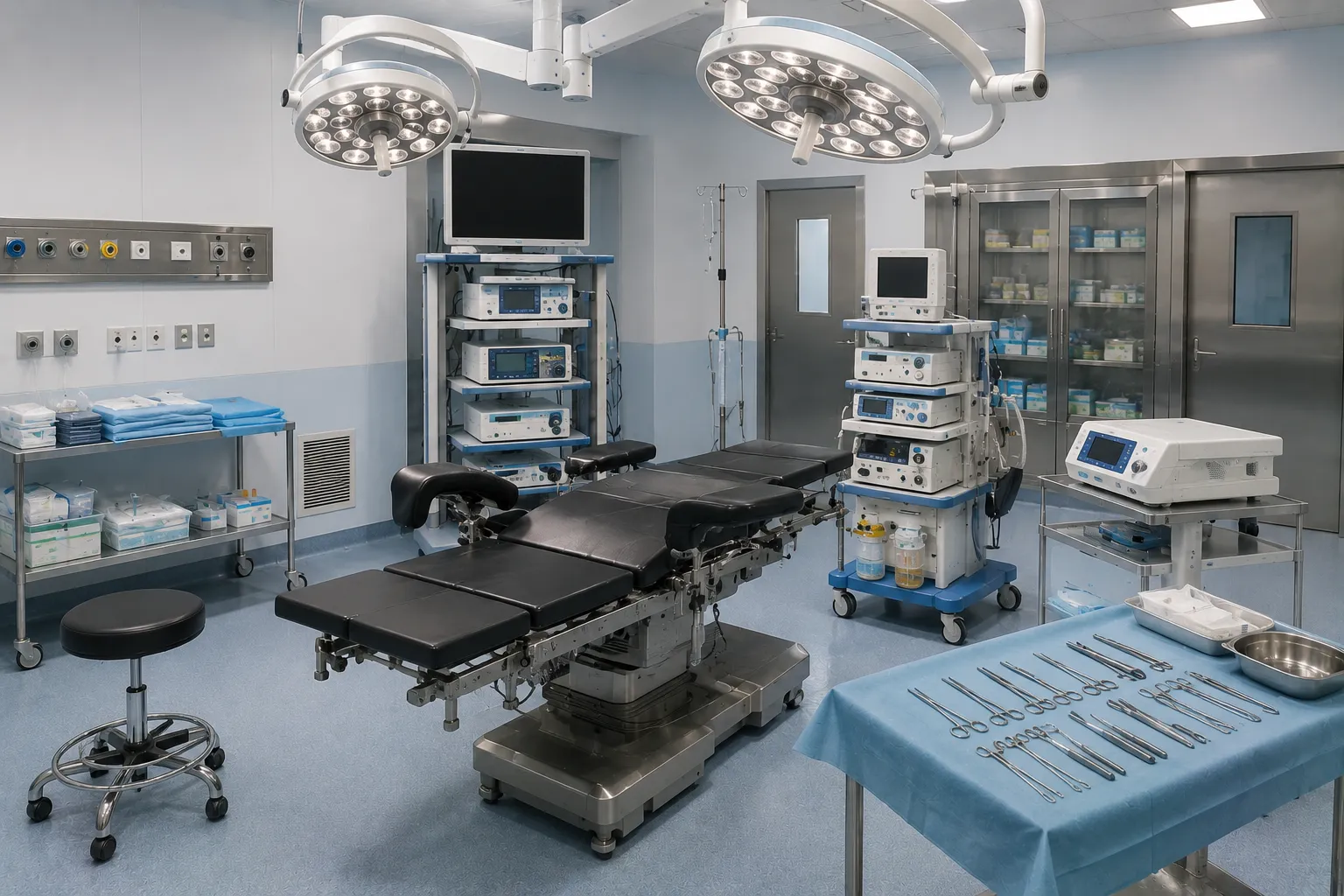
Introduction
Colorectal surgery covers operations on the colon, rectum and anus, from resections for cancer and inflammatory disease to procedures for benign conditions. A large share of this work is now done laparoscopically, and it depends heavily on two things: precise division and sealing of tissue, and reliable joining of bowel with stapling devices. The equipment set reflects that — a strong laparoscopic platform, energy devices and a range of staplers.
Equipping a colorectal theatre means building around minimal-access surgery while keeping the option to convert to open surgery, and ensuring the consumable devices the team relies on are consistently available. This colorectal surgery equipment buyer guide sets out what a theatre needs, how to plan the purchase, and the compliance and support questions worth settling early. It is written for surgical teams, theatre managers, biomedical engineering and procurement across the UK, Europe, the US, the Gulf and South Africa.
What defines colorectal surgery equipment — the short version
-
A laparoscopic platform, because most colorectal resections are now minimal-access.
-
Energy and stapling devices for precise tissue division and reliable bowel joining.
-
Endoscopy support and a clear route to convert to open surgery when needed.
Start with the laparoscopic platform and consumables.
The laparoscopic stack is the anchor, and imaging quality directly affects how safely the surgeon can work in a confined, moving field. A good camera, light source, insufflator and displays are the foundation. But in colorectal surgery,e consumable devices matter as much as capital equipment, because staplers and energy devices are used in almost every case.
That makes device availability a planning issue, not just a purchasing one. A theatre with an excellent stack but an unreliable supply of the right staplers and energy consumables cannot run a list. Plan the capital platform and ongoing consumable supply together, and confirm that the devices the surgical team prefers can be supplied consistently before committing.
What colorectal surgery needs
-
Laparoscopic stack. Camera, light source, insufflator and displays for minimal-access surgery.
-
Energy devices. Sealing and cutting instruments for precise, controlled tissue division.
-
Stapling devices. Linear and circular staplers for resection and anastomosis.
-
Laparoscopic instruments. Graspers, dissectors, scissors and retractors in a full set.
-
Endoscopy access. For on-table assessment and combined procedures where needed.
-
Open surgery instruments. A full open set ready for conversion at any time.
-
Operating table. Movement range and tilt for colorectal positioning and access.
-
Patient monitoring and anaesthesia. Full theatre provision for major abdominal surgery.
The equipment checklist
|
Equipment |
Role in the theatre |
Key selection point |
|
Laparoscopic stack |
Minimal-access surgery |
Image quality; insufflation |
|
Energy devices |
Tissue division and sealing |
Reliability; consumables |
|
Stapling devices |
Resection and anastomosis |
Range; consistent supply |
|
Laparoscopic instruments |
Dissection and handling |
Full set; durability |
|
Open instrument set |
Conversion readiness |
Complete and available |
|
Operating table |
Positioning and access |
Tilt; movement range |
How to plan the purchase
-
Define your case mix; cancer resection, benign and emergency work shape the device set.
-
Choose the laparoscopic platform, then confirm consistent supply of staplers and energy consumables.
-
Keep a full open instrument set ready, because conversion must always be possible.
-
Specify the operating table for the tilt and positioning colorectal access needs.
-
Confirm regulatory approval and documentation for every device before committing.
-
Agree servicing, training and consumable supply with the supplier in writing before the order.
Consumables keep the theatre running.
In colorectal surgery,y the ongoing device supply defines whether a theatre can run reliably. Staplers and energy consumables are used in most cases, so their availability, compatibility with your rm platform, and consistent supply are central to a working service. It is worth confirming, in writing, that the devices your surgeons rely on can be supplied dependably.
Conversion readiness is the other quiet essential. Even a mostly laparoscopic service must be able to convert to open surgery safely and immediately. Hence, a complete open instrument set has to be present and maintained for every case. NICE guidance informs which colorectal procedures a service is expected to provide and the standards around them.
Compliance and documentation
Every device must be approved for the market where it is used — UKCA, CE marking under the EU MDR, FDA clearance or the relevant national approval — with complete, current documentation. Energy and stapling devices are higher-risk and carry stricter evidence requirements, and single-use devices must be correctly documented and traceable. Ask suppliers for certification mapped to your market, confirm ISO quality standards sit behind manufacturing, and check current requirements with the MHRA or your national authority before committing.
Support keeps the theatre running.
-
Consumable supply is critical. Running out of the right stapler or energy device stops a list, so supply reliability matters as much as service.
-
Response times, in writing. Ask what fault response the supplier commits to and whether engineers cover your region.
-
Consumable availability. Confirm consistent supply of staplers and energy-device consumables.
-
Training included. Surgical, nursing and technical staff all need it as teams and devices change.
-
Parts availability. Confirm how long spares for the laparoscopic platform will be supported.
Settle each of these before you commit, and get the answers in writing rather than as verbal assurances.
More from Business
-
Buyers — source compliant, fully documented equipment.
-
Suppliers — list your equipment and reach buyers worldwide.
-
Advertise — promote your products and services to a clinical audience.
-
Business overview — explore everything MediGear offers healthcare organisations.
Disclaimer
This article is for general information only. It does not constitute clinical, procurement, legal or regulatory advice. Equipment requirements for colorectal surgery vary by service, facility, country and market, and change over time. Always confirm current requirements with the relevant authorities, and consult qualified clinical, biomedical engineering, procurement and regulatory professionals for decisions specific to your organisation. medigear.uk accepts no liability for actions taken based on this content.
"Precision through the wall" Colorectal kit that fits.
We supply medical equipment to healthcare organisations across the UK, Europe, the US, the Gulf and South Africa. Everything is genuine, documented and supported, so your theatre operates cleanly and reliably.
Frequently Asked Questions
Colorectal surgery is built around a laparoscopic stack with a a camera, light source, insufflator, and displays, along with energy devices for precise tissue division and stapling devices for resection and anastomosis. It needs a full set of laparoscopic instruments, endoscopy access for on-table assessment, a complete open instrument set for conversion, an operating table with good tilt, and full monitoring and anaesthesia for major abdominal surgery.
Staplers and energy consumables are used in almost every colorectal case, so a theatre with an excellent stack but an unreliable supply of the right devices cannot run a list. That makes consumable availability, platform compatibility and consistency of supply central to a working service, and worth confirming in writing before committing.
Even a mostly laparoscopic service must be able to convert to open surgery safely and immediately if the operation demands it. A complete open instrument set must therefore be present and maintained for every case, so conversion is always possible without delay.
Colorectal surgery uses linear staplers to divide bowel and circular staplers to join it during anastomosis, in a range of sizes to suit the operation. Consistent supply and compatibility with the platform and technique the team uses are the key considerations, alongside correct documentation and traceability of single-use devices.
Yes. Every device must be approved for the market where it is used, correctly classified and fully documented. Energy and stapling devices are higher-risk with stricter evidence requirements, and single-use devices must be correctly documented and traceable. Confirm current requirements with the relevant national authority before committing to any purchase.
Because running out of the right stapler or energy device stops a list, supply reliability matters as much as servicing. Check the committed fault response times and whether engineers cover your region; confirm consistent supply of staplers and energy consumables; ask what training is included; and ask how long spares for the laparoscopic platform will be supported. Get it in writing.