
Introduction
Bronchoscopy lets a clinician look directly inside the airways and, increasingly, sample and treat what they find there. A thin, flexible scope is passed into the lungs to inspect the airway lining, take biopsies, wash and sample tissue, and clear secretions; rigid bronchoscopy, performed under general anaesthesia, handles bigger interventions. Because the scope enters a delicate, non-sterile space and is reused between patients, the equipment picture is defined as much by imaging and reprocessing as by the scopes themselves.
Equipping a bronchoscopy service spans the flexible and rigid scopes, the video stack that displays and records the procedure, endobronchial ultrasound for sampling beyond the airway wall, the sampling and biopsy tools, and the decontamination and reprocessing that keep reusable scopes safe. This bronchoscopy equipment buyer guide sets out what each area needs, how imaging and reprocessing connect, and the infection-control and traceability questions to settle early. It is written for respiratory physicians, endoscopy teams and procurement across the UK, Europe, the US, the Gulf and South Africa.
What a bronchoscopy service needs — the short version
-
Flexible bronchoscopes and a video stack as the core of the service.
-
Endobronchial ultrasound and sampling tools for diagnosis beyond the airway wall.
-
Robust decontamination and reprocessing to keep reusable scopes safe.
Start with the scopes and the video stack.
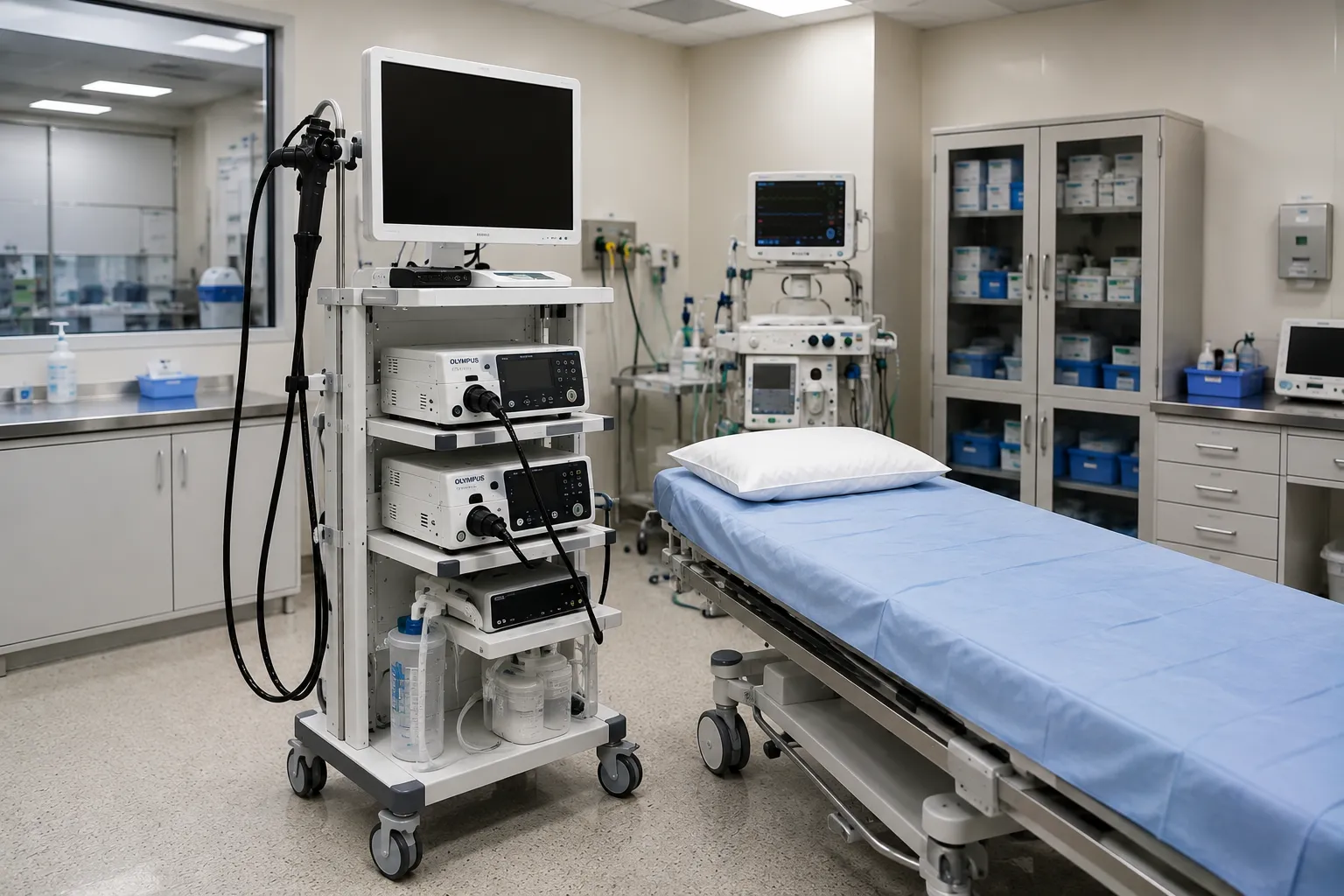
The core of a bronchoscopy service is the flexible bronchoscope and the video system that displays what it sees. A modern service uses video bronchoscopes connected to a processor and light source, giving a clear image on screen for the operator and team and allowing the procedure to be recorded. The number and range of scopes match the service's caseload, and rigid bronchoscopy equipment is added where the service performs larger interventions that require it.
Beyond simply looking, most bronchoscopy is diagnostic, so sampling capability comes next. Endobronchial ultrasound, or EBUS, lets the operator see and sample lymph nodes and lesions beyond the airway wall — central to staging lung cancer — and a range of biopsy and sampling tools collect tissue and fluid. Because scopes are reused, the decontamination and reprocessing equipment is planned alongside them, not afterwards, as an equal part of the service.
What bronchoscopy needs
-
Flexible bronchoscopes. Video scopes for inspection, sampling and airway clearance.
-
Video processor and light source. The stack that displays and records the procedure.
-
Rigid bronchoscopy set. Equipment for larger interventions under anaesthesia.
-
Endobronchial ultrasound. EBUS for sampling nodes and lesions beyond the airway.
-
Sampling and biopsy tools. Forceps, needles, brushes and lavage consumables.
-
Decontamination equipment. Automated reprocessors and drying and storage cabinets.
-
Traceability system. Records linking each scope to each patient and reprocessing cycle.
The equipment checklist
|
Equipment |
Role in the service |
Key selection point |
|
Flexible bronchoscope |
Airway inspection and sampling |
Image quality; channel; range |
|
Video stack |
Display and recording |
Image quality; recording; integration |
|
EBUS |
Sampling beyond the wall |
Image quality; needle compatibility |
|
Sampling tools |
Tissue and fluid collection |
Range; single use; compatibility |
|
Reprocessor |
Decontamination |
Validated cycle; capacity |
|
Storage cabinet |
Safe scope storage |
Drying; controlled conditions |
Sampling beyond the airway wall
Much of the value of modern bronchoscopy lies in reaching beyond what the eye can see. Endobronchial ultrasound places an ultrasound probe at the tip of the scope, so the operator can image lymph nodes and lesions next to the airway and pass a needle into them under guidance. This is central to diagnosing and staging lung cancer, turning bronchoscopy from an inspection into a precise sampling procedure. Planning EBUS and its needles alongside the scopes lets a service offer this diagnostic reach.
Decontamination and traceability
Because bronchoscopes are reused and enter the lungs, decontamination is not a background task but a core requirement. Automated reprocessors clean and disinfect scopes to a validated standard, drying and storage cabinets keep them safe between uses, and a traceability system records which scope was used for which patient through which reprocessing cycle. This chain protects patients and is essential for investigating any concern, so it is specified with the same care as the scopes and imaging.
Compliance and documentation
Bronchoscopy equipment must be genuine, current and fully documented, and scope reprocessing carries specific standards. In the UK, the MHRA regulates medical devices, and NICE publishes clinical guidance. ISO maintains international standards for medical devices. Requirements vary by country and market, so confirm current obligations with the relevant authorities before you buy.
Support keeps a bronchoscopy service running.
-
Installation, commissioning and clinical familiarisation for scopes, stacks and EBUS.
-
Preventive maintenance and repair that keep delicate scopes in service.
-
Reliable supply of sampling tools, reprocessing chemistry and consumables.
-
Rapid technical response, because a scope out of action limits the list.
-
Clear documentation and traceability for scopes, reprocessing and every procedure.
More from Business
-
Buyers — source compliant, fully documented equipment.
-
Suppliers — list your equipment and reach buyers worldwide.
-
Advertise — promote your products and services to a clinical audience.
-
Business overview — explore everything MediGear offers healthcare organisations.
Disclaimer
This article is for general information only. It does not constitute clinical, procurement, legal or regulatory advice. Equipment requirements for bronchoscopy vary by service, caseload, facility, country and market, and change over time. Scope decontamination and reprocessing are separately governed and require specialist input. Always confirm current requirements with the relevant authorities, and consult qualified clinical, endoscopy, biomedical engineering, procurement and regulatory professionals for decisions specific to your organisation. medigear.uk accepts no liability for actions taken based on this content.
"See the airway, sample with precision." A bronchoscopy service equipped end to end.
We supply medical equipment to healthcare organisations across the UK, Europe, the US, the Gulf and South Africa. Everything is genuine, documented and supported, so your bronchoscopy service investigates and samples safely.
Frequently Asked Questions
A bronchoscopy service needs flexible video bronchoscopes and a video stack—processor and light source—as its core, with rigid bronchoscopy equipment for larger interventions. It needs endobronchial ultrasound for sampling beyond the airway wall, a range of biopsy and sampling tools, and robust decontamination and reprocessing equipment, along with a traceability system linking each scope to each patient and cycle.
Endobronchial ultrasound, or EBUS, places an ultrasound probe at the tip of the bronchoscope so the operator can image lymph nodes and lesions next to the airway and pass a needle into them under guidance. It is central to diagnosing and staging lung cancer, turning bronchoscopy from inspection into precise sampling. Planning EBUS and its needles alongside the scopes gives a service this diagnostic reach.
Bronchoscopes are reused and enter the lungs, so decontamination is a core requirement rat, notackground task. Automated reprocessors clean and disinfect scopes to a validated standard, drying and storage cabinets keep them safe between uses, and a traceability system records which scope was used for which patient through which cycle. This chain protects patients and is essential for investigating any concern.
Flexible bronchoscopy uses a thin, steerable video scope to inspect the airways, take samples and clear secretions, usually with sedation. Rigid bronchoscopy uses a straight metal scope under general anaesthesia and is suited to larger interventions, such as managing bleeding or clearing an obstruction. Many services provide both, matched to the range of procedures they perform.
Yes, and reprocessing carries specific standards. Scopes, reprocessing and procedures should be genuine, current and traceable. In the UK, the MHRA regulates devices, NICE provides clinical guidance, and ISO maintains international device standards. Requirements vary by country and market, so confirm current obligations with the relevant authorities before purchasing.
Yes. MediGear supplies medical equipment to healthcare organisations across the UK, Europe, the US, the Gulf and South Africa. As a distributor,, we provide genuine, documente,d and supported equipment, from flexible and rigid scopes and video stacks to EBUS, sampling tool,s and reprocessing equipment. Requirements differ by service and market, so we work with your team to match equipment to your service and its regulatory setting.