
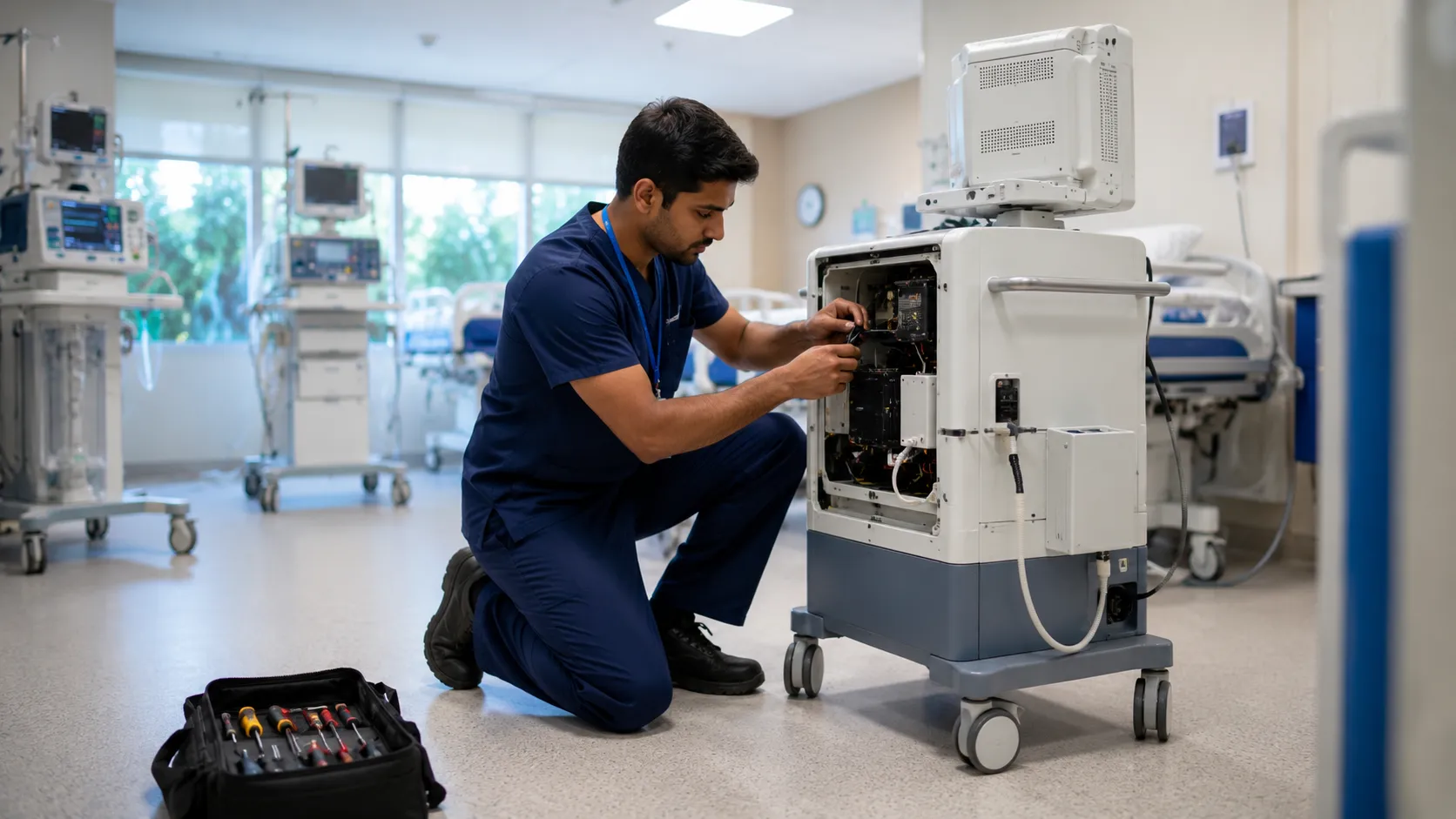
Introduction
When critical equipment fails unexpectedly, care is disrupted, and running costs rise. Predictive maintenance offers a smarter alternative — using sensor data and analytics to service devices based on their real condition, just before problems occur, rather than on a fixed schedule or after a breakdown.
This guide explains what predictive maintenance is, how it differs from reactive and preventive approaches, how it works in practice, why it matters for hospital equipment, and the benefits and challenges — so you can see where it fits in keeping equipment reliable.
What predictive maintenance is
Predictive maintenance uses sensor data and analytics to service medical equipment based on its actual condition, rather than on a fixed schedule or only after it breaks. Sensors monitor how a device is performing — usage hours, temperature, vibration, error log,s and more — and software predicts when a fault is likely to occur. Hence, maintenance happens just before a problem occurs. The goal is maximum uptime with minimum unnecessary servicing.
It marks a shift from two older approaches: reactive maintenance, which fixes equipment after it fails, and preventive maintenance, which services equipment on a fixed calendar, regardless of whether the device needs it. Predictive maintenance aims to get the timing right — neither too early nor too late.
Reactive, preventive and predictive compared
|
Approach |
How it works |
Upshot |
|
Reactive |
Fix it after it breaks |
Maximum downtime, emergency cost |
|
Preventive |
Service on a fixed schedule |
Some waste, but fewer surprises |
|
Predictive |
Service based on real condition data |
Minimum downtime, right-time servicing |
How it works in practice
-
Sensors collect data. Connected devices continuously report performance metrics — usage, temperature, vibration, error patterns — often over the Internet of Things.
-
Analytics spot patterns. Software analyses the data stream to detect early warning signs of wear, drift or impending fault.
-
Models predict failure. Algorithms estimate when a component is likely to fail, giving maintenance teams a window to act.
-
Teams intervene early. Engineers service the device before it fails, ordering parts and scheduling work with minimal disruption.
Keeping equipment running?
We help hospitals and clinics source dependable, supported medical equipment across the UK, Europe, the US, the Gulf and South Africa — with service and parts behind it.
No pressure, no obligation. → Talk to the team
Why it matters for hospital equipment
-
Less downtime. Fewer unexpected breakdowns keep critical equipment available when patients need it most.
-
Lower running costs. Servicing only when needed avoids both emergency call-outs and unnecessary planned maintenance visits.
-
Longer equipment life. Catching problems early and servicing at the right time extends the useful life of devices.
-
Safer, more reliable care. Dependable equipment supports patient safety, smoother clinic lists and better clinical workflows.
-
Smarter parts planning. Predicting which parts will be needed lets teams stock and order efficiently, reducing rush orders.
Benefits and challenges
Benefits — more uptime, lower maintenance running costs, longer equipment life and safer, more reliable care. For high-value or critical devices — imaging systems, ventilators, analysers — avoiding unexpected failure has clear clinical and financial value.
Challenges — predictive maintenance needs connected equipment with sensors, data analytics capability and integration with the maintenance management system. Not all devices support it yet, data quality matters, and there is an investment in technology and skills. Many organisations start with their most critical or costly equipment, where the payback is clearest, and expand from there.
More from Business
-
Buyers — source equipment from a worldwide supply base for your facility.
-
Suppliers — reach healthcare buyers in growing markets worldwide.
-
Advertise — promote your products and services to a clinical audience.
-
Business overview — explore everything MediGear offers healthcare organisations.
Disclaimer
This article is for general information only and does not constitute financial, investment, commercial, procurement or regulatory advice. It describes general industry trends and practices, which vary by organisation, market and over time, and any figures mentioned are indicative estimates drawn from publicly available sources. Always confirm the device class and certification for your market, and consult qualified procurement, clinical, biomedical engineering and professional advisers before making commercial decisions. medigear.UK accepts no liability for actions taken based on this content.
Equip with reliability in mind.
From a worldwide supply base to your facility, we help hospitals and clinics across the UK, Europe, the US, the Gulf and South Africa source dependable, supported medical equipment — with service and parts behind it.
Frequently Asked Questions
Predictive maintenance uses sensor data and analytics to service medical equipment based on its actual condition rather than a fixed schedule or after failure. Sensors monitor performance, software predicts when a fault is likely to occur, and maintenance occurs just before a problem occurs.
Preventive maintenance services equipment on a fixed calendar regardless of condition, while predictive maintenance uses real-time data to service just before a likely failure—predictive aims to avoid both unnecessary planned servicing and unexpected breakdowns by timing interventions correctly
Connected devices report performance data continuously. Software analyses it to spot early warning signs and predict when a component is likely to fail, so maintenance teams can intervene at the right moment, order parts and schedule work with minimal disruption.
Benefits include less downtime, lower maintenance and running costs, longer equipment life, safer, more reliable care, and smarter parts planning. For critical equipment, avoiding unexpected failures keeps devices available and reduces emergency call-outs.
No. Predictive maintenance needs connected equipment with sensors and data capability. Many organisations start with their most critical or costly equipment — imaging, ventilators, analysers — where uptime matters most and the payback is clearest.
For critical or high-value equipment where downtime is disruptive, predictive maintenance often pays back through more uptime, lower servicing costs and longer equipment life. The value is clearest where unexpected failure has a real clinical or financial impact.