
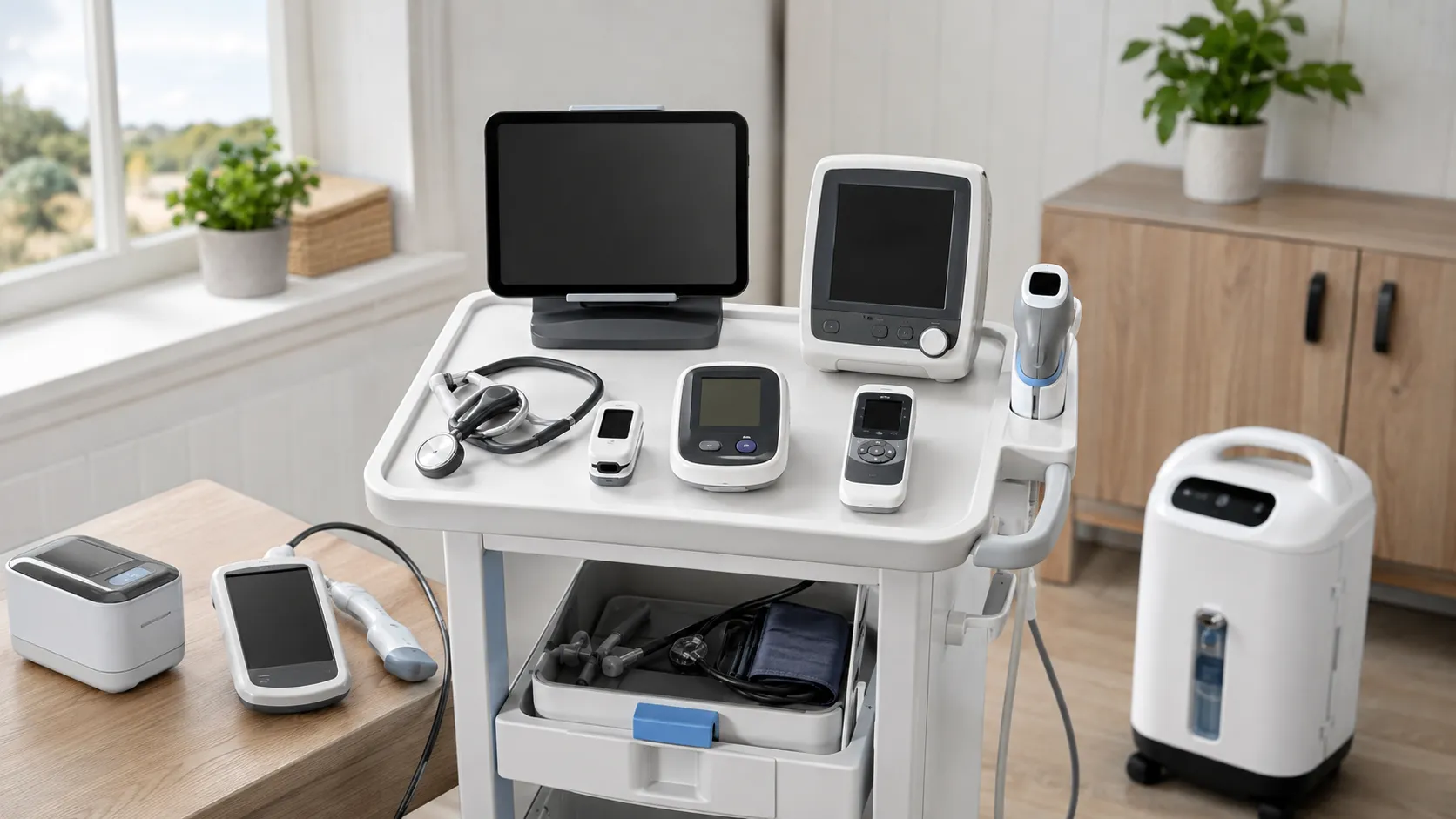
How devices will support remote care
Remote care lets a clinician and patient work together across distance, often between a home and a hospital or clinic. It depends on devices that can capture, transmit and support that exchange dependably. Home-use monitors send readings back to the care team. A connected diagnostic kit lets tests be done outside a central setting. And telehealth equipment supports consultation itself, from cameras and audio to the systems behind them. This article explains how future medical devices will support remote care, and what buyers should look for. The direction is already clear. Trust must reach both ends of the link for care to work as it should for the patient at home.
Devices that make distance work
It is easy to think of remote care as mainly software or a video call. In practice, it depends on devices: the kit that captures information from a patient, the diagnostics that produce reliable results outside a central setting, and the equipment that supports consultation itself. Devices are what make distance work in care today. Without dependable equipment at both ends, remote care becomes far less useful than it can be in practice.
This is different from the wider question of how hospitals support people at home, because it focuses specifically on the devices that enable remote exchange. Bodies that work on medical devices recognise how important safe, appropriate equipment is here, and the World Health Organisation's work on medical devices reflects it. For a buyer, the useful question is which devices genuinely enable remote care in practice, and how well they can be trusted at both ends of the link. Practical devices matter. Both ends need trust to work well together at a distance in real care over any link.
"Remote care is not just a video call. It is dependable devices working at both ends of a distance."
Home-use monitoring devices
A central category is monitoring devices that can be used by patients at home and send readings back to the care team. Blood pressure, heart rhythm, respiratory and other monitors that are easy to use and connect cleanly can support ongoing remote care. This is where much of the practical value of remote care sits, because it gives the care team a real picture between contacts.
For buyers, this raises the value of home-use monitoring that is easy to use, comfortable and reliable, with data that flows cleanly back to the record. Equipment that patients can use well themselves, and staff can trust the output of, fits this direction. Home-use monitoring is only useful when both patient and clinician can rely on it in daily practice. Ease of use is essential to trust. Reliable readings matter to care and to the safety of the patient at home and beyond.
Connected diagnostic kit at a distance
Some diagnostic tests can be done outside a central setting, using a connected kit that reports results back. This can support remote care by bringing testing closer to the patient without losing the link to clinical decision-making. It is close to point-of-care testing but shaped specifically for connection back to care that is happening remotely.
For buyers, this makes reliability, ease of use and connection central to a remote diagnostic kit. Equipment that produces trustworthy results outside a central setting, and shares them cleanly, supports remote care well. Fragile equipment, hard to use or badly connected offers much less. As with home monitoring, the value depends on being trusted at both ends of the link. Results must reach cleanly. Trust follows reliability in results from any source of data in remote care that reaches back.
Telehealth consultation equipment
Consultation itself needs equipment: cameras, audio, screens and the supporting systems that make a remote conversation clear and useful. Equipment that supports good, dependable telehealth consultation makes remote care feel like real clinical contact rather than a poor substitute. Small improvements in clarity and reliability can matter a great deal.
For buyers, this makes telehealth equipment part of the remote care picture, alongside monitors and diagnostics. Software and connected consultation tools are increasingly considered within digital health frameworks, such as the FDA Digital Health Centre of Excellence. Equipment that supports clear, dependable consultation and integrates cleanly with the wider system supports the value remote care can deliver. Clarity supports the exchange. Reliability keeps it real for both sides.
Reliable connection at both ends
None of this works without reliable connection between the patient and the care team. Devices that connect cleanly, on open standards, and cope with the connection conditions they may meet are far more useful than devices that assume ideal networks. Reliable connection is not a specialist concern but a central one for remote care equipment.
For buyers, this raises the importance of choosing devices that connect well in the real world. Equipment that copes with real connection conditions and shares data on recognised standards supports remote care dependably. Equipment that struggles with poor networks or locks a hospital into one supplier fits less well. Connection is part of whether remote care equipment truly delivers. Networks vary widely. Real conditions matter greatly here in remote settings, whatever they are in the setting of care.
Trust at both ends of the link
Remote care equipment carries a specific challenge: it has to be trusted at both ends of the link. Patients need to use devices well at home, and clinicians need to trust what they receive. So the equipment behind remote care is judged not only on what it does, but on how much confidence it supports on both sides.
For buyers, this makes ease of use and reliability inseparable from technical function. Devices that are dependable, easy to use, cleanly connected and clearly designed for their purpose support the trust remote care depends on. Equipment that undermines trust at either end, however clever, does more harm than good. Remote care equipment stands or falls on the confidence it earns. Trust is central here. Neither side can be lost, patient or clinician, in remote care that works in practice for both sides.
What buyers should really be asking
-
Easy home use? Can patients use monitoring devices well and comfortably themselves?
-
Trustworthy at a distance? Do diagnostic and monitoring devices produce reliable data?
-
Good telehealth? Does consultation equipment support clear, dependable remote contact?
-
Reliably connected? Do devices connect well on open standards in real conditions?
What buyers should take from this
How future medical devices will support remote care comes down to dependable equipment at both ends of a distance: home-use monitors patients can trust and use well, connected diagnostic kit that produces reliable results outside a central setting, telehealth consultation equipment that makes remote contact feel like real clinical care, and reliable connection tying it all together. The horizon work that informs this, such as the WHO horizon scan of emerging health technologies, exists to make such foresight ordinary rather than rare.
Underneath every trend sits one unchanging requirement. Remote care devices are only worth having if they are genuine, approved and reliable, and can be trusted at both ends of the link. The fundamentals of sound equipment outlast every shift in fashion. So the wise approach is to equip remote care with devices that earn trust in practice, built on equipment that is dependable in the first place. Curious about care across distance, firm about what has always mattered.
More from Business
-
Buyers — source approved, well-documented equipment.
-
Suppliers — list your equipment and reach buyers worldwide.
-
Advertise — promote your products and services to a clinical audience.
-
Business overview — explore everything MediGear offers healthcare organisations.
Disclaimer
This article is for general information only and does not constitute clinical, procurement, regulatory or legal advice. The examples given are illustrative. Trends in medical equipment are general directions, not certainties, and their pace and relevance vary by market and setting. Requirements and standards change over time and should always be confirmed with the relevant authorities. Always consult qualified clinical, biomedical engineering and procurement professionals for decisions specific to your organisation. medigear.uk accepts no liability for actions taken based on this content.
Buy for the future, built on the basics.
Genuine, approved, fully documented medical equipment — the dependable foundation every future trend still rests on, wherever you work.
Frequently Asked Questions
Future medical devices will support remote care by capturing, transmitting and supporting clinical work across distance. Home-use monitoring devices send readings back from the patient, connected diagnostic kit produces reliable results outside a central setting, and telehealth consultation equipment supports the remote conversation itself. Reliable connection ties it together. All of this depends on equipment that can be trusted at both ends of the link, so patients can use it well and clinicians can trust the output.
Home-use monitoring devices are equipment patients use at home to capture information such as blood pressure, heart rhythm or respiratory measurements, sending readings back to the care team. They give the care team a real picture between contacts and are where much of the practical value of remote care sits. For buyers, they should be easy to use, comfortable and reliable, with data that flows cleanly back to the record.
Remote care focuses specifically on the devices that enable clinical exchange across distance, whereas home care support is a broader idea about helping people live well at home. Remote care depends on devices that capture, transmit and support consultation, connecting patients and clinicians who are physically apart. The equipment is judged on how well it enables that exchange, so both ends of the link can rely on it in practice.
Telehealth consultation equipment is the cameras, audio, screens and supporting systems that make a remote conversation between clinician and patient clear and useful. It supports remote care by making consultation feel like real clinical contact rather than a poor substitute. Small improvements in clarity and reliability can matter a great deal, so equipment that supports clear, dependable consultation and integrates cleanly with wider systems adds real value.
None of remote care works without reliable connection between the patient and the care team. Devices that connect cleanly on open standards, and cope with the connection conditions they may meet, are far more useful than devices that assume ideal networks. Connection is a central concern for remote care equipment rather than a specialist one, so buyers should choose devices that connect well in real-world conditions and share data on recognised standards.
Remote care equipment has to be trusted at both ends of the link: patients need to use devices well at home, and clinicians need to trust the information they receive. So the equipment is judged on how much confidence it supports on both sides, not just on what it does technically. Devices that are dependable, easy to use, cleanly connected and clearly designed for their purpose support the trust remote care depends on.