
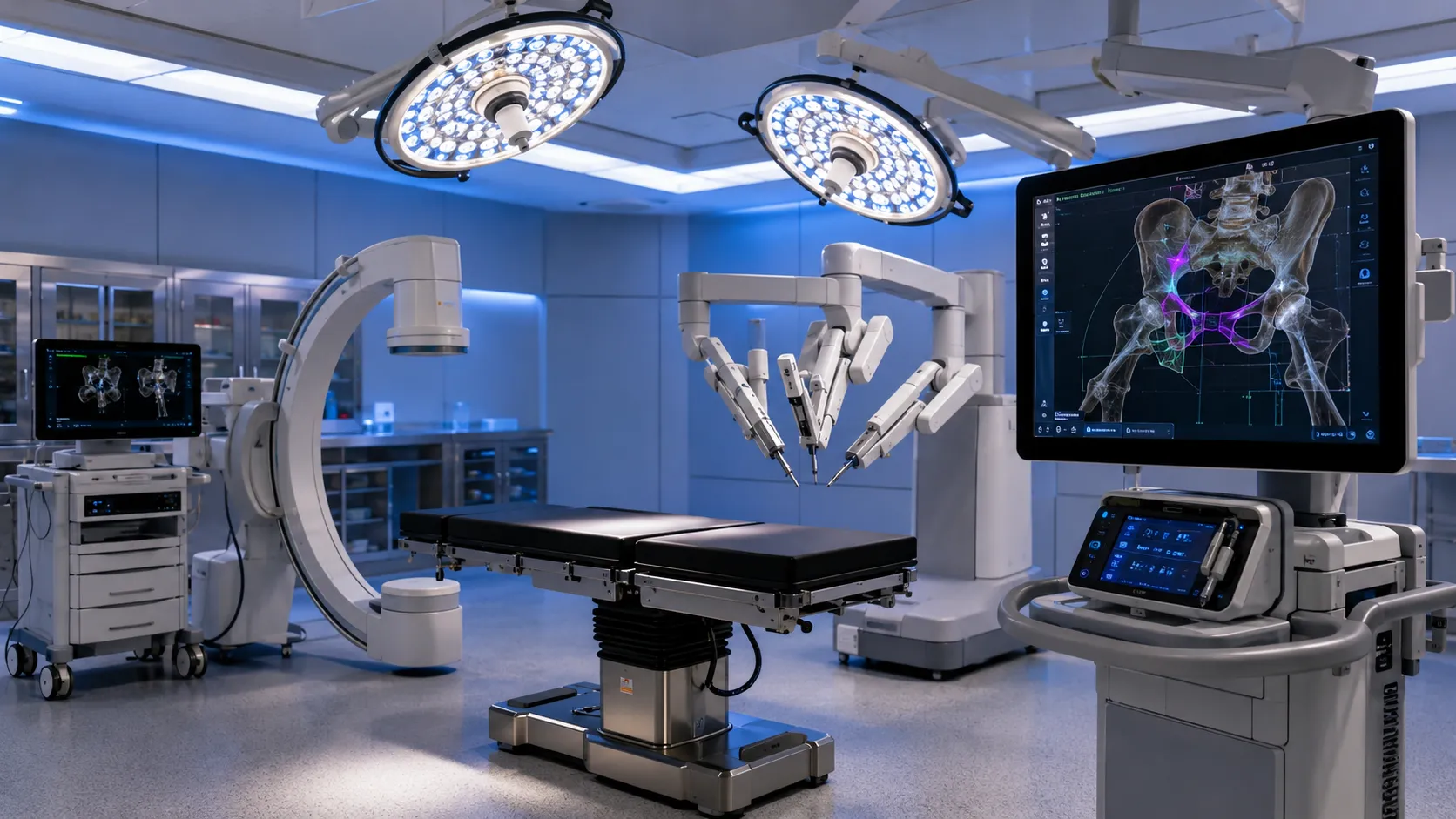
How augmented reality changes surgical equipment
Augmented reality places useful information into a surgeon's field of view, overlaying guidance onto the real world rather than replacing it. As it develops, it changes the equipment a surgical team needs around them. The technology can support navigation during an operation, help with planning beforehand, and improve training. This article explains how augmented reality will change surgical equipment. It sets out where the technology fits, what it means for the theatre, and what hospitals should consider when they plan and buy for surgery. The direction is already clear. Guidance moves closer to the work.
Information placed into the surgeon's view
It is easy to imagine augmented reality as a novelty. The useful way to see it is as a new layer of information for the surgical team. Instead of looking away at a separate screen, a surgeon can have relevant guidance placed into their view. That changes how surgical equipment presents information, and it changes what the equipment around an operation is expected to do. The direction is towards guidance that is closer to the work, not further from it. The surgeon keeps control. The tool supports the view.
This shift is worth understanding early, because the direction is clear even where the detail is still developing. Health bodies track this kind of technology as it matures, and the World Health Organisation's foresight work on emerging technologies exists to anticipate it. For a hospital, the useful question is not whether augmented reality will affect its surgical equipment, but where it fits first, and how well it works with everything else in the theatre.
"Augmented reality does not replace the surgeon's view. It adds a layer of guidance to it."
Guidance and navigation during surgery
The clearest use of augmented reality in surgery is guidance. By overlaying information onto the surgeon's view, it can help show where to work and support navigation during an operation. This connects to the imaging and navigation equipment a theatre already uses, extending it rather than replacing it. The aim is to bring useful information closer to the point of action. Guidance sits near the work. Distraction falls away.
For buyers, this means augmented reality is best understood as part of the wider guidance and imaging picture, not a standalone gadget. Equipment that helps place accurate, useful guidance into the surgeon's view, and works with existing imaging, fits the direction of travel. The value lies in supporting the surgeon's judgement, not in the novelty of the display. Accuracy and reliability come first. Guidance must be trusted. Novelty is not the point.
Planning before the operation
Augmented reality also has a role before surgery begins. It can help a team plan an operation by visualising a patient's anatomy more richly, drawing on imaging already gathered. Better planning can support a smoother, more considered procedure. This links augmented reality to the imaging and planning equipment a hospital already relies on. Preparation shapes the outcome. Scans guide the plan.
So its value is not only in the theatre but in the preparation around it. Equipment that helps a team plan clearly, using the imaging they already have, fits this direction. For a hospital, this makes augmented reality part of a wider planning and imaging capability rather than a single device. Planning is where much of the benefit can begin. Preparation shapes the outcome. Good planning pays off.
Training the surgical team
Training is one of the most valued uses of augmented reality. It can let surgeons and teams practise and learn in a rich, visual way, supporting skill and confidence before and between operations. This is a distinct benefit from its use during surgery, and an important one, because skilled teams are central to good outcomes. Practice builds skill. Confidence follows.
For buyers, this widens where augmented reality equipment earns its keep. Its value may lie as much in preparation and training as in live procedures. Responsible routes exist to evaluate promising tools as evidence grows, such as the NICE Early Value Assessment for promising health technologies. Equipment that supports training well is part of building a capable surgical team, which matters as much as any single device. Skilled teams drive outcomes. Practice builds confidence.
Fitting into the theatre
Augmented reality does not work in isolation. It has to fit into a theatre that already contains a great deal of equipment, and it depends on good information to be useful. So how well it integrates with existing imaging, navigation, and systems matters as much as what it can do on its own. A display that cannot connect cleanly becomes an island in a busy theatre. Integration is essential. Standards make it work.
The question behind this is about integration and standards. Does the equipment work with what the theatre already uses, drawing on existing imaging and connecting cleanly? Software and display tools like these are increasingly considered within digital health frameworks, such as the FDA Digital Health Centre of Excellence. Equipment that integrates well keeps fitting as the theatre evolves, while equipment that stands apart may add complexity rather than clarity. Integration is the test. Isolation is a drawback.
Accuracy and reliability above all
In surgery, accuracy and reliability come before everything. Guidance placed into a surgeon's view is only helpful if it is accurate and dependable, because misleading information would be worse than none. So augmented reality equipment is judged, above all, on whether it can be trusted completely in a high-stakes setting. Trust is the test. Nothing less will do. Reliability decides it. Focus stays on the patient.
This keeps the focus where it belongs. New capabilities matter only if they are delivered through equipment that is genuine, approved and reliable. Guidance, planning and training all add value, but only on a foundation of accuracy and trust. For a hospital, the honest question is whether augmented reality genuinely helps the surgeon work more safely and effectively, delivered through equipment that can be relied on. Trust comes first. Safety is the measure.
What buyers should really be asking
-
Accurate and reliable? Can the guidance it places into the surgeon's view be trusted completely?
-
Well integrated? Does it work with existing imaging, navigation and theatre systems?
-
Useful beyond surgery? Does it support planning and training, not only live procedures?
-
Genuinely helpful? Does it help the surgeon work more safely, not just add a display?
What buyers should take from this
Augmented reality is not a novelty for the theatre. It is a new layer of guidance for surgical teams, with real uses in navigation during surgery, planning beforehand and training. A hospital considering it is really asking how to bring useful information closer to the surgeon, through equipment that integrates well and can be trusted. The horizon work that tracks such shifts, including the WHO horizon scan of emerging health technologies, exists to make that foresight ordinary rather than rare.
Underneath every trend sits one unchanging requirement. Augmented reality equipment is only worth having if it is genuine, approved and reliable, and if the guidance it provides can be trusted in a high-stakes setting. The fundamentals of sound equipment outlast every shift in fashion. So the wise approach is to read where augmented reality is taking surgery, and to build on equipment that is dependable in the first place. Curious about what is coming, firm about what has always mattered.
More from Business
-
Buyers — source approved, well-documented equipment.
-
Suppliers — list your equipment and reach buyers worldwide.
-
Advertise — promote your products and services to a clinical audience.
-
Business overview — explore everything MediGear offers healthcare organisations.
Disclaimer
This article is for general information only and does not constitute clinical, procurement, regulatory or legal advice. The examples given are illustrative. Trends in medical equipment are general directions, not certainties, and their pace and relevance vary by market and setting. Requirements and standards change over time and should always be confirmed with the relevant authorities. Always consult qualified clinical, biomedical engineering and procurement professionals for decisions specific to your organisation. medigear.uk accepts no liability for actions taken based on this content.
Buy for the future, built on the basics.
Genuine, approved, fully documented medical equipment — the dependable foundation every future trend still rests on, wherever you work.
Frequently Asked Questions
Augmented reality places useful information into a surgeon's field of view, overlaying guidance onto the real world. This changes surgical equipment by supporting navigation during an operation, helping teams plan beforehand using existing imaging, and improving training. It connects to the imaging and navigation equipment a theatre already uses, extending it rather than replacing it, so its value lies in supporting the surgeon's judgement, delivered through accurate, reliable equipment.
Augmented reality in surgery places relevant information into the surgeon's field of view, overlaying guidance onto the real world rather than replacing it. Instead of looking away at a separate screen, a surgeon can have guidance placed into their view. It can support navigation during an operation, help with planning beforehand, and improve training, drawing on imaging the hospital already gathers.
No. Augmented reality works with existing imaging and navigation equipment rather than replacing it, extending how that information is presented to the surgeon. It depends on good imaging to be useful, so integration matters as much as the display itself. Equipment that connects cleanly with what the theatre already uses fits the direction of travel, while a display that cannot integrate adds complexity rather than clarity.
Augmented reality can let surgeons and teams practise and learn in a rich, visual way, supporting skill and confidence before and between operations. This is a distinct and valued use, separate from guidance during surgery, because skilled teams are central to good outcomes. For hospitals, it means augmented reality equipment can earn its keep in preparation and training as much as in live procedures.
In surgery, accuracy and reliability come before everything, because guidance placed into a surgeon's view is only helpful if it can be trusted completely. Misleading information would be worse than none. So augmented reality equipment is judged above all on whether it is accurate and dependable in a high-stakes setting, with new capabilities mattering only if they are delivered through genuine, approved and reliable equipment.
Hospitals should ask whether the guidance augmented reality provides is accurate and reliable, whether it integrates with existing imaging and theatre systems, whether it supports planning and training as well as live surgery, and whether it genuinely helps the surgeon work more safely. Because surgery is high-stakes, accuracy and trust come first, so augmented reality is best planned as part of the wider imaging and guidance picture, not as a standalone gadget.