
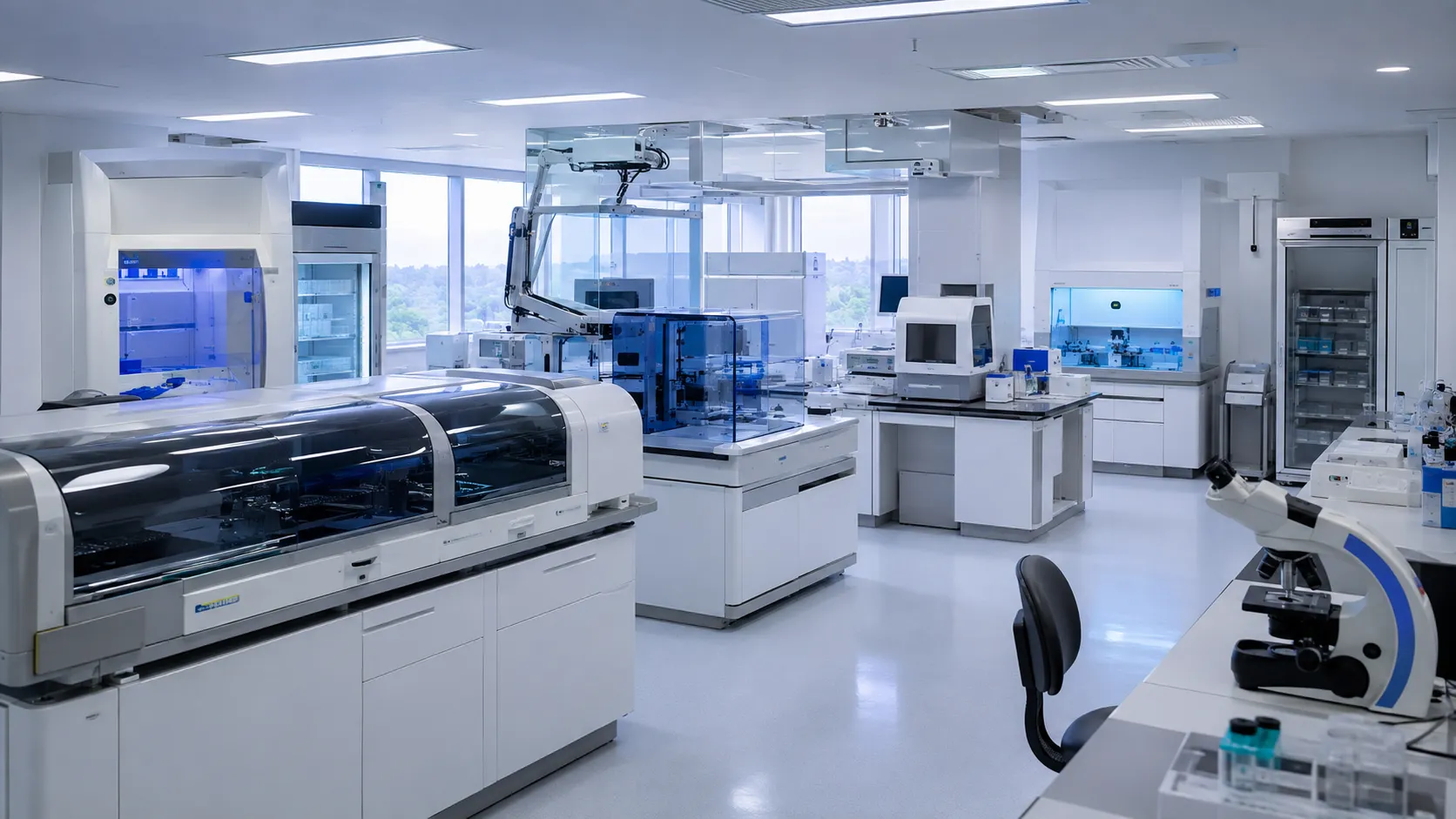
How laboratory equipment is changing
The hospital laboratory does much of the quiet work behind diagnosis and treatment, and its equipment is changing steadily. Laboratories are becoming more automated, handling higher volumes with less manual effort. They are becoming more connected, with equipment and results flowing into shared systems. Software is helping to interpret and manage what the lab produces. And some testing is moving out of the central lab towards the point of care. This article explains the main trends shaping the future of laboratory equipment in global hospitals. It sets out what they mean for the people who plan, buy and run it. The direction is clear enough to plan around.
The laboratory evolves, it does not stand still
It is easy to think of the laboratory as a fixed, traditional part of the hospital. In fact it is changing as much as any department. Automation is reducing manual handling and speeding results. Connection is linking equipment and results into shared systems. Molecular and advanced testing is expanding what the lab can detect. And software is helping manage the growing volume and complexity. These shifts change what a hospital should look for when it equips a laboratory. The basis of the choice is shifting.
None of this removes the need for skilled laboratory staff or reliable core equipment. It changes how the lab works and what its equipment must do. That raises the bar for its equipment. The lab keeps evolving, and its role keeps growing. Bodies that scan the horizon for healthcare broadly agree on the direction, and the World Health Organisation's foresight work on emerging technologies exists to make it visible. The trends below are the ones most worth planning around.
"The future of laboratory equipment is more automated, more connected and smarter — even as testing spreads beyond the lab."
Automation and higher throughput
The clearest trend is automation. Equipment increasingly handles sample processing and analysis with less manual effort, letting laboratories manage higher volumes reliably. This reduces repetitive work, speeds results and can improve consistency. It shapes the equipment a lab needs, from automated analysers to sample-handling systems. Volume drives the design. Consistency improves as well.
For buyers, this raises questions of scale and fit. How much automation does the laboratory's volume justify? How reliable and well supported is the equipment, since a stoppage affects the whole hospital? Automation is a significant investment, so it should match the workload and be dependable enough to run intensively. Over-buying helps no one. Match it to real demand, and scale to the workload. Planning it means matching capability to real demand.
Connected labs and flowing data
A result is only useful when it reaches the right place quickly. So connection is central to the future laboratory. Equipment that feeds results into shared systems removes manual copying, reduces error, and lets results reach clinicians without delay. A device that keeps its data to itself slows the whole pathway. Results must flow to help. Delay costs time and safety. Speed is part of care.
The question behind this is about standards. Does the equipment connect on open, recognised ones, so results flow cleanly between systems and makers? Equipment that connects well keeps fitting as the hospital's systems evolve. Equipment that locks data away becomes a bottleneck. Connection is now a core requirement for laboratory equipment, not a bonus feature. Data that cannot move is wasted. Open standards keep it flowing.
Molecular and advanced testing
Laboratories are increasingly able to detect and analyse at the molecular level, expanding what a hospital can diagnose. This growth in molecular and advanced testing supports areas such as precision and personalised care, and it brings new equipment into the lab. The range of what a laboratory can offer keeps widening. New tests open new answers. Detection gets finer over time.
For buyers, this means the equipment list is broadening beyond traditional analysis. Deciding which advanced capabilities to bring in-house, and which to keep specialised, becomes a real planning question. Advanced testing equipment can be a strong investment where demand justifies it, but it should be chosen to match the hospital's role and the testing it genuinely needs. Fit matters more than breadth. Match capability to the role. Not every lab needs everything.
Software that manages complexity
As volume and complexity grow, software becomes more important in the laboratory. Intelligent tools can help manage workflow, flag results that need attention, and support quality. This is a much-discussed part of the trend, and the most misread, because it is easy to assume the software replaces the laboratory scientist. It does not. It supports the skilled scientist.
The settled direction is that these tools support skilled staff rather than replace them. They help manage the load and highlight what matters, while judgement and oversight stay human. Responsible routes exist to evaluate such tools as evidence grows, such as the NICE Early Value Assessment for promising health technologies. For a buyer, the honest questions are whether the software genuinely helps the lab work better, and whether its use can be governed. The scientist stays in charge. Oversight remains human.
Efficiency, sustainability and the wider network
Laboratory equipment is increasingly judged on efficiency and sustainability as well as performance. Energy and consumable use, lifespan, and the ability to be maintained and repaired all matter more than before. At the same time, testing is spreading towards the point of care, so the central lab increasingly works as part of a wider network. Testing is spreading out. The lab anchors it.
For buyers, this means planning the laboratory not in isolation but as the hub of a network that reaches towards the bedside and community. Equipment that is efficient, durable and able to connect into that wider picture fits the future better. The central laboratory does not disappear; it takes on the complex, confirmatory work while simpler tests move closer to the patient. Each does what it does best. Together they cover more.
What buyers should really be asking
-
Right level of automation? Does it match the laboratory's real volume, and is it dependable?
-
Connected? Do results flow on open standards into shared systems without delay?
-
The right advanced testing? Do molecular and advanced capabilities match the hospital's role?
-
Efficient and networked? Is equipment durable, and does it fit the wider testing network?
What buyers should take from this
The future of laboratory equipment in global hospitals is a steady move towards labs that are more automated, more connected, capable of more advanced testing and better supported by software, working as the hub of a wider testing network. A hospital that equips a laboratory with this direction in mind avoids kit that ages quickly, and builds a capability that keeps fitting how diagnosis is delivered. The horizon work that informs this, such as the WHO horizon scan of emerging health technologies, exists to make such foresight ordinary rather than rare.
Underneath every trend sits one unchanging requirement. An automated, connected, advanced laboratory is only as good as the equipment it is built on, and that equipment must be genuine, approved and reliable. The fundamentals of sound equipment outlast every shift in fashion. So the wise approach is to read the trends to buy well, without letting them distract from the basics. The hospitals that do best are curious about what is coming and firm about what has always mattered.
More from Business
-
Buyers — source approved, well-documented equipment.
-
Suppliers — list your equipment and reach buyers worldwide.
-
Advertise — promote your products and services to a clinical audience.
-
Business overview — explore everything MediGear offers healthcare organisations.
Disclaimer
This article is for general information only and does not constitute clinical, procurement, regulatory or legal advice. The examples given are illustrative. Trends in medical equipment are general directions, not certainties, and their pace and relevance vary by market and setting. Requirements and standards change over time and should always be confirmed with the relevant authorities. Always consult qualified clinical, biomedical engineering and procurement professionals for decisions specific to your organisation. medigear.uk accepts no liability for actions taken on the basis of this content.
Buy for the future, built on the basics.
Genuine, approved, fully documented medical equipment — the dependable foundation every future trend still rests on, wherever you work.
Frequently Asked Questions
The future of laboratory equipment is a move towards labs that are more automated, more connected, capable of more advanced and molecular testing, and better supported by software. Automation handles higher volumes with less manual effort, results flow into shared systems, and the central lab increasingly works as the hub of a wider network as some testing moves towards the point of care. Efficiency and sustainability are also judged earlier.
Laboratory automation means equipment that handles sample processing and analysis with less manual effort, from automated analysers to sample-handling systems. It lets laboratories manage higher volumes reliably, reduces repetitive work, speeds results and can improve consistency. Because it is a significant investment and a stoppage affects the whole hospital, automation should match the laboratory's real workload and be dependable enough to run intensively.
A result is only useful when it reaches the right place quickly. Laboratory equipment that connects on open standards feeds results into shared systems, removes manual copying, reduces error and speeds the pathway. Equipment that keeps its data to itself becomes a bottleneck. Connection is now a core requirement for laboratory equipment, helping results reach clinicians without delay as the hospital's systems evolve.
No. The clear direction is that intelligent software supports laboratory scientists rather than replacing them. It can help manage workflow, flag results that need attention and support quality, while judgement and oversight stay human. For buyers, the sensible questions are whether the software genuinely helps the laboratory work better and whether its use can be properly governed.
No. As simpler tests move towards the point of care, the central laboratory takes on the complex, confirmatory and advanced work that needs depth and control. The two settings become partners in a wider testing network rather than rivals. This is why laboratory equipment is increasingly planned to connect into that network, giving the right answer in the right place at the right speed.
Hospitals should ask whether automation matches real volume and is dependable, whether results connect on open standards into shared systems, whether advanced and molecular capabilities match the hospital's role, and whether equipment is efficient, durable and fits the wider network. Choosing with these questions in mind, alongside reliability, builds a laboratory capability that keeps fitting how diagnosis is delivered.