
Introduction
Telemedicine extends clinical care beyond the consulting room — to patients at home, remote communities, ambulances and other hospitals. It spans the platforms and cameras used for live video consultations, the remote monitoring devices that track patients outside the hospital, and the diagnostic peripherals and teleICU systems that bring specialist expertise to the bedside from a distance. Understanding those groups helps any service plan, compare options and budget sensibly.
This guide walks through the main types of telemedicine equipment used worldwide, what each does, where it fits, and how to choose — with notes on approval across the UK, the EU, the US, the Gulf (GCC) states, and South Africa.
The short version — telemedicine equipment in three groups
Most telemedicine equipment falls into one of three groups — teleconsultation and video platforms, remote monitoring devices, and diagnostic peripherals and specialist systems.
-
Teleconsultation & video — platforms, cameras and carts that connect clinicians and patients by video.
-
Remote monitoring — wearables, home monitors and connected devices that track patients outside the hospital.
-
Diagnostic peripherals & specialist systems — digital stethoscopes, otoscopes, teleICU and store-and-forward imaging.
Types of telemedicine equipment
-
Teleconsultation platforms. Secure video-consultation software and hardware for remote clinical appointments between patient and clinician.
-
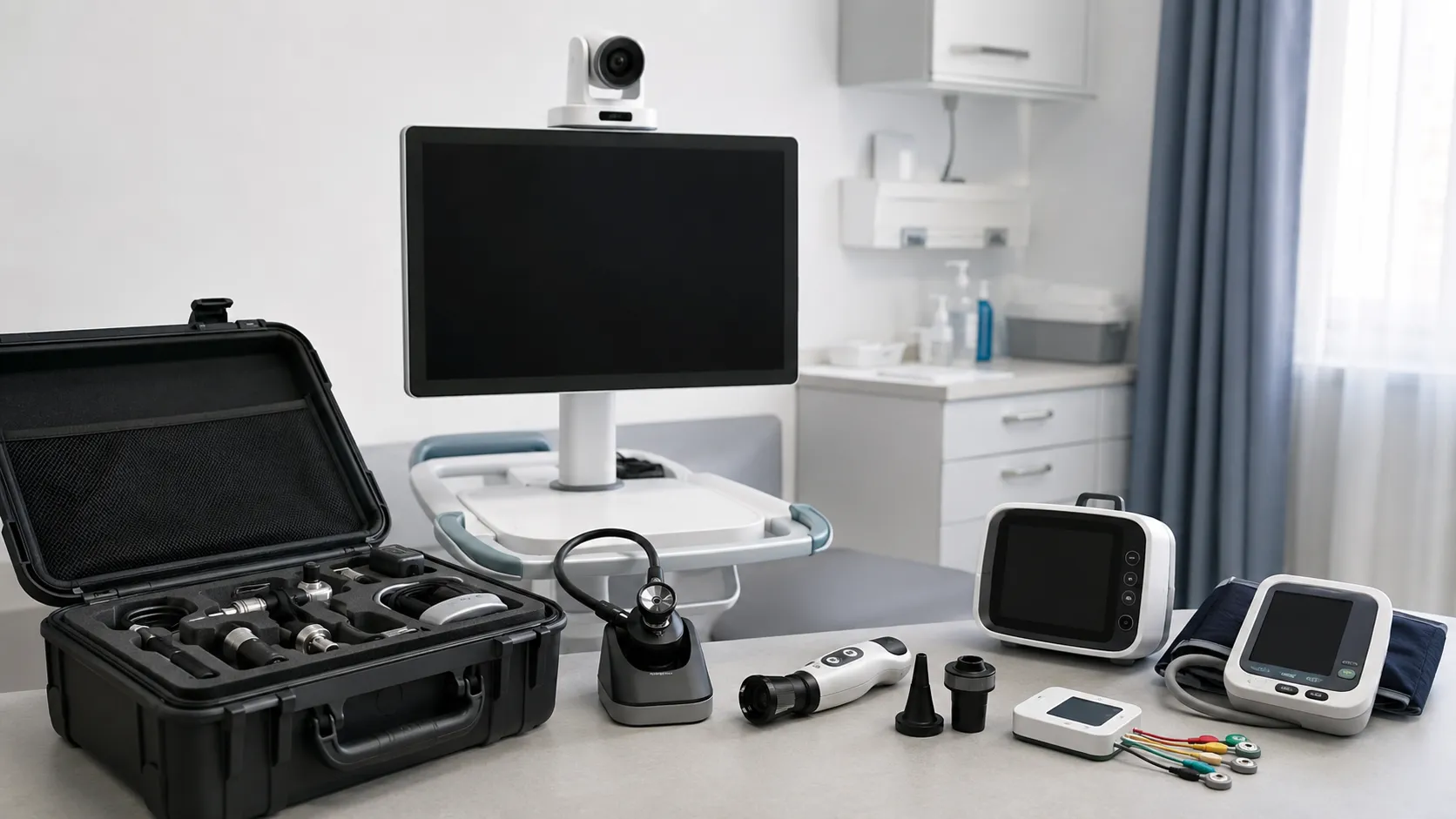
Telemedicine carts. Mobile carts with camera, screen, peripherals and connectivity for ward-to-specialist or emergency teleconsultation.
-
Remote patient monitoring. Home wearables, pulse oximeters, blood pressure monitors and ECG patches that transmit data to clinical teams.
-
Digital stethoscopes. Electronic stethoscopes that amplify and transmit heart and lung sounds for remote auscultation.
-
Telemedicine otoscopes & cameras. Digital otoscopes, dermatoscopes and general-purpose cameras for remote examination of ears, skin and wounds.
-
Store-and-forward systems. Asynchronous platforms that transmit images, ECGs and clinical data for expert review without a live consultation.
-
TeleICU systems. Centralised critical-care monitoring platforms connecting intensivists remotely to ICU patients across sites.
-
Home health hubs. Connected devices and apps that aggregate patient data — vital signs, weight, glucose — for remote clinical review.
What each type does
|
Category |
Examples |
Used for |
|
Teleconsultation |
Video platforms and software |
Remote clinical appointments |
|
Telemedicine carts |
Mobile carts with peripherals |
Ward and emergency teleconsult |
|
Remote monitoring |
Wearables, home monitors |
Tracking patients at home |
|
Digital stethoscope |
Electronic stethoscopes |
Remote auscultation |
|
Otoscopes & cameras |
Digital otoscopes, dermatoscopes |
Remote examination |
|
Store-and-forward |
Async image and data platforms |
Asynchronous specialist review |
|
TeleICU |
Centralised ICU monitoring |
Remote critical care support |
|
Home health hubs |
Connected home device platforms |
Aggregating remote patient data |
Telemedicine models compared
Telemedicine is delivered in several models, each suited to different clinical needs and settings.
|
Model |
How it works |
Best for |
Consider |
|
Live video |
Real-time video consultation |
GP, outpatient, mental health |
Connectivity; patient access |
|
Remote monitoring |
Continuous device data to clinician |
Chronic disease, post-discharge |
Data management; alert fatigue |
|
Store-and-forward |
Async data and images to specialist |
Dermatology, teleradiology, ECG |
Not for urgent review |
|
TeleICU |
Remote intensivist covers multiple ICUs |
ICU quality and overnight cover |
Cost; infrastructure; integration |
Most telemedicine services combine live video for consultations with remote monitoring for ongoing care, adding store-and-forward and teleICU for specialist and critical-care reach.
Equipping a telemedicine service?
We'll help you choose the right kit. Tell us the clinical model, your setting and your market — we'll help you pick telemedicine equipment that fits your service and is approved for use where you'll use it.
No pressure, no obligation. → Talk to the team
Telemedicine equipment by setting
-
Primary care and outpatient - video platforms, digital stethoscopes and store-and-forward for remote consultations.
-
Hospital wards - telemedicine carts for specialist review and remote support across sites.
-
Intensive care - teleICU platforms connecting remote intensivists to multiple ICU sites.
-
Remote and rural communities - satellite-connected carts, portable diagnostic peripherals and store-and-forward.
-
Home care and chronic disease - remote monitoring wearables, home health hubs and video follow-up.
Choosing telemedicine equipment
-
Define the clinical model — live, asynchronous or monitoring — the service must deliver.
-
Match video platforms, diagnostic peripherals and monitoring to that model.
-
Plan connectivity, data security and integration with clinical records.
-
Confirm medical-device approval for diagnostic peripherals and monitoring devices.
-
Plan training, patient onboarding and technical support into the running programme.
Telemedicine depends on connectivity and integration as much as hardware — confirm data-security standards, system integration and regulatory approval of any diagnostic devices before deployment.
Emerging telemedicine technology
-
AI clinical decision support. AI triages symptoms and flags deterioration in remotely monitored patients.
-
Wearable and patch monitoring. Long-wear ECG patches and biosensor wearables extend monitoring to weeks.
-
Remote examination advances. Higher-definition cameras and haptic feedback are improving remote physical examination.
-
Telehealth at scale. National telemedicine platforms are expanding access in low- and middle-income countries.
-
Integrated virtual care. Telemedicine is integrating with EHR, pharmacy and remote monitoring into unified virtual care platforms.
Approval by region
|
Region |
Regulator |
Requirement |
|
United Kingdom |
UKCA mark (CE accepted to 2028–2030) |
|
|
European Union |
CE marking under the EU MDR |
|
|
United States |
510(k) clearance or PMA approval |
|
|
Gulf (GCC) |
SFDA & GCC bodies |
National registration / GCC conformity |
|
South Africa |
Medical device licensing |
Telemedicine software may be regulated as a medical device depending on its diagnostic function, and diagnostic peripherals are regulated as medical devices. For clinical and quality guidance, the NICE and World Health Organisation resources are useful references. Our buyer hub sets out how to purchase with confidence.
More from Business
-
Buyers — source telemedicine platforms, carts and remote monitoring for your service.
-
Suppliers — list your telemedicine equipment and digital health solutions and reach buyers worldwide.
-
Advertise — promote your products and services to a clinical audience.
-
Business overview — explore everything MediGear offers healthcare organisations.
Disclaimer
This article is for general information only and does not constitute clinical, medical, procurement or regulatory advice. Telemedicine equipment, regulations and requirements vary by country, setting and need, and change over time. Always confirm that equipment and software suit the intended clinical use and are approved for your market (for example, UKCA, CE under the EU MDR, FDA, SFDA/GCC or SAHPRA), observe data-protection and cybersecurity standards, and consult qualified clinical, information-technology and procurement professionals for decisions specific to your organisation. medigear.uk accepts no liability for actions taken based on this content.
The right telemedicine equipment for your service.
From teleconsultation platforms and remote monitoring to diagnostic peripherals, teleICU and store-and-forward systems, we supply telemedicine equipment to hospitals and clinics across the UK, Europe, the US, the Gulf and South Africa.
Frequently Asked Questions
Telemedicine equipment covers secure video-consultation platforms, mobile telemedicine carts with camera, screen and peripherals, remote patient monitoring including wearables, connected blood pressure monitors and pulse oximeters, digital stethoscopes for remote auscultation, digital otoscopes and dermatoscopes, store-and-forward platforms for asynchronous image and data review, and teleICU systems for centralised critical-care monitoring.
A telemedicine cart is a mobile unit equipped with a high-definition camera, screen, microphone, speaker and clinical peripherals — often including a stethoscope, blood pressure monitor and otoscope — connected securely to a teleconsultation platform. It allows a clinician at a remote site to conduct a detailed clinical assessment, and is used for ward rounds, emergency consultations and specialist review across sites.
Store-and-forward telemedicine collects clinical data — images, ECGs, photographs, diagnostic reports — and transmits them electronically to a specialist for review at a later time, without a live consultation. It is widely used in teledermatology, teleradiology, remote ECG reporting and ophthalmic screening, and allows specialists to review cases from multiple sites asynchronously.
Remote patient monitoring uses wearable and home devices that measure vital signs and transmit data automatically. This includes pulse oximeters, blood pressure monitors, ECG patches, weight scales, blood glucose meters and activity trackers, connected to a platform that presents the data to clinical teams and generates alerts when readings fall outside defined thresholds.
Diagnostic telemedicine peripherals such as stethoscopes, otoscopes and monitoring devices are regulated as medical devices and must be approved for the market — UKCA or CE under the EU MDR in the UK and EU, FDA clearance in the US, and SFDA or SAHPRA registration in the Gulf and South Africa. Telemedicine software may be regulated as a medical device depending on its function, and data-protection laws also apply.
A teleICU is a centralised monitoring system where remote intensivists and nurses monitor multiple ICU patients across one or more sites using cameras, vital-sign feeds and patient-record integration. Alerts flag deteriorating patients and the remote team can support bedside staff with diagnosis and decision-making. It improves ICU coverage, especially overnight and in hospitals without 24-hour intensivist presence.