
Introduction
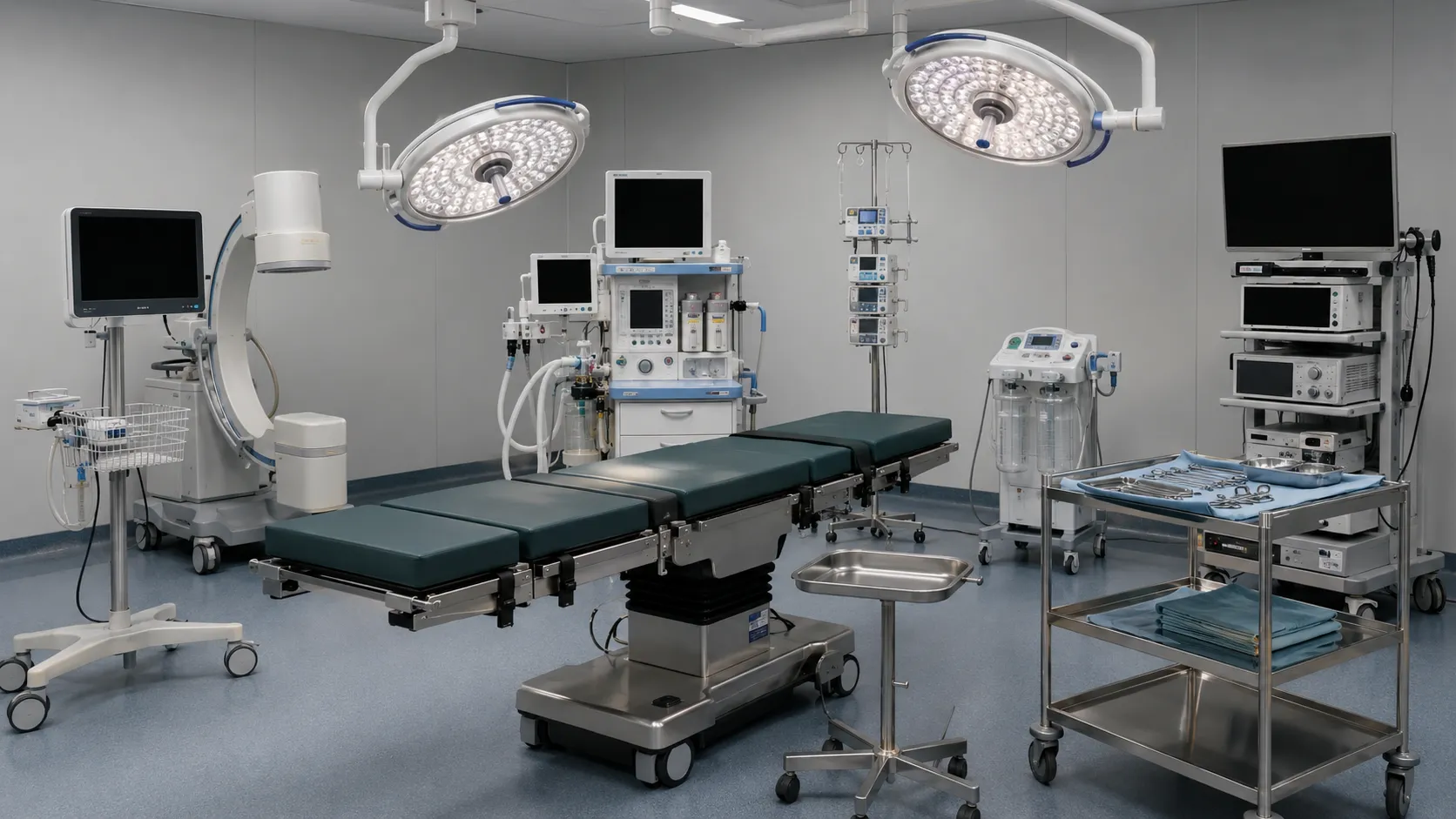
Every operation depends on the right equipment around the table. Surgical equipment spans the room itself — tables and lights — through the instruments and energy devices the surgeon uses, to the suction, monitoring and sterile supply that keep the procedure safe. Understanding those groups helps any theatre plan, compare options and budget sensibly.
This guide walks through the main types of surgical equipment used in operating rooms worldwide, what each does, where it fits, and how to choose — with notes on approval across the UK, the EU, the US, the Gulf (GCC) states, and South Africa.
The short version — surgical equipment in three groups
Most surgical equipment falls into one of three groups — the operating environment, the instruments and energy devices, and the support that keeps the room running.
-
The operating environment — tables, surgical lights and pendants that position and illuminate the patient.
-
Instruments & energy devices — hand instruments, electrosurgery and advanced energy that cut and control bleeding.
-
Support & safety — anaesthesia, monitoring, suction and sterile supply that keep surgery safe.
Types of surgical equipment
-
Operating tables. Hydraulic or electric tables with accessories to position the patient for any procedure and speciality.
-
Surgical lighting. Overhead LED lights and ceiling pendants that illuminate the surgical field and carry services.
-
Anaesthesia & monitoring. Anaesthesia machines and patient monitors that deliver anaesthesia and track vital signs throughout surgery.
-
Electrosurgery (diathermy). Monopolar and bipolar electrosurgical units that cut tissue and control bleeding with high-frequency current.
-
Surgical hand instruments. Scalpels, forceps, scissors, retractors and clamps — the core sets for cutting, holding and retracting tissue.
-
Advanced energy devices. Ultrasonic scalpels, vessel sealers and surgical staplers that seal vessels and divide tissue quickly.
-
Minimally invasive systems. Laparoscopic towers, cameras and insufflators for keyhole surgery through small incisions.
-
Suction & support. Surgical suction, smoke evacuation and sterile-supply equipment that keep the field clear and safe.
What each type does
|
Category |
Examples |
Used for |
|
Operating table |
Hydraulic/electric tables, accessories |
Positioning the patient |
|
Surgical lighting |
LED overhead lights, pendants |
Illuminating the field |
|
Anaesthesia & monitoring |
Anaesthesia machine, patient monitor |
Anaesthesia and vital signs |
|
Electrosurgery |
Monopolar/bipolar diathermy |
Cutting and coagulating tissue |
|
Hand instruments |
Scalpels, forceps, retractors, clamps |
Cutting, holding, retracting |
|
Advanced energy |
Ultrasonic scalpels, vessel sealers, staplers |
Sealing vessels, dividing tissue |
|
Minimally invasive |
Laparoscopic towers, insufflators |
Keyhole surgery |
|
Suction & support |
Suction, smoke evacuation, sterile supply |
Keeping the field clear |
Surgical energy devices compared
Modern surgery relies on energy devices to cut tissue and control bleeding, and several technologies do the job in different ways.
|
Device |
How it works |
Best for |
Consider |
|
Electrosurgery |
High-frequency current |
Cutting and broad coagulation |
Burns risk; surgical plume |
|
Ultrasonic |
High-frequency vibration |
Precise cutting, less thermal spread |
Cost; slower on large vessels |
|
Laser |
Focused light energy |
Precision on specific tissues |
Safety; cost; training |
|
Vessel sealing |
Pressure plus bipolar energy |
Sealing larger vessels fast |
Consumable cost |
Most operating rooms run more than one — basic electrosurgery for everyday work, with ultrasonic, laser or vessel-sealing systems added for specific procedures.
Equipping an operating room?
We'll help you choose the right kit. Tell us the procedures, your budget and your market — we'll help you pick surgical equipment that fits your theatre and is approved for use where you'll use it.
No pressure, no obligation. → Talk to the team
Surgical equipment by setting
-
General operating rooms - tables, lights, electrosurgery and core instrument sets for routine and emergency surgery.
-
Specialist theatres - dedicated kit for cardiac, orthopaedic, neuro or ophthalmic surgery, often with imaging and microscopes.
-
Day-surgery units - streamlined instrument sets and minimally invasive systems for short-stay procedures.
-
Hybrid theatres - integrated imaging such as a C-arm or fixed system alongside surgical equipment for image-guided surgery.
-
Low-resource settings - portable lights, basic instrument sets and manual suction where infrastructure is limited.
Choosing surgical equipment
-
Define the procedures and specialties the theatre must support.
-
Match the table, lighting and energy devices to those procedures.
-
Standardise instrument sets to simplify sterilisation and stock control.
-
Confirm market approval, the device risk class and electrical safety.
-
Plan consumables, sterilisation throughput and service support.
Cost of ownership matters as much as the purchase price — energy devices, staplers and laparoscopic systems carry ongoing consumable and service costs. Weigh new against certified refurbished, and confirm each device's risk class before buying.
Emerging surgical technology
-
Robotic surgery. Robotic-assisted platforms bring precision and minimally invasive access, and are expanding across specialties.
-
Integrated digital theatres. Networked lights, cameras, displays and data capture support image-guided and recorded surgery.
-
Smart energy devices. Newer vessel-sealing and energy systems use feedback to cut faster with less thermal injury.
-
Single-use instruments. Sterile single-use sets reduce reprocessing burden and cross-infection risk in some settings.
-
Navigation & AR. Surgical navigation and augmented-reality overlays guide complex procedures.
Approval by region
|
Region |
Regulator |
Requirement |
|
United Kingdom |
UKCA mark (CE accepted to 2028–2030) |
|
|
European Union |
CE marking under the EU MDR |
|
|
United States |
510(k) clearance or PMA approval |
|
|
Gulf (GCC) |
SFDA & GCC bodies |
National registration / GCC conformity |
|
South Africa |
Medical device licensing |
Surgical equipment also follows electrical-safety and sterilisation standards. For clinical and quality guidance, the NICE and World Health Organisation resources are useful references. Our buyer hub sets out how to purchase with confidence.
More from Business
-
Buyers — source operating-room equipment and surgical instruments for your theatre.
-
Suppliers — list your surgical equipment and instruments and reach buyers worldwide.
-
Advertise — promote your products and services to a clinical audience.
-
Business overview — explore everything MediGear offers healthcare organisations.
Disclaimer
This article is for general information only and does not constitute clinical, surgical, medical, procurement or regulatory advice. Surgical equipment, techniques, requirements and regulations vary by country, speciality and need, and change over time. Always confirm that equipment suits the intended clinical use and is approved for your market (for example, UKCA, CE under the EU MDR, FDA, SFDA/GCC or SAHPRA), observe electrical-safety and sterilisation standards, and consult qualified clinical, biomedical engineering and procurement professionals for decisions specific to your organisation. medigear.uk accepts no liability for actions taken based on this content.
The right kit for your operating room.
From operating tables, lights and electrosurgery to instruments, energy devices and laparoscopic systems, we supply surgical equipment to theatres and hospitals across the UK, Europe, the US, the Gulf and South Africa — compliant, supported and ready to use.
Frequently Asked Questions
Surgical equipment covers the operating environment (tables, lights and pendants), patient support (anaesthesia machines and monitors), energy devices (electrosurgery, ultrasonic scalpels and vessel sealers), surgical hand instruments (scalpels, forceps, retractors and clamps), minimally invasive systems (laparoscopic towers and insufflators), and support equipment such as suction and smoke evacuation. The exact set depends on the procedures performed.
Monopolar electrosurgery passes current through the patient to a return electrode and is used for cutting and broad coagulation, while bipolar passes current only between the two tips of an instrument, giving precise coagulation with less risk to surrounding tissue. Most theatres use both, chosen by the task.
Minimally invasive, or keyhole, surgery uses a laparoscopic tower with a camera and light source, an insufflator to inflate the cavity with gas, long instruments passed through ports, and often advanced energy devices. It allows surgery through small incisions, with faster recovery than open surgery for many procedures.
Yes. Operating tables, lights, electrosurgical units and laparoscopic systems are commonly available as certified refurbished units, offering significant savings. Confirm certified refurbishment, a warranty, calibration and service support, and check the device is approved for your market. Reusable instruments must be properly reprocessed and sterilised.
Surgical devices must be approved for the market where they're used — UKCA or CE under the EU MDR in the UK and EU, FDA clearance or approval in the US, and SFDA or SAHPRA registration in the Gulf and South Africa. Electrical-safety testing and sterilisation standards also apply, so plan for compliance, servicing and calibration.
Surgical equipment is used directly in the operation — instruments, energy devices and the operating table — while theatre support equipment keeps the room running, such as suction, smoke evacuation, sterile supply and the anaesthesia and monitoring systems. Both are essential for a safe, functioning operating room.