
Introduction
Safe surgery and care depend on properly sterilised instruments, and that depends on the right equipment. Hospital sterilisation spans the cleaning that removes soil, the sterilisers that destroy all microorganisms, and the packing, water treatment and monitoring that prove and protect the process. Understanding those groups helps any unit plan, compare options and budget sensibly.
This guide walks through the main types of sterilisation equipment used in hospitals worldwide, what each does, where it fits, and how to choose — with notes on approval across the UK, the EU, the US, the Gulf (GCC) states, and South Africa.
The short version — sterilisation equipment in three groups
Most sterilisation equipment falls into one of three groups — cleaning and disinfection, the sterilisers themselves, and the monitoring and support that prove every cycle.
-
Cleaning & disinfection — washer-disinfectors and ultrasonic cleaners that remove soil before sterilisation.
-
Sterilisers — steam autoclaves and low-temperature systems that destroy all microorganisms.
-
Monitoring & support — sealing, indicators, water treatment and tracking that prove and protect the process.
Types of sterilisation equipment
-
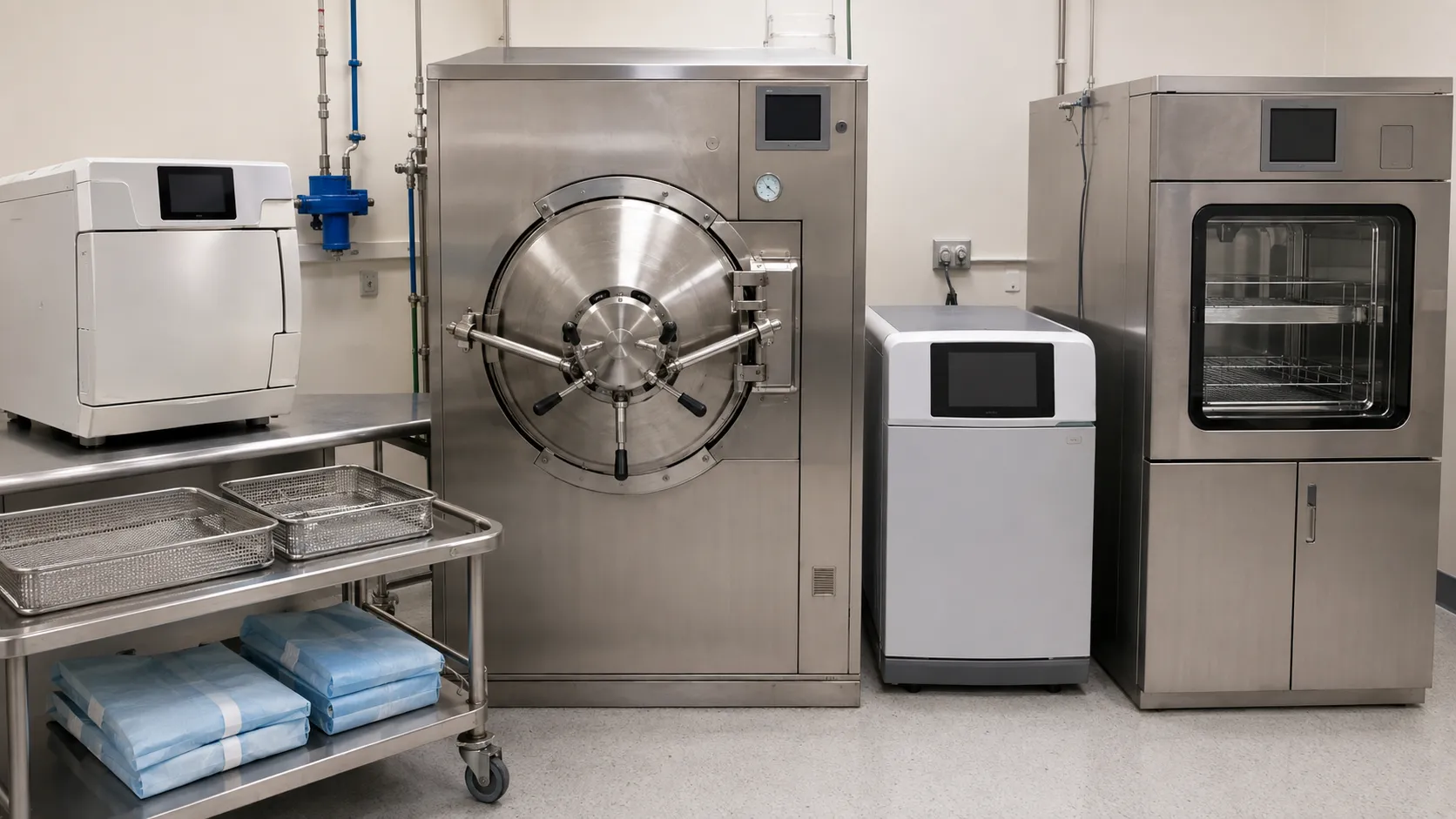
Steam autoclaves. Pre-vacuum and gravity steam sterilisers — the workhorses for the majority of reusable instruments.
-
Low-temperature sterilisers. Hydrogen-peroxide gas plasma, ethylene oxide, and formaldehyde systems for heat-sensitive devices.
-
Washer-disinfectors. Automated machines that clean and thermally disinfect instruments before sterilisation.
-
Ultrasonic cleaners. Ultrasonic baths that remove fine soil from delicate and complex instruments.
-
Endoscope reprocessors. Automated endoscope reprocessors (AERs) and drying cabinets for flexible scopes.
-
Sealing & packaging. Heat sealers, pouches, wraps and rigid containers that package instruments before sterilisation.
-
Water & steam systems. Reverse-osmosis or deionised water treatment and steam generators that protect instruments and sterilisers.
-
Monitoring & tracking. Biological and chemical indicators, Bowie-Dick tests and tracking software that prove every cycle.
What each type does
|
Category |
Examples |
Used for |
|
Steam sterilizers |
Pre-vacuum, gravity autoclaves |
Sterilising most instruments |
|
Low-temp sterilizers |
Gas plasma, ETO, formaldehyde |
Heat-sensitive devices |
|
Washer-disinfectors |
Automated washers |
Cleaning and disinfecting |
|
Ultrasonic cleaners |
Ultrasonic baths |
Removing fine soil |
|
Endoscope reprocessing |
AERs, drying cabinets |
Flexible scopes |
|
Packing & sealing |
Heat sealers, pouches, wraps |
Packaging instruments |
|
Water & steam |
RO/DI units, steam generators |
Protecting instruments |
|
Monitoring |
Indicators, tracking software |
Proving each cycle |
Sterilisation methods compared
No single method sterilises everything, so hospitals match the method to the instrument and its heat tolerance.
|
Method |
How it works |
Best for |
Consider |
|
Steam (autoclave) |
Pressurised saturated steam |
Most reusable instruments |
Not for heat-sensitive items |
|
Ethylene oxide |
Chemical gas |
Heat- and moisture-sensitive devices |
Long cycle; toxic; aeration |
|
Gas plasma |
Hydrogen-peroxide vapour |
Many heat-sensitive items, fast |
Material limits; cost |
|
Dry heat |
Hot air |
Powders, oils, glassware |
Long cycle; high temperature |
Steam is the default for the majority of instruments, with low-temperature methods reserved for heat- and moisture-sensitive devices that steam would damage.
Equipping a sterilisation unit?
We'll help you choose the right kit. Tell us your instrument load, your budget and your market — we'll help you pick sterilisation equipment that fits your hospital and is approved for use where you'll use it.
No pressure, no obligation. → Talk to the team
Sterilisation equipment by setting
-
Central sterile services - the full range, serving the whole hospital with a strict dirty-to-sterile flow.
-
Operating theatres - immediate-use steam sterilisers and instrument support close to surgery.
-
Clinics & dental - compact bench-top autoclaves and ultrasonic cleaners for smaller instrument loads.
-
Endoscopy units - automated endoscope reprocessors and drying cabinets for flexible scopes.
-
Low-resource settings - basic autoclaves and manual cleaning where infrastructure is limited.
Choosing sterilisation equipment
-
Define the instrument load, materials and turnaround the unit must handle.
-
Match steam and low-temperature capacity to that load.
-
Plan cleaning, packing, water treatment and tracking around the sterilisers.
-
Confirm market approval, the device risk class and validation requirements.
-
Plan consumables, indicators, servicing and validation into the running cost.
Validation, indicators, water treatment and servicing add to the purchase price — weigh new against certified refurbished, confirm the device's risk class, and plan routine validation before you buy.
Emerging sterilisation technology
-
Greener low-temperature methods. Hospitals are moving away from ethylene oxide toward hydrogen peroxide and other lower-toxicity methods.
-
Full traceability. Barcode and software tracking link each instrument set to its cycle, load and patient.
-
Faster cycles. Newer sterilisers and reprocessors cut turnaround to ease instrument bottlenecks.
-
Single-use shift. More single-use instruments and packs reduce the reprocessing burden in some areas.
-
Connected monitoring. Networked cycle data and remote monitoring support audit and compliance.
Approval by region
|
Region |
Regulator |
Requirement |
|
United Kingdom |
UKCA mark (CE accepted to 2028–2030) |
|
|
European Union |
CE marking under the EU MDR |
|
|
United States |
510(k) clearance or PMA approval |
|
|
Gulf (GCC) |
SFDA & GCC bodies |
National registration / GCC conformity |
|
South Africa |
Medical device licensing |
Sterilisation equipment also follows decontamination standards such as ISO 17665 for steam sterilisation and ISO 15883 for washer-disinfectors. For clinical and quality guidance, the NICE and World Health Organisation resources are useful references. Our buyer hub sets out how to purchase with confidence.
More from Business
-
Buyers — source sterilisers, washer-disinfectors and CSSD equipment for your hospital.
-
Suppliers — list your sterilisation and decontamination equipment and reach buyers worldwide.
-
Advertise — promote your products and services to a clinical audience.
-
Business overview — explore everything MediGear offers healthcare organisations.
Disclaimer
This article is for general information only and does not constitute clinical, decontamination, medical, procurement or regulatory advice. Sterilisation equipment, methods, requirements and regulations vary by country, setting and need, and change over time. Always confirm that equipment suits the intended use and is approved for your market (for example, UKCA, CE under the EU MDR, FDA, SFDA/GCC or SAHPRA), follow decontamination and validation standards, and consult qualified decontamination, biomedical engineering and procurement professionals for decisions specific to your organisation. medigear.uk accepts no liability for actions taken based on this content.
The right sterilization for your hospital.
From steam autoclaves and washer-disinfectors to low-temperature sterilizers, sealing and monitoring, we supply sterilization equipment to hospitals and clinics across the UK, Europe, the US, the Gulf and South Africa — compliant, supported and ready to use.
Frequently Asked Questions
The main types are steam autoclaves (pre-vacuum and gravity), low-temperature sterilizers using hydrogen-peroxide gas plasma, ethylene oxide or formaldehyde, washer-disinfectors and ultrasonic cleaners for cleaning, automated endoscope reprocessors, sealing and packaging machines, water-treatment and steam systems, and monitoring with biological and chemical indicators and tracking software.
Disinfection reduces microorganisms to a safe level but may not destroy all of them, while sterilization destroys all microorganisms including spores. Cleaning and disinfection, usually in a washer-disinfector, come first; sterilization, usually by steam autoclave, follows. Instruments that enter sterile tissue must be sterilized, not just disinfected.
Low-temperature sterilization is used for heat- and moisture-sensitive devices that steam would damage, such as some endoscopes, cameras and plastics. Common methods are hydrogen-peroxide gas plasma, ethylene oxide and formaldehyde. Steam autoclaving remains the default for most metal instruments because it is fast, reliable and economical.
Yes. Autoclaves and washer-disinfectors are available as certified refurbished units and can reduce costs, provided they are properly refurbished, validated and supported. Confirm certified refurbishment, a warranty, installation and service support, and check the device is approved for your market. Sterilizers must be validated after installation and tested routinely.
Sterilizers are medical devices and must be approved for the market — UKCA or CE under the EU MDR in the UK and EU, FDA clearance in the US, and SFDA or SAHPRA registration in the Gulf and South Africa. Decontamination standards such as ISO 17665 also apply, so plan for validation, indicators and routine testing such as the Bowie-Dick check.
Each cycle is monitored with physical readings, chemical indicators that change colour when conditions are met, and biological indicators that confirm spores have been killed. Steam sterilizers are also checked with a daily Bowie-Dick test, and tracking software links each set to its cycle and load for full traceability and recall.