
Introduction
Cancer care requires specialist equipment at every step, from the imaging that detects a tumour to the radiotherapy and chemotherapy that treat it and the palliative care that supports the patient through and beyond treatment. Oncology equipment spans diagnostic imaging and biopsy, radiotherapy and ablation, infusion and drug delivery, and the supportive care equipment that manages side effects. Understanding those groups helps any cancer centre plan, compare options and budget sensibly.
This guide walks through the main types of oncology equipment used in cancer centres worldwide, what each does, where it fits, and how to choose — with notes on approval across the UK, the EU, the US, the Gulf (GCC) states, and South Africa.
The short version — oncology equipment in three groups
Most oncology equipment falls into one of three groups — diagnostic and staging, treatment, and supportive care.
-
Diagnostic & staging — PET-CT, MRI, biopsy and pathology equipment to detect, characterise and stage cancer.
-
Treatment — radiotherapy, chemotherapy infusion, surgical and ablation equipment to treat the tumour.
-
Supportive care — infusion, nutrition, symptom management and monitoring that support patients through treatment.
Types of oncology equipment
-
PET-CT & nuclear medicine. PET-CT scanners for oncology staging, restaging and treatment response — the standard for many cancers.
-
Oncology biopsy equipment. Image-guided biopsy systems including core biopsy guns, vacuum-assisted and CT-guided devices.
-
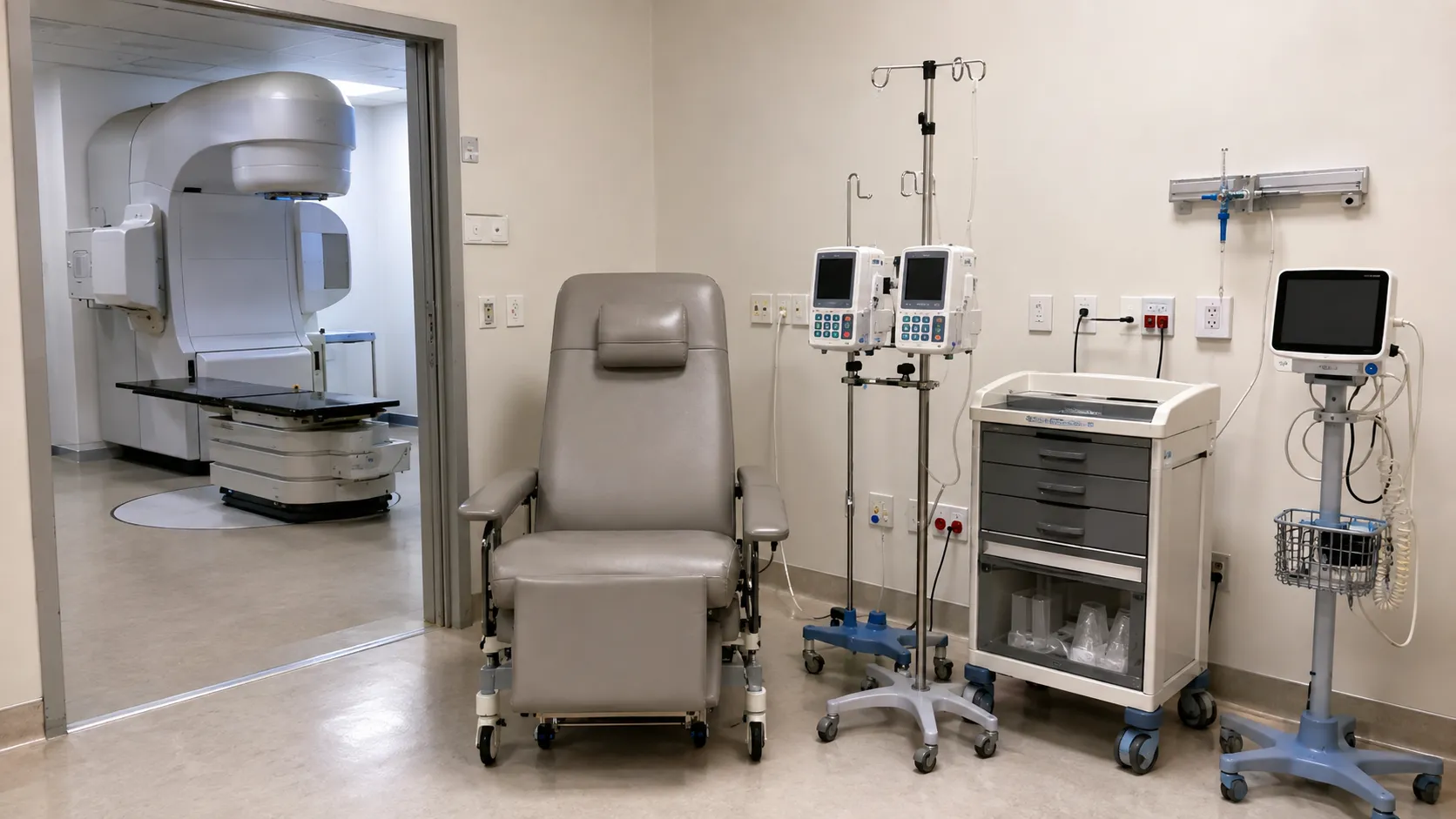
Linear accelerators (LINAC). External-beam radiotherapy machines that deliver precise radiation to the tumour with minimal scatter.
-
Brachytherapy. Radioactive sources placed inside or next to a tumour for internal radiotherapy, used in gynaecology and prostate.
-
Chemotherapy infusion. Infusion pumps, syringe drivers and chair-side systems for cytotoxic drug delivery in daycare oncology.
-
Radiotherapy planning. CT simulation, treatment-planning software and dosimetry systems used to plan and verify radiotherapy.
-
Ablation systems. Radiofrequency, microwave and cryoablation for percutaneous tumour destruction in the liver and kidney.
-
Palliative & supportive care. Symptom management, nutritional support, portable infusion and pain-control equipment for palliative care.
What each type does
|
Category |
Examples |
Used for |
|
PET-CT |
PET-CT and nuclear imaging |
Staging and response assessment |
|
Biopsy |
Image-guided core and vacuum biopsy |
Tissue diagnosis |
|
LINAC |
Linear accelerators |
External-beam radiotherapy |
|
Brachytherapy |
Afterloaders and applicators |
Internal radiotherapy |
|
Chemotherapy infusion |
Infusion and syringe pumps |
Cytotoxic drug delivery |
|
RT planning |
CT simulators, planning, dosimetry |
Radiotherapy planning and QA |
|
Ablation |
RFA, microwave, cryo systems |
Percutaneous tumour ablation |
|
Palliative/supportive |
Pumps, nutrition, pain control |
Symptom and quality-of-life support |
Radiotherapy delivery methods compared
External-beam radiotherapy is delivered by several techniques, each giving different dose precision and tissue sparing.
|
Technique |
How it works |
Best for |
Consider |
|
Conventional RT |
Fixed-field external beams |
Wide range of tumours |
Less conformal |
|
IMRT |
Intensity-modulated beams |
Sparing organs at risk |
Planning complexity |
|
SBRT/SABR |
High-dose in few fractions |
Small tumours, oligomets |
Precision required |
|
Proton therapy |
Proton beam, Bragg peak |
Paediatric, radio-sensitive sites |
Cost; very limited access |
IMRT is now the standard for most radical radiotherapy, with SBRT/SABR used for selected indications and proton therapy available in a small number of centres.
Equipping a cancer centre?
We'll help you choose the right kit. Tell us the oncology services, your budget and your market — we'll help you pick oncology equipment that fits your cancer centre and is approved for use where you'll use it.
No pressure, no obligation. → Talk to the team
Oncology equipment by setting
-
Comprehensive cancer centres - the full range — LINACs, PET-CT, brachytherapy, chemotherapy and multidisciplinary support.
-
Radiotherapy departments - CT simulators, LINACs, treatment planning and dosimetry as the core radiotherapy suite.
-
Medical oncology daycare - chemotherapy infusion chairs, pumps, syringe drivers and pre-medication monitoring.
-
Interventional oncology - image-guided biopsy, ablation and palliative interventions.
-
Palliative care units - infusion pumps, symptom-control and nutritional support equipment.
Choosing oncology equipment
-
Define the cancer types and treatment modalities the centre must offer.
-
Match radiotherapy, chemotherapy and imaging equipment to those needs.
-
Plan radiotherapy planning, dosimetry and quality assurance around the LINAC.
-
Confirm market approval, radiation-protection requirements and device risk class.
-
Plan radiation safety, consumables, maintenance and medical-physics support.
LINACs and PET-CT are capital-intensive, and radiation protection, planning systems and medical-physics support add to the running cost — confirm device approval, shielding requirements and physics resources before you invest.
Emerging oncology technology
-
MR-guided radiotherapy. MR-LINACs combine MRI with a linear accelerator for real-time tumour tracking during treatment.
-
Immunotherapy monitoring. New imaging and laboratory techniques monitor immune response and treatment toxicity.
-
Liquid biopsy. Blood-based tumour DNA tests detect cancer, monitor response and track resistance without tissue.
-
FLASH radiotherapy. Ultra-high dose-rate delivery is being studied to reduce normal tissue toxicity.
-
AI in radiotherapy. AI assists target delineation, treatment planning and quality assurance in radiotherapy.
Approval by region
|
Region |
Regulator |
Requirement |
|
United Kingdom |
UKCA mark (CE accepted to 2028–2030) |
|
|
European Union |
CE marking under the EU MDR |
|
|
United States |
510(k) clearance or PMA approval |
|
|
Gulf (GCC) |
SFDA & GCC bodies |
National registration / GCC conformity |
|
South Africa |
Medical device licensing |
Radiotherapy equipment carries radiation-protection requirements in addition to medical-device regulation. For clinical and quality guidance, the NICE and World Health Organisation resources are useful references. Our buyer hub sets out how to purchase with confidence.
More from Business
-
Buyers — source oncology imaging, radiotherapy and chemotherapy equipment for your cancer centre.
-
Suppliers — list your oncology equipment and reach buyers in cancer centres worldwide.
-
Advertise — promote your products and services to a clinical audience.
-
Business overview — explore everything MediGear offers healthcare organisations.
Disclaimer
This article is for general information only and does not constitute clinical, oncological, medical, procurement or regulatory advice. Oncology equipment, techniques, requirements and regulations vary by country, setting and need, and change over time. Always confirm that equipment suits the intended clinical use and is approved for your market (for example, UKCA, CE under the EU MDR, FDA, SFDA/GCC or SAHPRA), observe radiation-protection requirements for radiotherapy, and consult qualified oncology, medical physics, biomedical engineering and procurement professionals for decisions specific to your organisation. medigear.uk accepts no liability for actions taken based on this content.
The right oncology equipment for your cancer centre.
From radiotherapy systems and infusion equipment to oncology imaging, biopsy tools and supportive care, we supply oncology equipment to cancer centres and hospitals across the UK, Europe, the US, the Gulf and South Africa.
Frequently Asked Questions
Oncology equipment covers PET-CT and nuclear imaging for staging, image-guided biopsy systems, linear accelerators for external-beam radiotherapy, brachytherapy afterloaders and applicators, CT simulators and treatment-planning software, chemotherapy infusion pumps and daycare chairs, radiofrequency and microwave ablation systems, and palliative-care infusion and symptom-management equipment.
A linear accelerator (LINAC) is an external-beam radiotherapy machine that uses microwave energy to accelerate electrons, which hit a target to produce X-rays delivered to the tumour. Modern LINACs use intensity modulation and image guidance to shape dose precisely to the tumour while minimising dose to surrounding tissues. They are the core machine of any radiotherapy department.
External-beam radiotherapy delivers radiation from outside the body using a LINAC. Brachytherapy places radioactive sources inside or next to the tumour using applicators or implanted seeds, giving very high local dose with rapid dose fall-off. Brachytherapy is used in cervical, endometrial, prostate and some head-and-neck cancers, often alongside external beam.
Some oncology equipment including chemotherapy infusion pumps, ultrasound and infusion chairs can be bought refurbished. LINACs may be available as certified refurbished or re-engineered systems through specialist suppliers. Confirm certified refurbishment, a warranty, radiation-safety compliance and physics support, and check the device is approved for your market before clinical commissioning.
Oncology devices must be approved for the market — UKCA or CE under the EU MDR in the UK and EU, FDA clearance in the US, and SFDA or SAHPRA registration in the Gulf and South Africa. Radiotherapy equipment also follows radiation-protection legislation and requires physics commissioning, acceptance testing, routine QA and shielding compliance before clinical use.
PET-CT combines positron emission tomography, which shows metabolic activity using a radioactive tracer, with CT, which provides anatomical detail, in a single scan. It is the standard staging and restaging investigation for many cancers including lymphoma, lung and colorectal cancer, detecting disease that CT alone may miss and guiding radiotherapy planning and treatment-response assessment.