
Introduction
Neurostimulation is a poor name for what is actually one of the most heterogeneous device categories in medicine. It covers cochlear implants that restore hearing, deep brain stimulators for Parkinson's, spinal cord stimulators for chronic back pain, sacral nerve stimulators for bladder problems, vagus nerve stimulators for treatment-resistant epilepsy and depression, and non-invasive scalp electrodes that hobbyists use at home. What ties this collection together is only the general principle of applying electrical stimulation to a nerve target. Almost every other design decision differs.
What follows walks through the main types organised by anatomical target rather than by device brand, because that framing captures how neurostimulation is actually prescribed and how the equipment is actually procured. Each target has its own manufacturers, its own NICE technology appraisals in the UK, its own reimbursement pathway, and its own patient selection criteria. Buying one type of neurostimulator tells you very little about buying another.
Deep brain stimulation (DBS)
DBS delivers electrical stimulation to specific deep brain targets through implanted electrodes connected to a pulse generator, typically sited in the chest wall. The main clinical uses in the UK are Parkinson's disease (subthalamic nucleus or globus pallidus targeting), essential tremor (ventral intermediate thalamic nucleus), and dystonia. NICE has approved DBS for these indications, with specific patient selection criteria and pre-implant assessment requirements. Newer indications including obsessive-compulsive disorder, treatment-resistant depression, and some epilepsy syndromes have narrower approvals.
The market is dominated by three manufacturers: Medtronic (with the Activa and newer Percept PC systems, the latter offering neural sensing), Abbott (Infinity system, directional leads), and Boston Scientific (Vercise Genus platform, also with directional leads). Directional leads — where stimulation can be steered in specific directions rather than being applied radially — have become an important differentiator over the past decade. Implantable pulse generators range from £12,000 to £25,000 per patient, with the full implant procedure including consumables and imaging costing considerably more.
Newer sensing-enabled systems can record local field potentials from the target region, opening the possibility of closed-loop stimulation that adjusts to the patient's brain activity in real time. This is genuinely early in clinical rollout — most current DBS in the UK is still open-loop, with patients returning for periodic parameter adjustments by a specialist team. The infrastructure around DBS matters as much as the hardware: a functional DBS programme needs specialist neurologists, neurosurgeons, specialist nurses, imaging capacity, and long-term follow-up capability that many centres cannot provide.
Vagus nerve stimulation (VNS)
VNS uses an electrode wrapped around the left vagus nerve in the neck, connected to a subcutaneous pulse generator in the upper chest. UK-approved indications are drug-resistant epilepsy (NICE-approved since 2004) and treatment-resistant depression (narrower NICE approval, more controversial). The clinically dominant manufacturer is LivaNova (formerly Cyberonics), with the SenTiva and Symmetry devices covering most current implants. Device costs are lower than DBS at £8,000–£15,000 for the pulse generator.
Non-invasive VNS — transcutaneous stimulation of the auricular branch of the vagus at the outer ear — is a distinct category and worth flagging separately. The GammaCore device (electroCore) has NICE approval for cluster headache and migraine. It is not the same class of intervention as implanted VNS, doesn't have the same evidence base for the same indications, and shouldn't be conflated in procurement conversations even though both are called "vagus nerve stimulation".
Spinal cord stimulation (SCS)
SCS treats chronic neuropathic pain, most often failed back surgery syndrome, complex regional pain syndrome, and diabetic peripheral neuropathy. Electrodes are placed in the epidural space and connected to an implanted pulse generator. NICE technology appraisal TA159 (with subsequent updates) is the anchor UK guidance. The market is more crowded than DBS or VNS — Medtronic, Abbott, Boston Scientific, and Nevro all compete, with Nevro's Senza HF10 (high-frequency 10 kHz stimulation) representing a distinct clinical approach.
The clinical rationale for different SCS waveforms has been contested. Conventional tonic stimulation produces paraesthesia that the patient feels; high-frequency and burst stimulation approaches aim to deliver pain relief without the paraesthesia. Head-to-head trials have shown mixed results depending on population and outcome measure. What this means for procurement: there isn't a single dominant technology, and the choice between platforms should be made by pain clinicians familiar with the specific patient cohort rather than by generic device procurement.
Sacral nerve stimulation and peripheral targets
Sacral nerve stimulation (SNS) treats overactive bladder, non-obstructive urinary retention, and faecal incontinence resistant to conservative treatment. The InterStim system (Medtronic) has held the dominant UK market share; Axonics offers a rechargeable alternative with a smaller pulse generator and MRI compatibility that has taken significant market share since its introduction. NICE has approved SNS for specific indications with careful patient selection.
Other peripheral nerve stimulation targets include the tibial nerve (for overactive bladder, either percutaneous or implanted), the occipital nerve (for chronic migraine, though evidence has weakened over time), and various targets for chronic pain. This is a diverse micro-category with different manufacturers, different evidence bases, and different NICE positions on each. Not all peripheral nerve stimulation currently has NICE approval, and commissioning arrangements vary significantly.
Cochlear implants and auditory implants
Cochlear implants sit within the neurostimulation family but have a completely separate clinical and procurement pathway. They restore hearing in profound sensorineural deafness by stimulating the auditory nerve directly, bypassing the damaged hair cells of the cochlea. Three main manufacturers dominate the UK market: Cochlear (Nucleus), Advanced Bionics (HiRes), and MED-EL (Synchrony). Devices are implanted at specialist centres, with external processors that patients wear and can upgrade separately from the implant.
Cochlear implantation in the UK is commissioned through specialised commissioning at NHS England level, with NICE technology appraisal TA566 setting the eligibility criteria. This differs from most of the other neurostimulation categories in this article, which are managed locally. The equipment lifecycle also differs — the internal implant is intended for lifetime use, while the external processor is upgraded every 5–10 years, sometimes with significant capability improvements between generations.
Non-invasive: TMS, tDCS and where the boundary sits
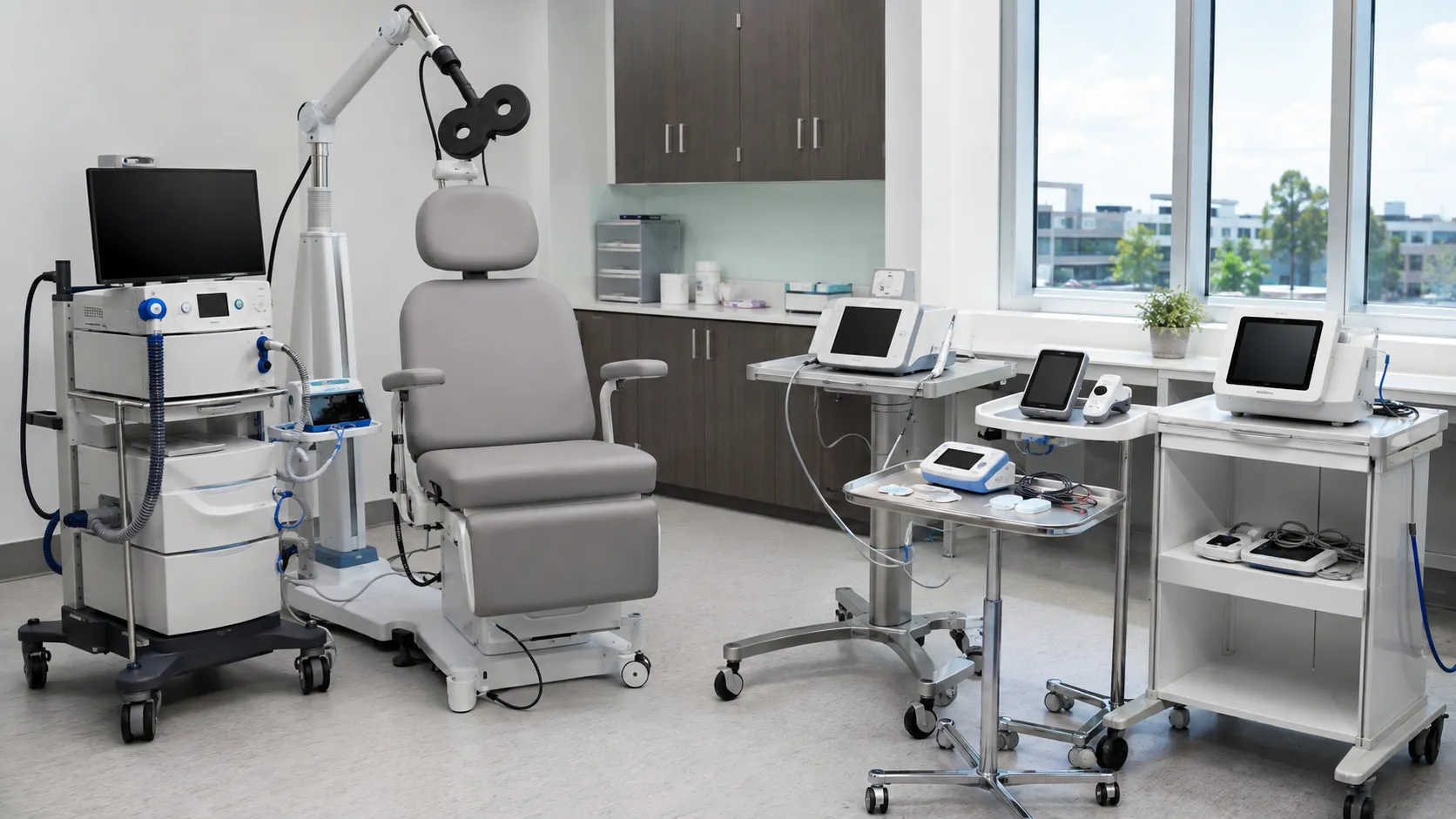
Transcranial magnetic stimulation (TMS) uses external magnetic pulses to stimulate cortical neurons through the intact skull. It has NICE approval for treatment-resistant depression via specific delivery protocols (repetitive TMS or rTMS, sometimes intermittent theta-burst stimulation). Equipment is made by MagVenture, MagStim, Neurosoft, and others; a clinical rTMS chair setup costs £40,000–£80,000 including the coil, and treatment courses are labour-intensive.
Transcranial direct current stimulation (tDCS) is a lower-tech, lower-intensity approach using scalp electrodes and small direct currents. It is available as consumer devices and remains largely investigational for clinical indications. NICE has not made positive recommendations for clinical tDCS. Buyers approaching neurostimulation for the first time should understand that TMS and tDCS are very different in evidence base, regulatory status, and clinical use, even though they can appear similar in patient-facing materials.
An overview of NICE technology appraisals across these types:
| Category Main | n UK indications NICE | E status |
|---|---|---|
| Deep brain stimulation | Parkinson's, tremor, dystonia | Approved (multiple TAs) |
| Vagus nerve stimulation (implanted) | Drug-resistant epilepsy, TR depression | Approved with restrictions |
| Spinal cord stimulation | Chronic neuropathic pain | Approved (TA159 and updates) |
| Sacral nerve stimulation | Bladder and bowel dysfunction | Approved for specific indications |
| Cochlear implantation | Profound sensorineural deafness | Approved (TA566) |
| rTMS | Treatment-resistant depression | Approved for specific delivery |
| tDCS | Various investigational | Not currently approved |
| Non-invasive VNS (GammaCore) | Cluster headache, migraine | Approved for specific use |
See NICE's guidance library for the current specific technology appraisals; individual TAs are updated periodically and the picture shifts.
Choosing between platforms in a competitive market
For most of the categories above, the market has consolidated around three or four main manufacturers, each with their own platform ecosystem, patient programmer, remote-adjustment capability, and MRI compatibility profile. MRI compatibility is worth a specific mention: patients with older neurostimulation implants used to be excluded from MRI scans entirely, but current generations of most implants have conditional MRI approval under specific scanning protocols. The specific approvals differ between manufacturers and generations, and knowing which of your implanted patients can safely have MRI under what conditions is a real service management concern.
The choice between manufacturer platforms is best made by the clinicians who will programme and follow up the devices, since the programming software, remote adjustment capabilities, and service infrastructure differ meaningfully between vendors. Cross-vendor comparison of clinical outcomes for a given indication is genuinely difficult; head-to-head trials are relatively rare, and where they exist, the populations and outcome measures often differ.
Neurostimulation is a Class III medical device area subject to the strictest regulatory oversight in the UK and internationally. This article is for orientation only and does not substitute for specialist clinical consultation or specific product evaluation. Named products reflect current UK market presence and are not endorsements. Patient selection, implant procedures, and long-term programming are specialist activities requiring appropriately trained multidisciplinary teams.
Build a neurostimulation service, not just buy a device
Setting up a DBS programme, an SCS pain service, or a specialist neurostimulation clinic? This is a category where the equipment procurement is inseparable from the clinical team, the imaging infrastructure, and the long-term programming capacity. We can point you toward specialist suppliers and consultants who understand the whole picture across the different neurostimulation types rather than pushing a single platform. Tell us what service you're building.
Frequently Asked Questions
Neurostimulation is the therapeutic application of electrical stimulation to nerve targets, either through implanted electrodes (deep brain, vagus, spinal cord, sacral, cochlear) or non-invasively through the scalp or skin (transcranial magnetic stimulation, transcranial direct current stimulation, non-invasive vagus stimulation). The category is heterogeneous — the same word covers hearing restoration, Parkinson's tremor control, chronic pain, epilepsy, and bladder dysfunction, among others.
In the UK, deep brain stimulation (DBS) has NICE approval for Parkinson's disease (targeting the subthalamic nucleus or globus pallidus), essential tremor (targeting the ventral intermediate thalamic nucleus), and dystonia. Newer indications including obsessive-compulsive disorder, treatment-resistant depression, and specific epilepsy syndromes have narrower approvals or are still under evaluation. DBS requires a specialist multidisciplinary team and infrastructure that many centres cannot provide.
Three manufacturers dominate the market: Medtronic (Activa and Percept PC, the latter with neural sensing capability), Abbott (Infinity system with directional leads), and Boston Scientific (Vercise Genus platform, also with directional leads). Directional leads — which steer stimulation in specific directions rather than radially — have become an important differentiator. Pulse generators range from £12,000 to £25,000 with the full implant procedure costing considerably more.
Yes. Conventional tonic stimulation produces paraesthesia the patient feels; high-frequency (Nevro's Senza HF10 at 10 kHz) and burst stimulation approaches aim to deliver pain relief without paraesthesia. Head-to-head trials have shown mixed results depending on the patient population and outcome measure. There isn't a single dominant technology, and the choice between platforms should be made by pain clinicians familiar with the specific patient cohort.
No, and they shouldn't be conflated. Transcranial magnetic stimulation (TMS) uses magnetic pulses to stimulate cortical neurons and has NICE approval for treatment-resistant depression via specific delivery protocols. Transcranial direct current stimulation (tDCS) uses much lower-intensity scalp electrode currents and remains largely investigational for clinical indications, with no positive NICE recommendation currently. They differ substantially in evidence base, regulatory status, and clinical use.
Cochlear implants are commissioned through NHS England specialised commissioning rather than local commissioning, they have their own NICE technology appraisal (TA566), and the equipment lifecycle differs — the internal implant is intended for lifetime use while the external processor is upgraded every 5 to 10 years. The three main manufacturers are Cochlear (Nucleus), Advanced Bionics, and MED-EL. Implantation happens only at specialist centres.
Some non-invasive devices in the tDCS category and some auricular vagus nerve stimulators are available as consumer products, particularly online. This is a genuinely confusing area for patients: the marketing often implies clinical benefits that don't reflect the evidence base, and the regulatory status is different from implanted clinical devices. Patients considering any neurostimulation should be advised by a clinician who understands the distinctions between clinical and consumer categories.