
Introduction
Within days of the February 2023 earthquake in Türkiye and Syria, UK-EMT, the UK's classified emergency medical team, had deployed a self-sufficient field hospital to Antakya, complete with operating theatres, sterile services, laboratory, radiology, inpatient wards, and the water, power, sanitation, and accommodation to sustain the medical mission for weeks. The equipment for that deployment had been staged in warehouses in the UK, categorised by function and packed to standardised specifications, ready to load onto RAF transport aircraft within hours of the request. What made the deployment possible was the equipment, and the classification and logistics framework that made the equipment usable at scale in a disaster zone.
Disaster response medical equipment is a specialist category with its own regulatory frameworks, its own logistical constraints, and its own international coordination. What follows walks through the equipment picture using the WHO Emergency Medical Team (EMT) classification system as the organising structure, because that's how disaster response equipment is actually specified, deployed, and coordinated internationally.
The WHO EMT classification, and what it means for equipment
Following the 2010 Haiti earthquake response, which exposed serious quality gaps in international medical response, WHO developed the Emergency Medical Team classification system. Teams are classified as Type 1 (mobile or fixed outpatient), Type 2 (inpatient with surgical capability, minimum 20 beds), or Type 3 (inpatient referral care with complex surgical capability, minimum 40 beds), with specialist cell classifications for burn care, dialysis, maternal-child health, mental health, and others.
Each type has defined minimum equipment standards, minimum self-sufficiency requirements (typically 2 weeks of consumables), and minimum staffing. Teams undergo formal WHO classification and are placed on the global registry — only classified teams are typically accepted by requesting governments in response to major disasters. UK-EMT is a classified Type 2 team led by UK-Med with support from DHSC, NHS England, and academic partners. The classification process itself has driven substantial improvements in equipment specification and readiness across the international disaster response community. See the WHO Emergency Medical Team initiative for the current framework.
Type 1 mobile clinic equipment
The smallest classified team, providing outpatient primary care in mobile or fixed configurations. Type 1 mobile teams travel to communities that cannot easily reach fixed medical points; Type 1 fixed teams establish outpatient clinics in a defined location. Equipment specification centres on primary care consumables and diagnostics rather than complex interventions.
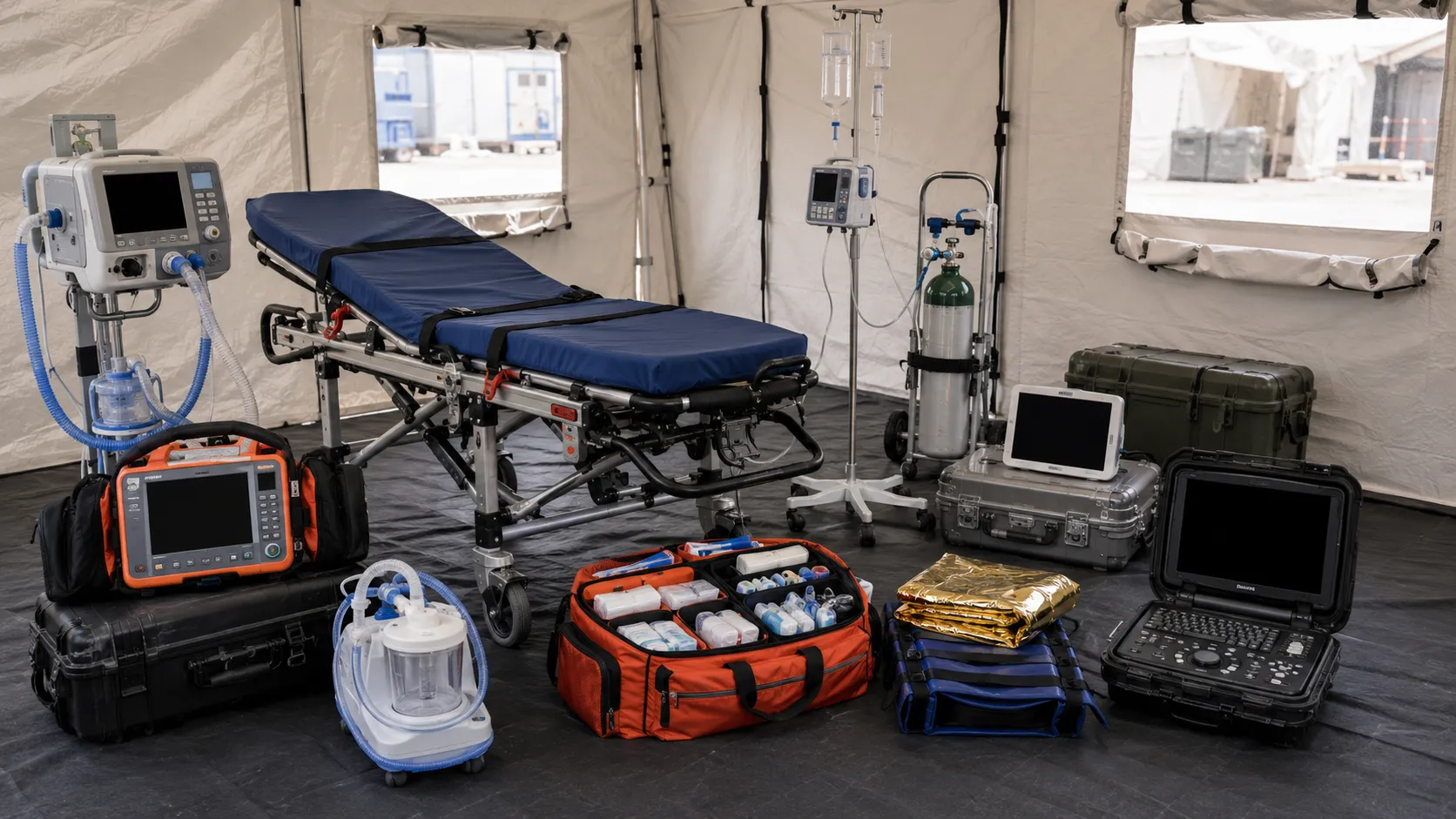
Core equipment includes point-of-care diagnostics (rapid tests for malaria, cholera, and other locally relevant conditions, portable haemoglobin measurement, glucose meters, pregnancy tests), portable ultrasound (increasingly used in field settings, though requiring appropriately trained operators), basic emergency equipment (bag-valve-mask ventilation, oxygen from concentrators where power supports them or from cylinders, basic wound care and suturing kits), and pharmacy consumables to standard essential medicines lists. Mobile teams add vehicle-mounted or backpackable configurations of the same essential kit.
Water and sanitation equipment (portable water purification units, latrine construction materials, hand-washing stations) are as important as clinical equipment in Type 1 deployments, because the settings these teams work in often have compromised water and sanitation infrastructure themselves. Sphere Project standards for humanitarian water and sanitation shape what teams provide alongside medical care.
Type 2 inpatient surgical equipment
The category that includes UK-EMT. A Type 2 team provides inpatient care with surgical capability — typically a 20-bed inpatient facility with at least one operating theatre capable of general anaesthesia and major surgery. Equipment specification is substantially more complex than Type 1.
Surgical equipment includes at least one full-specification operating table, anaesthetic machine (typically drawover in field settings for reliability without complex piped gas supply, though newer field anaesthetic systems are more sophisticated), full surgical instrument sets covering emergency abdominal, obstetric, and orthopaedic procedures, autoclave sterilisation on site, patient monitoring, and blood and blood product handling capacity. Inpatient equipment includes hospital beds, oxygen supply (concentrators, cylinders, or in some deployments generated on-site), infusion pumps, and the wider ward equipment picture. Radiology capacity typically includes portable X-ray and portable ultrasound; CT capability is rare in Type 2 deployments and starts to appear in Type 3.
Type 2 equipment is designed for tent-based or containerised deployment, with equipment that can be packed for airlift, unpacked and commissioned quickly in field conditions, and operated with locally-generated power (typically diesel generators sized to the mission). Self-sufficiency requirements mean the team also brings living accommodation, water, sanitation, kitchen equipment, and communications, at scale, for the deployed personnel over the mission duration.
Type 3 referral care equipment
The largest and most complex classification, providing referral inpatient care with complex surgical capability. Typically 40 or more beds, two or more operating theatres, capability for extended-stay inpatient care including intensive care, and specialist services depending on the specific team's classification. Only a small number of Type 3 teams exist worldwide, deployed for the largest and longest disaster responses.
Equipment specification approaches that of a small permanent hospital, with the additional complications of deployability. This includes multiple operating theatres, ICU capability with ventilators and monitors, laboratory beyond point-of-care diagnostics, blood bank, radiology including portable CT in some cases, dialysis capacity in specialist cells, and the full range of consumables and pharmaceutical supplies to sustain complex care over weeks to months of deployment.
Specialist cells and specific capability
Alongside the main type classifications, WHO recognises specialist cells that add specific capability to a team or that can be deployed independently. Burn cells provide dedicated burn care equipment (dressings, cleansing, pain management, specialist skin substitutes). Dialysis cells provide portable renal replacement therapy equipment for major crush injury events, which is a documented major cause of preventable death in earthquake responses. Rehabilitation cells add early rehabilitation equipment and specialists. Maternal and child health cells add obstetric and paediatric equipment. Mental health and psychosocial support cells add the equipment and specialist personnel for that dimension of disaster response.
The specialist cell concept lets responding organisations tailor deployments to the specific disaster's needs — earthquake responses have a specific pattern of injury requiring surgical and dialysis capacity; flood responses often need infectious disease and outbreak response capability; conflict responses require trauma surgery and mental health support at higher levels.
The logistics behind the equipment
What makes disaster response medical equipment usable is the logistics and coordination that surrounds it. This includes pre-positioned equipment caches in strategic locations, standardised packaging and manifests so equipment can be located and deployed rapidly, transport arrangements (typically military airlift or specialist logistics providers for the initial response), and inter-agency coordination through mechanisms like the UN Office for the Coordination of Humanitarian Affairs (OCHA) and the WHO EMT Coordination Cell in the affected country.
In-country coordination shapes what equipment actually gets used effectively. A classified team arriving in an affected area is placed by the coordination cell rather than choosing its own location; this maximises coverage and avoids duplication, though it can be frustrating for teams arriving with specific capabilities that don't match the placement. Handover and transition arrangements — either back to a functioning local health system as it recovers, or to longer-term humanitarian actors like MSF or the ICRC — are as much part of the equipment picture as the deployment itself. UK-Med and the broader UK-EMT programme handle much of this coordination for UK deployments, working alongside partner classified teams from other nations that arrive under the same WHO framework. The days when uncoordinated volunteer medical teams turned up in disaster zones with well-intentioned but incompatible equipment and no permission to work are largely over, at least among classified responders. The coordination architecture is one of the clearest post-Haiti improvements in international humanitarian medical response, and the equipment specifications that underpin it are inseparable from that broader shift in how the world responds to major disasters requiring outside help; see UK-Med's operational framework for the specific UK approach.
Disaster response medical equipment is a specialist category with international frameworks that supersede individual national or supplier standards. This article is orientation for those approaching the field without disaster response experience; anyone considering participation in international disaster response should engage with UK-EMT, UK-Med, or an equivalent classified team pathway rather than approaching independently. Named organisations reflect current UK deployment structure and may change.
Humanitarian response as a specialism
Working on disaster response equipment procurement for an NGO, engaging with UK-EMT capacity questions, or planning specialist cell capability for an international response programme? This is a specialist procurement area governed by WHO frameworks and international humanitarian standards rather than by domestic medical device regulation alone. We can point you toward suppliers and consultants who work in humanitarian response as a specialism. Tell us what you're building.
Frequently Asked Questions
Following the 2010 Haiti earthquake response, WHO developed the Emergency Medical Team classification system to address quality gaps in international medical response. Teams are classified as Type 1 (mobile or fixed outpatient), Type 2 (inpatient with surgical capability, minimum 20 beds), or Type 3 (inpatient referral care with complex surgical capability, minimum 40 beds), with specialist cells for burn care, dialysis, maternal-child health, and other specific capabilities. Only classified teams are typically accepted by requesting governments in major disasters.
UK-EMT is the UK's classified Type 2 emergency medical team, led by UK-Med with support from DHSC (Department of Health and Social Care), NHS England, and academic partners. Equipment is staged in UK warehouses ready for rapid deployment via RAF transport aircraft on request from affected governments through WHO coordination. Individual clinicians participate through UK-Med's registered volunteer pathway rather than independently. UK-EMT deployments have included Nepal 2015, Sierra Leone Ebola response, Mozambique cyclone 2019, and Türkiye earthquake 2023.
Classified Emergency Medical Teams must be self-sufficient for typically 2 weeks in the deployment area, meaning they bring not only clinical equipment but also water purification, power generation (typically diesel generators), sanitation, kitchen and living accommodation for personnel, communications equipment, and consumables at scale. This is why field hospital equipment packages are much larger than the clinical kit alone — the surrounding infrastructure to sustain the medical mission is a substantial part of the deployment.
Crush syndrome is a documented major cause of preventable death in earthquake responses. When crushed muscle tissue is released after prolonged compression, myoglobin and other breakdown products flood the circulation and can cause acute kidney injury requiring dialysis to prevent death. Portable renal replacement therapy equipment as part of specialist dialysis cells attached to Emergency Medical Teams addresses this specific need. It is one of the clearest examples of matched-capability disaster response equipment.
The Sphere Project standards are internationally recognised minimum standards for humanitarian response, covering water and sanitation, food and nutrition, shelter, and health. They shape what disaster response teams provide alongside medical care, particularly Type 1 teams working in settings with compromised water and sanitation infrastructure. Sphere standards are not medical device standards but they define the context in which medical equipment operates and are referenced throughout international humanitarian response guidance.
Field hospital equipment is typically pre-positioned in warehouses in strategic locations, packaged and manifested for rapid deployment, and transported via military airlift (RAF for UK deployments) or specialist logistics providers for the initial response. Standardised packaging is essential — equipment must be locatable and deployable within hours of request, which requires disciplined maintenance of caches between deployments. Between-deployment servicing, replacement of expired consumables, and equipment upgrade programmes are a continuous programme rather than a one-off activity.
Alongside the main type classifications (Type 1, 2, 3), WHO recognises specialist cells that add specific capability. Burn cells for burn care, dialysis cells for crush syndrome, rehabilitation cells for early rehabilitation, maternal and child health cells, and mental health and psychosocial support cells. The specialist cell concept lets responding organisations tailor deployments to the specific disaster's needs — earthquake responses need surgical and dialysis capacity, flood responses need infectious disease capability, conflict responses need trauma surgery and mental health support at higher levels.