
Introduction
Almost every clinical decision starts with a diagnosis, and a diagnosis depends on the right equipment. Medical diagnostic equipment spans a wide range, from room-sized MRI scanners to handheld glucose meters, grouped into families by what they examine and how. Understanding those families helps any buyer plan a service, compare options and budget sensibly.
This guide walks through the main types of medical diagnostic equipment used worldwide, what each does, where it fits within the hospital and community settings, and how to choose — with notes on approval across the UK, the EU, the US, the Gulf (GCC) states, and South Africa.
The short version — diagnostic equipment in three families
Most diagnostic equipment falls into one of three broad families — picturing the body, testing samples, or measuring function.
-
Imaging — X-ray, CT, MRI, ultrasound and more — seeing inside the body without surgery.
-
Laboratory & IVD — analysers and point-of-care tests that examine blood, tissue and other samples.
-
Functional — ECG, spirometry, EEG and similar — measuring how the body's systems are working.
Types of medical diagnostic equipment
-
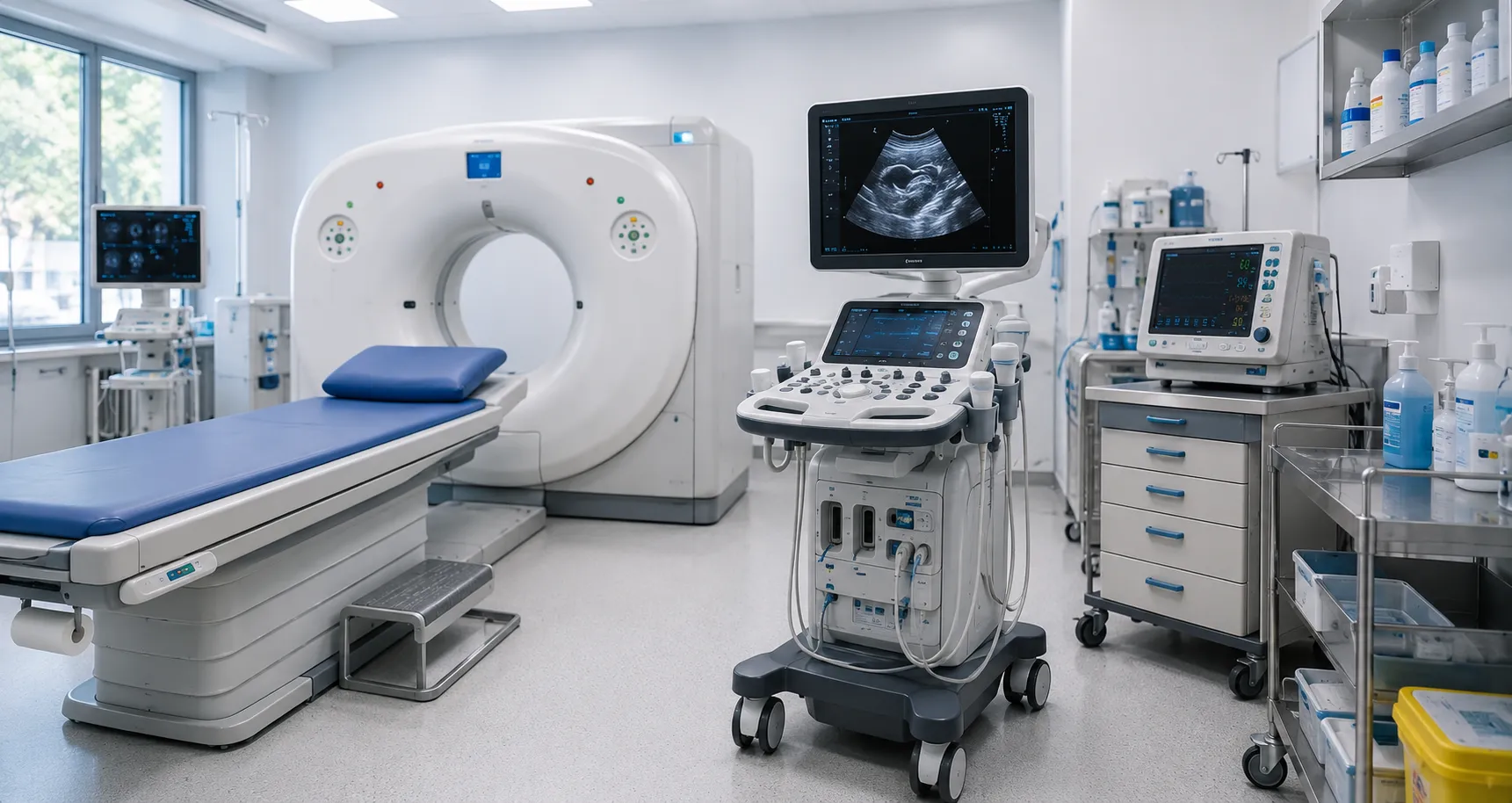
Diagnostic imaging. X-ray, CT, MRI, ultrasound, mammography and fluoroscopy — the workhorses of diagnosis, from broken bones to detailed cross-sectional and soft-tissue imaging.
-
Nuclear & molecular imaging. PET and SPECT imaging, which show function and metabolism, are widely used in oncology, cardiology, and neurology.
-
Cardiac diagnostics. ECG machines, echocardiography (cardiac ultrasound), stress-testing systems, and Holter monitors to assess heart rhythm and function.
-
Laboratory & in-vitro diagnostics. Haematology, clinical-chemistry and immunoassay analysers that test blood and other samples — the backbone of the hospital laboratory.
-
Endoscopy. Flexible and rigid endoscopes with camera towers, letting clinicians see inside the body's cavities for diagnosis and minimally invasive procedures.
-
Neurological & respiratory. EEG and EMG for neural and brain activity, and spirometry and pulmonary function tests for lung performance.
-
Point-of-care & portable. Glucose meters, blood-gas analysers, rapid infection tests and handheld ultrasound — fast results at the bedside, clinic or community.
-
Screening & vital signs. Blood pressure monitors, pulse oximeters, audiometers, and ophthalmic devices are used for routine checks and early detection.
What each category does
|
Category |
Examples |
Used for |
|
Imaging |
X-ray, CT, MRI, ultrasound |
Seeing inside the body |
|
Nuclear imaging |
PET, SPECT |
Function & metabolism |
|
Cardiac |
ECG, echo, stress test |
Heart rhythm & function |
|
Laboratory / IVD |
Haematology, chemistry analysers |
Testing blood & samples |
|
Endoscopy |
Flexible & rigid scopes |
Viewing internal cavities |
|
Neuro / respiratory |
EEG, EMG, spirometry |
Nerve, brain & lung function |
|
Point-of-care |
Glucose, blood gas, rapid tests |
Fast bedside results |
|
Screening |
BP, SpO2, audiometry |
Routine checks & detection |
X-ray vs CT vs MRI vs ultrasound
Imaging is the largest diagnostic family, and the four most common modalities each suit different questions. Choosing well means matching the modality to the clinical question, the patient and the budget.
|
Modality |
How it works |
Best for |
Consider |
|
X-ray |
Ionising radiation |
Bones, chest, fast triage |
Low cost; radiation dose |
|
CT |
Cross-sectional X-ray |
Trauma, detailed internal imaging |
Higher dose & cost |
|
MRI |
Magnetic fields, no radiation |
Soft tissue, brain, joints |
Costly, slower, contraindications |
|
Ultrasound |
Sound waves, no radiation |
Obstetrics, abdomen, vascular, bedside |
Operator-dependent; affordable |
No single modality is "best" — X-ray and ultrasound are affordable first-line workhorses, while CT and MRI answer more complex questions at higher cost.
Building diagnostic capacity?
We'll help you choose the right kit. Tell us the service, your budget, and your market — we'll help you pick diagnostic equipment that fits your clinical needs and is approved for use where you'll use it.
No pressure, no obligation. → Talk to the team
Imaging modalities compared
Within imaging, the four most common modalities suit very different jobs, and most services run several side by side. X-ray is fast, low-cost and ideal for bone and chest imaging, but offers limited soft-tissue detail. Ultrasound is portable, radiation-free, and excellent for soft tissue imaging, pregnancy, and guiding procedures at the bedside, though image quality depends heavily on the operator. CT builds detailed cross-sectional images in seconds, making it the workhorse for trauma, stroke and complex diagnosis, at the cost of a higher radiation dose. MRI provides the richest soft-tissue contrast with no ionising radiation, but it's slower, costlier, requires significant infrastructure, and isn't suitable for all patients, including those with certain implants. Choosing between them is rarely either/or — the right mix is matched to the clinical question, the patient, available space and budget, which is why understanding each modality's strengths matters before you invest.
Diagnostic equipment by care setting
-
Large hospitals - The full range — CT, MRI, nuclear imaging, full laboratory analysers and endoscopy — supporting complex and emergency care.
-
Clinics & diagnostic centres - X-ray, ultrasound, ECG and core lab or point-of-care testing, balancing capability with cost and space.
-
Primary care & community - Portable and point-of-care diagnostics — ultrasound, ECG, glucose and rapid tests — bringing diagnosis closer to the patient.
-
Emergency & bedside - Portable X-ray, handheld ultrasound and blood-gas analysers for fast answers where the patient is.
-
Screening programmes - Mammography, audiometry and ophthalmic devices are used at scale for early detection across populations.
Emerging diagnostic technology
-
AI-assisted diagnostics. Software now helps flag findings on X-ray, CT and retinal images, speeding reporting and supporting less specialised settings. It augments clinicians rather than replacing them — and any tool used for diagnosis is itself a regulated medical device.
-
Molecular & genomic testing. From PCR to next-generation sequencing, precision diagnostics for infection, cancer and inherited disease are moving from reference centres into routine labs, changing what equipment a modern laboratory needs.
-
Connected point-of-care. Point-of-care devices increasingly feed results straight into the patient record and remote-monitoring platforms, blurring the line between the lab, the bedside, and the home.
-
Buy for tomorrow. When investing, check how upgradeable and connectable a device is — software updates, data standards and interoperability matter as much as what the device does on day one.
Choosing diagnostic equipment
-
Define the clinical need and test volumes the equipment must support.
-
Match capability to setting — don't buy hospital-grade kit for a small clinic, or vice versa.
-
Weigh portable vs fixed, and new vs refurbished, against budget and lifespan.
-
Confirm market approval, the device risk class, and radiation safety where relevant.
-
Plan consumables, reagents, calibration and service support into the running cost.
Cost of ownership matters as much as the purchase price — analysers and imaging incur ongoing reagent, consumable, and service costs. Weigh new against certified refurbished, and confirm the device's risk class before buying.
Where diagnostic equipment is heading
-
AI-assisted diagnostics. Software that helps read images and flag abnormalities is increasingly built into imaging and pathology — speeding reporting and supporting, not replacing, clinicians. These tools are themselves regulated medical devices.
-
Molecular & genomic testing. PCR, sequencing and molecular diagnostics have moved into routine use, expanding what laboratories can detect — from infections to cancer markers and inherited conditions.
-
Decentralised & point-of-care. Testing continues to move closer to the patient, with compact analysers and handheld ultrasound bringing diagnosis to clinics, ambulances and the community.
-
Connected & cloud diagnostics. Devices that share results directly into the electronic record and remote-reporting platforms speed decisions and support telemedicine — raising data-security and interoperability requirements.
-
Greener, smaller systems. Manufacturers are reducing the footprint, power, and consumable burden of analysers and imaging systems, easing installation and running costs.
Approval by region
|
Region |
Regulator |
Requirement |
|
United Kingdom |
UKCA mark (CE accepted to 2028–2030) |
|
|
European Union |
CE marking (IVDR for diagnostics) |
|
|
United States |
510(k) clearance or PMA approval |
|
|
Gulf (GCC) |
SFDA & GCC bodies |
National registration / GCC conformity |
|
South Africa |
Medical device licensing |
Imaging also follows radiation-safety rules. For clinical and quality guidance, the NICE and World Health Organisation resources are useful references. Our buyer hub sets out how to purchase with confidence.
More from Business
-
Buyers — source the right diagnostic equipment for your clinic or hospital.
-
Suppliers — list your diagnostic equipment and reach healthcare buyers worldwide.
-
Advertise — promote your products and services to a clinical audience.
-
Business overview — explore everything MediGear offers healthcare organisations.
Disclaimer
This article is for general information only and does not constitute clinical, medical, procurement or regulatory advice. Diagnostic capabilities, requirements and regulations vary by country, clinical setting and need, and change over time. Always confirm that equipment suits the intended clinical use and is approved for your market (for example, UKCA, CE under EU MDR/IVDR, FDA, SFDA/GCC or SAHPRA), observe radiation-safety rules for imaging, and consult qualified clinical, biomedical engineering and procurement professionals for decisions specific to your organisation. medigear.uk accepts no liability for actions taken based on this content.
The right diagnostics for your service.
From imaging and lab analysers to endoscopy and point-of-care devices, we supply diagnostic equipment to clinics, hospitals and care services across the UK, Europe, the US, the Gulf and South Africa — compliant, supported and ready to use.
Frequently Asked Questions
The main categories are diagnostic imaging (X-ray, CT, MRI, ultrasound, mammography and nuclear imaging), cardiac diagnostics (ECG, echocardiography, stress testing), laboratory and in-vitro diagnostics (haematology, chemistry and immunoassay analysers), endoscopy, neurological and respiratory diagnostics, and point-of-care or portable devices such as glucose meters and rapid tests.
Diagnostic equipment is used to identify or confirm a condition — for example, an X-ray, a blood test, or an ECG. Monitoring equipment continuously tracks a patient's status, such as a bedside vital-signs monitor. Some devices, like ECG, can do both depending on how they're used.
Point-of-care (POC) diagnostics are tests performed near the patient rather than in a central lab — blood glucose meters, blood gas analysers, rapid infection tests, and portable ultrasound. They give faster results at the bedside, in clinics or in the community, though a central laboratory is still needed for complex testing.
X-ray and ultrasound are the most widely used because they're versatile, relatively affordable and available from large hospitals to small clinics. CT and MRI provide more detailed cross-sectional imaging for complex cases, while mammography and nuclear imaging serve specific diagnostic roles.
Yes. Imaging systems, analysers and ultrasound machines are commonly available as certified refurbished units, offering significant savings. Confirm certified refurbishment, a warranty, calibration and reliable service and consumable support, and check the device is approved for your market.
Diagnostic devices must be approved for the market where they're used — UKCA or CE in the UK and EU (in-vitro diagnostics follow the EU IVDR), FDA clearance in the US, and SFDA or SAHPRA registration in the Gulf and South Africa. Imaging equipment also follows radiation safety rules, so plan for compliance, calibration, and servicing.