
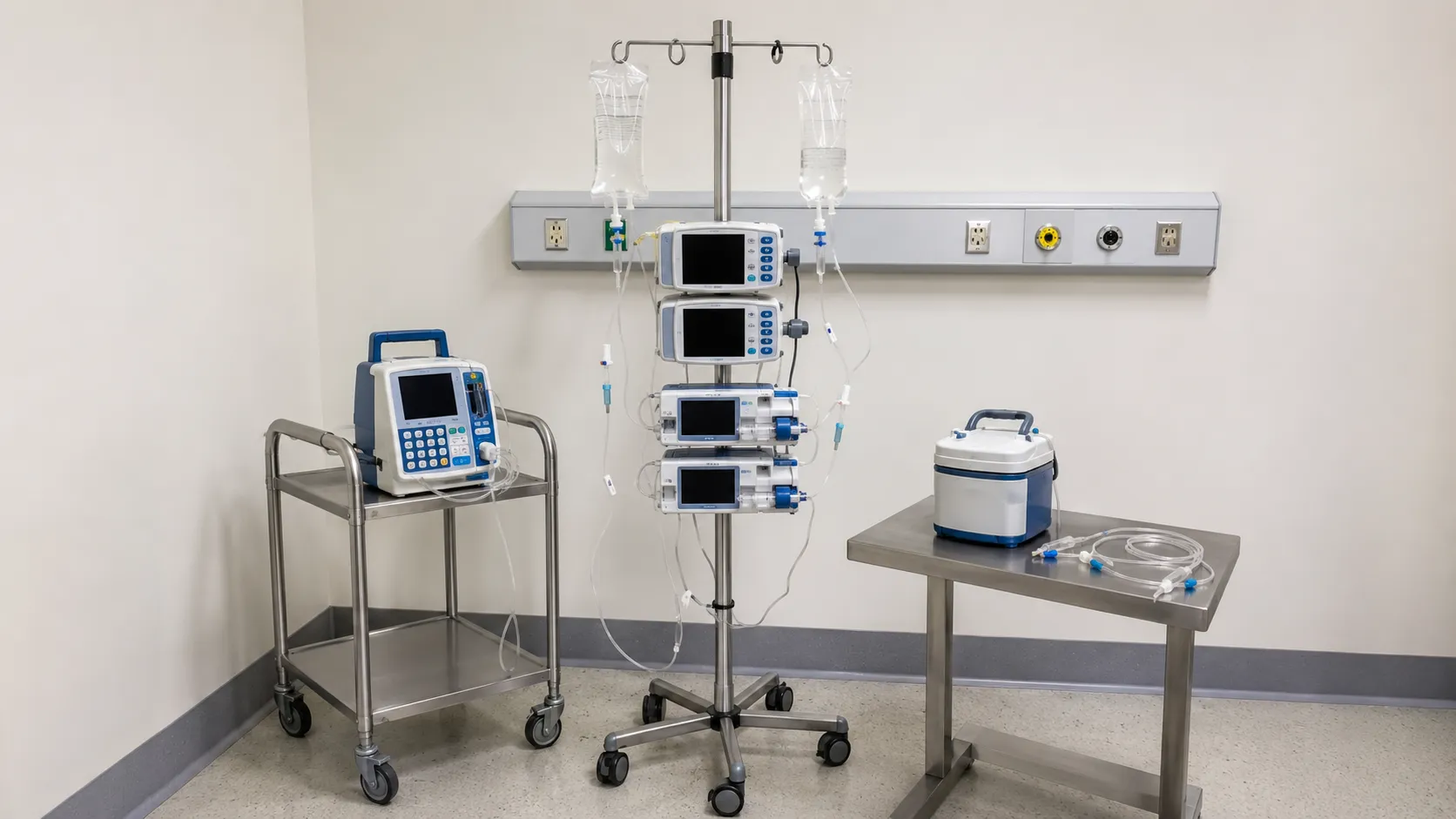
Introduction
Infusion is one of the most common things hospitals do, and doing it safely depends on the right equipment. IV therapy spans the pumps that deliver fluids and drugs precisely, the cannulae, catheters and lines that reach the vein, and the specialist pumps for pain control, feeding and ambulatory care. Understanding those groups helps any service plan, compare options and budget sensibly.
This guide walks through the main types of infusion and IV therapy equipment used worldwide, what each does, where it fits, and how to choose — with notes on approval across the UK, the EU, the US, the Gulf (GCC) states, and South Africa.
The short version — infusion equipment in three groups
Most infusion equipment falls into one of three groups — the pumps that deliver, the access and lines that reach the vein, and the specialist pumps for particular therapies.
-
Pumps — volumetric and syringe pumps that deliver fluids and drugs precisely.
-
Access & delivery — cannulae, catheters, giving sets and the lines that reach the vein.
-
Specialist infusion — PCA, enteral and ambulatory pumps for specific therapies.
Types of infusion and IV therapy equipment
-
Volumetric infusion pumps. Pumps that deliver large-volume fluids, blood and nutrition at a set rate in millilitres per hour.
-
Syringe pumps. Syringe drivers that deliver small, very precise volumes for potent drugs and neonatal care.
-
PCA pumps. Patient-controlled analgesia pumps that let patients deliver pain relief on demand within safe limits.
-
Ambulatory & elastomeric pumps. Portable and disposable pumps for infusion outside the hospital, including at home.
-
Enteral feeding pumps. Pumps that deliver controlled tube feeding to patients who cannot eat normally.
-
IV cannulae & catheters. Peripheral cannulae, central lines, PICCs and midlines that provide access to the vein.
-
Giving sets & lines. Gravity and pump giving sets, extension sets and connectors linking the bag to the patient.
-
Infusion accessories. IV stands, fluid warmers and pressure infusers that support safe infusion.
What each type does
|
Category |
Examples |
Used for |
|
Volumetric pumps |
Large-volume infusion pumps |
Fluids, blood, nutrition |
|
Syringe pumps |
Syringe drivers |
Small, precise drug doses |
|
PCA pumps |
Patient-controlled analgesia |
Pain relief on demand |
|
Ambulatory pumps |
Elastomeric, portable pumps |
Mobile and home infusion |
|
Enteral pumps |
Feeding pumps |
Tube feeding |
|
IV access |
Cannulae, central lines, PICCs |
Reaching the vein |
|
Giving sets |
Gravity and pump sets |
Connecting bag to patient |
|
Accessories |
Stands, warmers, pressure infusers |
Supporting infusion |
Infusion pump types compared
Different infusions need different pumps, and most hospitals run several types matched to the therapy.
|
Pump type |
Delivers |
Best for |
Consider |
|
Volumetric |
Large volumes (mL/h) |
Fluids, blood, nutrition |
Mains/battery; alarms |
|
Syringe |
Small, precise volumes |
Drugs, neonatal, critical care |
Limited volume |
|
PCA |
Patient-triggered boluses |
Post-op and chronic pain |
Lock-outs; safety |
|
Elastomeric |
Fixed-rate, no power |
Ambulatory and home infusion |
Single-use; less flexible |
Volumetric and syringe pumps cover most hospital infusions, with PCA and elastomeric pumps added for pain control and ambulatory care.
Equipping infusion and IV therapy?
We'll help you choose the right kit. Tell us the therapies, your budget and your market — we'll help you pick infusion equipment that fits your service and is approved for use where you'll use it.
No pressure, no obligation. → Talk to the team
Infusion equipment by setting
-
Hospital wards - volumetric and syringe pumps for fluids, drugs and nutrition.
-
Critical care & neonatal - multiple precise syringe pumps for tightly controlled, low-volume infusions.
-
Oncology & day units - infusion pumps and PCA for chemotherapy and supportive care.
-
Theatres & recovery - infusion and PCA pumps, fluid warmers and pressure infusers.
-
Home & community - ambulatory and elastomeric pumps for infusion outside the hospital.
Choosing infusion equipment
-
Define the infusions, volumes and patient groups the equipment must cover.
-
Match volumetric, syringe and specialist pumps to those therapies.
-
Standardise pumps and sets to simplify training and reduce error.
-
Confirm market approval, the device class and drug-library safety features.
-
Plan consumables — sets, cannulae and batteries — into the running cost.
Giving sets, cannulae and servicing dominate the running cost of an infusion fleet — weigh new against certified refurbished pumps, confirm set compatibility, and standardise devices to cut error before you buy.
Emerging infusion technology
-
Smart pumps & drug libraries. Dose-error-reduction software and preset drug libraries cut infusion errors.
-
Interoperability. Pumps link to the patient record and electronic prescribing for closed-loop safety.
-
Wireless monitoring. Networked pumps report status and alarms to central stations.
-
Wearable infusion. Smaller, smarter pumps support infusion at home.
-
Needle-safety devices. Safety cannulae and connectors reduce sharps injuries and infection.
Approval by region
|
Region |
Regulator |
Requirement |
|
United Kingdom |
UKCA mark (CE accepted to 2028–2030) |
|
|
European Union |
CE marking under the EU MDR |
|
|
United States |
510(k) clearance or PMA approval |
|
|
Gulf (GCC) |
SFDA & GCC bodies |
National registration / GCC conformity |
|
South Africa |
Medical device licensing |
Infusion equipment also follows electrical-safety and infusion-accuracy standards. For clinical and quality guidance, the NICE and World Health Organisation resources are useful references. Our buyer hub sets out how to purchase with confidence.
More from Business
-
Buyers — source infusion pumps, syringe drivers and IV equipment for your service.
-
Suppliers — list your infusion and IV therapy equipment and reach buyers worldwide.
-
Advertise — promote your products and services to a clinical audience.
-
Business overview — explore everything MediGear offers healthcare organisations.
Disclaimer
This article is for general information only and does not constitute clinical, medical, procurement or regulatory advice. Infusion equipment, therapies, requirements and regulations vary by country, setting and need, and change over time. Always confirm that equipment suits the intended clinical use and is approved for your market (for example, UKCA, CE under the EU MDR, FDA, SFDA/GCC or SAHPRA), follow infusion-accuracy and electrical-safety standards, and consult qualified clinical, biomedical engineering and procurement professionals for decisions specific to your organisation. medigear.uk accepts no liability for actions taken based on this content.
Frequently Asked Questions
The main types are volumetric infusion pumps for large-volume fluids, syringe pumps for small, precise doses, patient-controlled analgesia (PCA) pumps for pain relief, ambulatory and elastomeric pumps for mobile infusion, and enteral feeding pumps. These work with IV access such as cannulae and central lines, giving sets and accessories like stands, fluid warmers and pressure infusers.
A volumetric pump delivers larger volumes, measured in millilitres per hour, and is used for fluids, blood and nutrition. A syringe pump delivers small, very precise volumes from a syringe and is used for potent drugs, critical care and neonatal infusions. Hospitals use both, matched to the volume and accuracy needed.
A patient-controlled analgesia (PCA) pump lets the patient deliver a preset dose of pain relief on demand by pressing a button, within safe limits set by staff. It is widely used after surgery and in chronic or cancer pain. Lock-out periods and dose limits keep it safe, and the pump records every dose for review.
Yes. Volumetric and syringe pumps are available as certified refurbished units and can reduce costs. Confirm certified refurbishment, a warranty, calibration and service support, check giving-set compatibility, and confirm the device is approved for your market. Pumps should be tested for delivery accuracy and electrical safety before clinical use.
Infusion devices must be approved for the market — UKCA or CE under the EU MDR in the UK and EU, FDA clearance in the US, and SFDA or SAHPRA registration in the Gulf and South Africa. Accuracy and electrical-safety standards apply, and many pumps include drug-library safety software, so plan for calibration, servicing and staff training.
Standardising pumps and giving sets, using smart pumps with dose-error-reduction software and drug libraries, and linking pumps to electronic prescribing all reduce infusion errors. Clear labelling, staff training and double-checks for high-risk drugs are equally important, alongside routine maintenance and calibration of the pumps themselves.
The right infusion kit for your service.
From volumetric and syringe pumps to PCA, enteral pumps, cannulae and giving sets, we supply infusion and IV therapy equipment to hospitals and clinics across the UK, Europe, the US, the Gulf and South Africa — compliant, supported and ready to use.