
Introduction
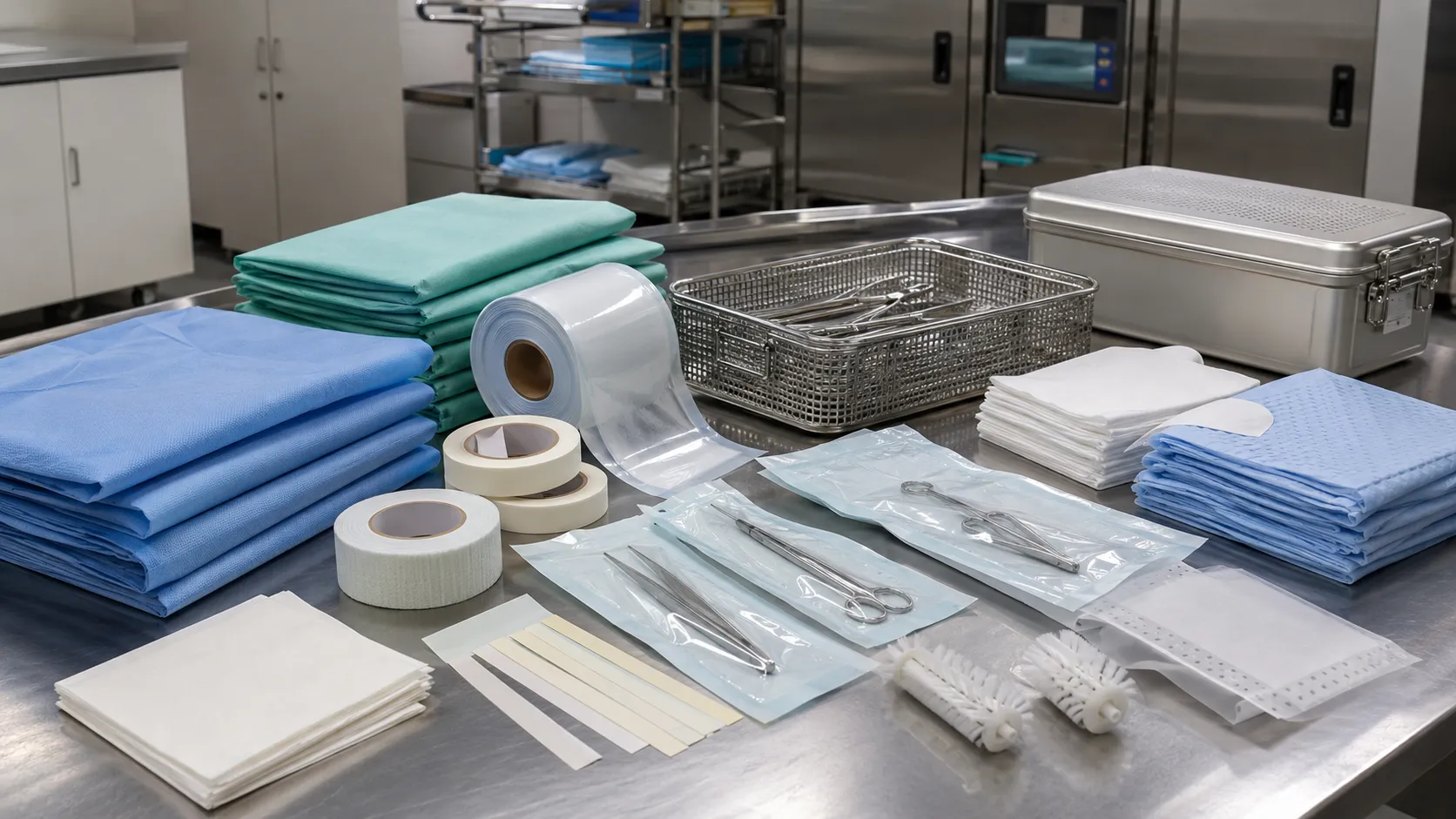
Sterilisation consumables are the everyday backbone of infection prevention — the pouches, wraps and containers that package instruments, the indicators that prove each cycle worked, and the gowns and drapes that maintain sterility at the point of care. They are used in every sterilisation department, operating theatre and endoscopy unit, and choosing the right ones is as important as choosing the right steriliser. Understanding those groups helps any hospital plan, compare options and budget sensibly.
This guide walks through the main types of hospital sterilisation consumables used worldwide, what each does, where it fits, and how to choose — with notes on approval across the UK, the EU, the US, the Gulf (GCC) states, and South Africa.
The short version — sterilisation consumables in three groups
Most sterilisation consumables fall into one of three groups — packaging, monitoring and process verification, and sterile barrier products used at the point of care.
-
Packaging — pouches, wraps, rigid containers and reels that package instruments for sterilisation and storage.
-
Monitoring & verification — chemical and biological indicators, test packs and tape that prove every cycle worked.
-
Sterile barrier products — gowns, drapes, fenestrations and sterile field supplies used at the point of care.
Types of sterilisation consumables
-
Sterilisation pouches. Self-seal and heat-seal paper/film pouches and reels for packaging individual instruments and small sets.
-
Sterilisation wraps. Non-woven wrap and SMS wrap for wrapping instrument trays and larger sets in a sterile barrier.
-
Rigid sterilisation containers. Reusable rigid containers with filter heads and locking lids for instrument sets.
-
Chemical indicators. Class 1-6 chemical indicators — including process challenge devices, Bowie-Dick test packs and integrators — that change to show sterilisation conditions were met.
-
Biological indicators. Spore-based biological indicators that prove sterilisation actually occurred by killing a defined microbial challenge.
-
Sterilisation tape & labels. Autoclave tape and identification labels that change colour and carry lot and cycle information.
-
Surgical gowns. Sterile single-use surgical gowns for surgeons, scrub and theatre staff to maintain the sterile field.
-
Surgical drapes. Sterile single-use drapes, fenestrations and packs that create and maintain the sterile surgical field.
What each type does
|
Category |
Examples |
Used for |
|
Sterilization pouches |
Paper/film pouches and reels |
Packaging individual instruments |
|
Wraps |
Non-woven and SMS wrap |
Wrapping trays and sets |
|
Rigid containers |
Reusable filter containers |
Instrument sets |
|
Chemical indicators |
Class 1-6 CIs, integrators |
Proving sterilisation conditions |
|
Biological indicators |
Spore-based BIs |
Proving actual sterilisation |
|
Tape & labels |
Autoclave tape, cycle labels |
Identification and cycle tracking |
|
Surgical gowns |
Sterile single-use gowns |
Sterile field for theatre staff |
|
Surgical drapes |
Sterile drapes, fenestrations |
Creating the sterile surgical field |
Sterilisation packaging types compared
Several packaging formats are used for sterilised instruments, each suited to different instrument types and volumes.
|
Type |
Best for |
Reusable |
Consider |
|
Pouches |
Single instruments and small items |
No |
Easy to check integrity |
|
Wraps |
Trays and larger sets |
No (usually) |
Double-wrapping for storage |
|
Rigid containers |
Complete instrument sets |
Yes |
Filter maintenance; cost |
|
Vacuum-sealed reels |
Custom-sized single items |
No |
Sealer needed; versatile |
Most CSSDs use pouches for individual instruments and sets of one to a few pieces, with wraps for trays and rigid containers for high-use complete sets.
Stocking your sterilisation department?
We'll help you choose the right supplies. Tell us your instrument load, sterilisation methods and your market — we'll help you pick consumables that meet your decontamination standards and are approved for use where you'll use them.
No pressure, no obligation. → Talk to the team
Sterilisation consumables by setting
-
Central sterile services - the full range — pouches, wraps, rigid containers, all indicator classes and tracking labels.
-
Operating theatres - surgical gowns, drapes and sterile packs alongside near-theatre packing and indicators.
-
Endoscopy units - reprocessing consumables and chemical indicators for endoscope disinfection cycles.
-
Dental clinics - Class B autoclave pouches, biological indicators and tape for dental instrument sterilisation.
-
Day surgery and clinics - pouches, wraps and chemical indicators for smaller, high-turnover instrument loads.
Choosing sterilisation consumables
-
Match packaging format to instrument type — pouches for singles, wraps for trays, containers for sets.
-
Select indicator class to meet the sterilisation validation and routine monitoring requirements.
-
Confirm compatibility with your steriliser model and cycle parameters.
-
Ensure consumables carry the correct regulatory approval for your market.
-
Plan stock levels, storage, lot tracking and single-use policy across the department.
Indicator compatibility, packaging seal integrity and gown performance need to be validated for your steriliser and processes — never assume a cheaper alternative performs equivalently without checking the supplier's validation data.
Emerging trends in sterilisation consumables
-
Traceability integration. QR codes and RFID on pouches and containers link instruments to cycles, patients and records.
-
Sustainable materials. Manufacturers are developing lower-footprint wraps and packaging to reduce sterilisation waste.
-
Single-use expansion. The shift to single-use instruments extends the scope of pouches and wraps needed.
-
Process challenge devices. More sophisticated PCDs provide tighter process monitoring and early failure detection.
-
Low-temperature packaging. New pouch and wrap materials compatible with gas plasma and ETO expand the range of packaged loads.
Approval by region
|
Region |
Regulator |
Requirement |
|
United Kingdom |
UKCA mark (CE accepted to 2028–2030) |
|
|
European Union |
CE marking under the EU MDR |
|
|
United States |
510(k) clearance or PMA approval |
|
|
Gulf (GCC) |
SFDA & GCC bodies |
National registration / GCC conformity |
|
South Africa |
Medical device licensing |
Sterilisation consumables including pouches, wraps and indicators are regulated as medical devices or as accessories to medical devices. For clinical and quality guidance, the NICE and World Health Organisation resources are useful references. Our buyer hub sets out how to purchase with confidence.
More from Business
-
Buyers — source sterilisation pouches, wraps, indicators and CSSD supplies for your hospital.
-
Suppliers — list your sterilisation consumables and reach buyers worldwide.
-
Advertise — promote your products and services to a clinical audience.
-
Business overview — explore everything MediGear offers healthcare organisations.
Disclaimer
This article is for general information only and does not constitute clinical, decontamination, medical, procurement or regulatory advice. Sterilisation consumable requirements and regulations vary by country, setting and need, and change over time. Always confirm that consumables suit the intended use and are approved for your market (for example, UKCA, CE under the EU MDR, FDA, SFDA/GCC or SAHPRA), follow decontamination and sterilisation standards, and consult qualified decontamination, biomedical engineering and procurement professionals for decisions specific to your organisation. medigear.uk accepts no liability for actions taken based on this content.
The right sterilization consumables for your hospital.
From sterilization pouches, wraps and containers to chemical indicators, biological indicators, gowns and surgical drapes, we supply sterilization consumables to hospitals and clinics across the UK, Europe, the US, the Gulf and South Africa.
Frequently Asked Questions
Hospital sterilization consumables include paper/film pouches and reels for packaging individual instruments, non-woven wraps for instrument trays and sets, reusable rigid sterilization containers, chemical indicators from Class 1 tape to Class 6 integrators, biological indicators containing spores, sterilization tape and cycle labels, sterile single-use surgical gowns, and surgical drapes and fenestrations.
A chemical indicator — such as autoclave tape, process indicators or integrators — changes colour or appearance when sterilization parameters such as temperature, time and steam have been met, giving a quick visible result. A biological indicator contains live bacterial spores and proves sterilization actually occurred by showing the spores have been killed after incubation. Both are used together as part of a complete monitoring programme.
Chemical indicators are classified from Class 1 to Class 6. Class 1 includes process indicator tape placed on packages to show they have been processed. Class 2 indicators are Bowie-Dick test packs for steam penetration. Classes 3 and 4 indicate specific variables. Class 5 integrating indicators respond to all sterilization variables, and Class 6 emulating indicators are cycle-specific. Higher classes provide more information about cycle performance.
Pouches, wraps and indicators must be validated for compatibility with the specific sterilizer type, cycle parameters and manufacturer's recommendations. A pouch validated for a pre-vacuum steam autoclave may not perform correctly in a low-temperature gas-plasma system. Always check the supplier's validation data for your sterilizer model and confirm the product is approved for the intended use.
Sterilization pouches, wraps and indicators are regulated as medical devices or as accessories and must be approved for the market — UKCA or CE under the EU MDR in the UK and EU, FDA clearance in the US, and SFDA or SAHPRA registration in the Gulf and South Africa. They must also conform to standards such as ISO 11607 for packaging and ISO 11138 for biological indicators.
Surgical drapes are sterile barriers placed over the patient and surgical field to prevent contamination from adjacent non-sterile surfaces during a procedure. They are typically single-use non-woven material with impermeable reinforced zones, adhesive incise films and fenestrations shaped to the procedure. Single-use drapes eliminate the reprocessing, validation and quality-control requirements of reusable textile drapes and reduce cross-contamination risk.