
Introduction
Medication errors are one of the largest single causes of preventable harm in hospitals, both in the UK and globally. The World Health Organisation's Medication Without Harm challenge set a target of halving avoidable medication-related harm in five years; achieving that requires attention to the whole medication pathway, from procurement through dispensing to administration at the bedside. Pharmacy automation is one of the tools that hospitals use to reduce errors in that pathway, though it is far from the whole answer. What follows walks through the main types of automation in use in UK hospitals, structured by where they sit in the workflow rather than by manufacturer or technology.
The scale matters for anyone deciding what to invest in. A large UK teaching hospital pharmacy might process several million dispensing events per year, cover hundreds of thousands of inpatient episodes, and compound tens of thousands of complex parenteral doses. At that scale, small percentage improvements in error rate or throughput translate into meaningful patient safety and workforce gains. At smaller scales, the case for capital-intensive automation is different and needs its own analysis.
Automated storage and picking in central pharmacy
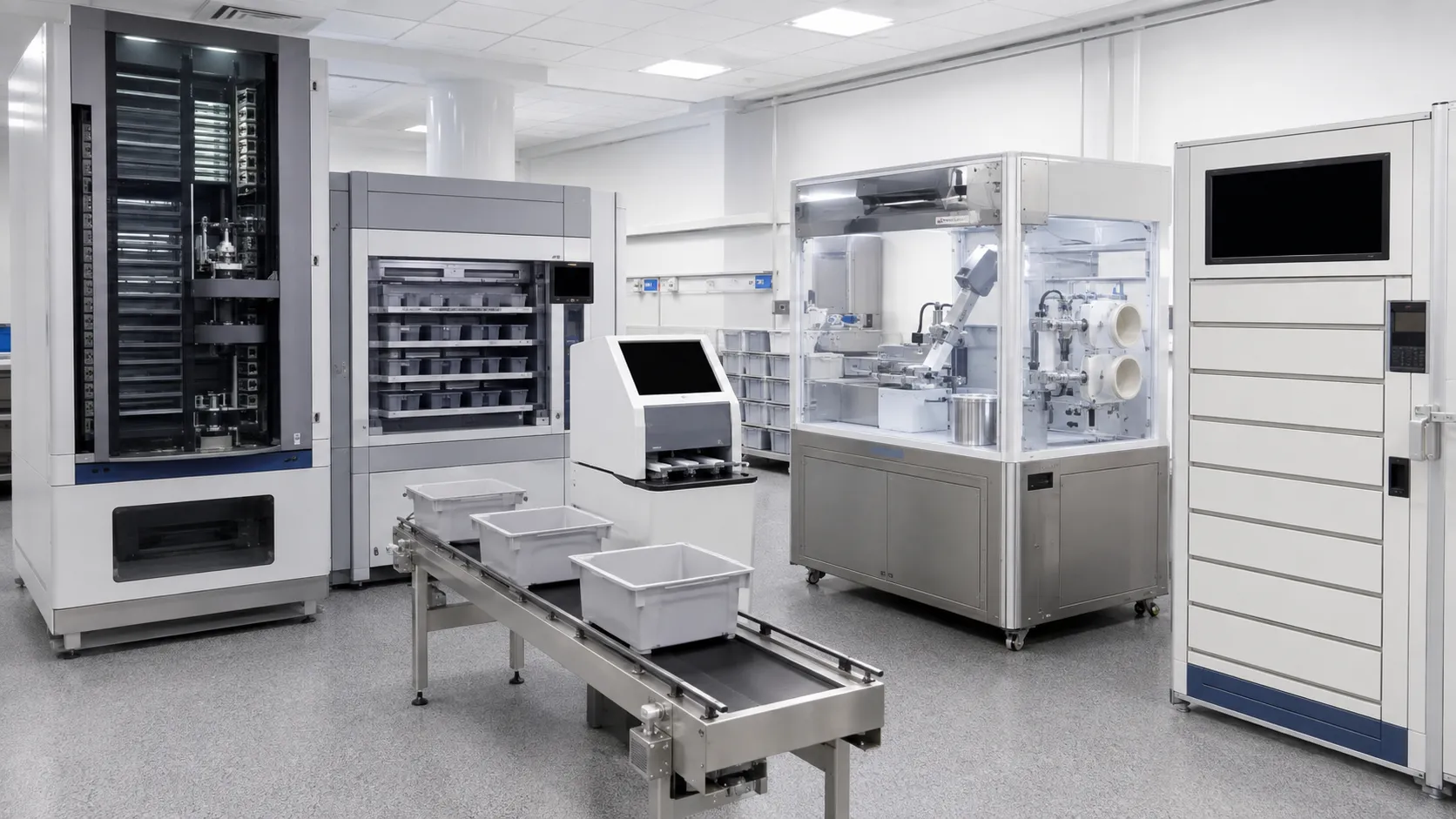
The best-established category. Robotic dispensing systems in central hospital pharmacy handle bulk medicine storage and picking, replacing manual shelf-search and picking with computer-controlled storage carousels or bin-based automated systems. The two dominant manufacturers in the UK market are BD Rowa (Vmax, Prologue, ProCube ranges) and Willach (Consis and CONA). These systems store thousands of medicine packs in high-density arrangements, retrieve them on prescription request, and deliver them to dispensing points via conveyor or automated dispensing chutes.
The clinical case for central pharmacy robotics is a combination of picking error reduction, faster turnaround, better stock rotation (first-expiry-first-out is genuinely enforced rather than aspirational), and freed pharmacist time for clinical rather than dispensing duties. Capital cost is substantial — a fully-featured central pharmacy robotic system runs into the low millions once installed. Business cases typically depend on demonstrating error reduction, throughput improvements, and reallocation of pharmacist time to clinical services.
Not every hospital pharmacy needs this. Smaller pharmacies with lower throughput may get better return from workflow software and lightweight automation. The UK NHS picture is a spread from fully-automated large teaching hospital pharmacies to smaller community hospital pharmacies operating largely manually, and the optimum on that spread varies with scale, workforce, and specific service mix.
Automated dispensing cabinets at ward level
Automated dispensing cabinets (ADCs) are ward-based lockable cabinets that hold medicines closer to the point of use, with electronic access control tied to the patient's prescription. Omnicell's XT series and BD's Pyxis MedStation are the two dominant products in the UK NHS market. Cabinets are typically stocked from central pharmacy and refilled based on utilisation, with usage data feeding back to inform stocking.
The clinical rationale is faster access to medicines at the point of use (particularly for controlled drugs, where the audit trail is also improved), reduced ward-based medicine storage, and reduced pressure on central pharmacy for routine ward dispensing. There are trade-offs: ward staff need to understand and use the system correctly, and poorly configured ADCs can create workarounds that undermine the safety case. Successful implementations pair the equipment with careful workflow design and ongoing user support, not just installation-and-forget. Trusts that have measured before-and-after error rates on properly implemented ADC rollouts have documented meaningful reductions; trusts that installed and walked away have not always seen the same benefits at the ward level of the hospital.
Controlled drug management
Controlled drug management deserves separate mention because the compliance requirements are stricter than for general medicines. UK Misuse of Drugs Regulations 2001 require detailed record-keeping, witnessed transactions for certain schedules, and specific storage requirements. Automated systems supporting CD management include the ADCs above with enhanced CD workflow, dedicated CD safes and cabinets (CIVAS, Bailey, and others), and specialist CD management software that maintains the CD register digitally with the required audit trail.
The direction of travel is toward digital CD registers replacing paper, which reduces the historical burden of manual reconciliation. Trusts implementing digital CD management need to ensure the systems meet the specific regulatory requirements for record integrity and audit trails, which not all general medicine management software does.
IV compounding and aseptic preparation
The highest-risk part of hospital pharmacy in error-and-harm terms, and increasingly a candidate for automation. IV compounding robots (BD Cato, Riva by ARxIUM, and others) prepare individualised patient IV doses under aseptic conditions, with barcode verification of ingredients and gravimetric or volumetric confirmation of dose. These systems address several risks: wrong drug, wrong strength, wrong diluent, wrong volume, and wrong patient labelling — all documented sources of serious harm in manual compounding.
The systems are expensive (mid-to-high six figures for a full robotic compounding installation) and their business case depends on the volume and complexity of parenteral compounding at the specific hospital. Oncology chemotherapy compounding, parenteral nutrition, and neonatal intensive care preparation are the highest-risk contexts and often the ones where automation is prioritised. Manual compounding continues to be the norm for lower-volume compounding and remains safe when performed correctly under proper aseptic technique and independent verification.
Unit-dose packaging and repackaging
Repackaging bulk medicines into patient-specific or dose-specific packaging is another established automation area. Systems from ARxIUM (formerly McKesson Automation), Baxter's ATC-series unit-dose packagers, and others produce blister-packed or pouch-packed medicines labelled for specific patients or wards. The use case is strongest where multi-dose administration systems (blister packs for elderly patients, dose administration aids in mental health services) are heavily used.
Community pharmacy automation for compliance aids (Nomad, Venalink, and others) is a related but distinct category that supports domiciliary and care home medication management. Hospital pharmacies increasingly support these workflows for discharge medicines and community outreach services.
Bedside verification and closed-loop administration
The final link in the automation chain. Bedside medication administration verification uses barcode scanning to confirm the "five rights" (right patient, right drug, right dose, right route, right time) at the point of administration. Systems integrate with the hospital's electronic patient record so that scanned barcodes on the patient's wristband and the medicine packaging cross-check against the prescription. Vendor implementations differ — Omnicell, BD, and various EPR vendors including Epic, Cerner and System C all offer bedside verification within broader medication management modules.
Closed-loop medication administration (CLMA) is the term for the full workflow: prescription entered electronically, verified by pharmacy, dispensed through automation, administered with barcode verification, and recorded automatically. Achieving genuine closed-loop workflow requires all the links to be in place and working together, which is a substantial organisational undertaking rather than a single procurement. The evidence for closed-loop reducing serious medication errors is strong; the evidence for how difficult it is to implement well is equally strong.
The regulatory and standards picture
Pharmacy automation sits at the intersection of medical device regulation (some equipment is registered as a medical device, some is not), medicines legislation (Misuse of Drugs Regulations for CDs, Human Medicines Regulations for general medicines), and hospital pharmacy professional standards. The Royal Pharmaceutical Society's professional standards and the Chief Pharmaceutical Officer's guidance provide the framework for UK NHS implementations, alongside NHS England's hospital pharmacy transformation guidance that has driven much of the recent investment direction.
For hospitals investing in pharmacy automation, the important point is that the technology itself is only part of what needs to be right. Workflow redesign, workforce role changes, training, and ongoing support all determine whether the automation delivers the safety and efficiency benefits it can, or becomes an expensive addition to existing manual processes that persist alongside it. Vendors that focus only on selling equipment tend to leave hospitals with automation that underperforms; vendors that engage with the workflow side tend to be worth the higher up-front cost.
Hospital pharmacy automation touches medicines legislation, medical device regulation, and professional pharmacy standards. This overview does not substitute for specialist procurement advice, business case development, or the pharmacy workforce planning that any substantial automation project requires. Named vendors reflect UK NHS market presence and are not endorsements. Adoption should be led by the chief pharmacist, IT, clinical governance, and workforce leads together, not by any one function in isolation.
Pair the technology with the workflow, not the other way round
Building the business case for a central pharmacy robot, expanding an ADC deployment across wards, or working through the pharmacy elements of a closed-loop medication programme? These are procurement decisions where the equipment cost is only part of the picture — workflow redesign, workforce planning, and integration with the electronic patient record all shape whether the investment delivers. We can put you in touch with specialists who understand hospital pharmacy from both the pharmacy and the technology sides. Tell us what you're working through.
Frequently Asked Questions
Hospital pharmacy automation covers a range of technologies that support the medication pathway from procurement through dispensing to administration: central pharmacy robotic storage and picking (BD Rowa, Willach), automated dispensing cabinets at ward level (Omnicell, BD Pyxis), IV compounding robots (BD Cato, Riva), unit-dose packaging systems, controlled drug management systems, and bedside barcode verification. The purpose is to reduce medication errors, improve throughput, and free pharmacist time for clinical work rather than dispensing.
For central pharmacy robotic dispensing, BD Rowa (Vmax, Prolog, ProCube) and Willach (Consis and CONA) are the two dominant manufacturers in the UK NHS market. For automated dispensing cabinets at ward level, Omnicell's XT series and BD's Pyxis MedStation lead the market. For IV compounding, BD Cato and Riva (by ARxIUM) are the main systems. Choice depends on the specific application, integration requirements, and workflow design of the individual hospital pharmacy.
No. The case for automation depends on scale, workforce, and service mix. A large teaching hospital pharmacy processing several million dispensing events per year benefits substantially from robotic dispensing. A smaller community hospital pharmacy with lower throughput may get better return from workflow software and lightweight automation. The optimum varies significantly, and the business case for any particular automation should be built on specific local data rather than on general assumptions.
An automated dispensing cabinet (ADC) is a ward-based lockable cabinet that holds medicines closer to the point of use, with electronic access control tied to the patient's prescription. Products like Omnicell XT and BD Pyxis MedStation are the main UK examples. Cabinets are stocked from central pharmacy and refilled based on utilisation data. Benefits include faster access at the point of use, improved controlled drug audit trails, and reduced pressure on central dispensing for routine ward medicines.
Closed-loop medication administration (CLMA) is the full workflow of a prescription entered electronically, verified by pharmacy, dispensed through automation, administered with barcode verification at the bedside, and recorded automatically in the electronic patient record. Achieving genuine closed-loop workflow requires all the links to be in place and working together, and is a substantial organisational undertaking rather than a single procurement. The evidence for closed-loop reducing serious medication errors is strong.
Increasingly, but not yet universal. IV compounding robots such as BD Cato and Riva prepare individualised patient IV doses under aseptic conditions with barcode and gravimetric verification. They address well-documented risks in manual compounding: wrong drug, wrong strength, wrong diluent, wrong volume. Investment tends to be prioritised in the highest-risk contexts: oncology chemotherapy, parenteral nutrition, and neonatal intensive care preparation. Manual compounding continues to be safe when performed under proper aseptic technique and independent verification.
The evidence base for pharmacy automation reducing certain types of medication error is strong — particularly picking errors in central dispensing, and administration errors at the bedside when barcode verification is used. However, the evidence is also clear that automation on its own doesn't eliminate errors and can introduce new error modes if implementations are rushed or workflows aren't redesigned properly. Successful implementations pair the equipment with workflow design, training, and ongoing support rather than treating installation as the end of the project.