
Introduction
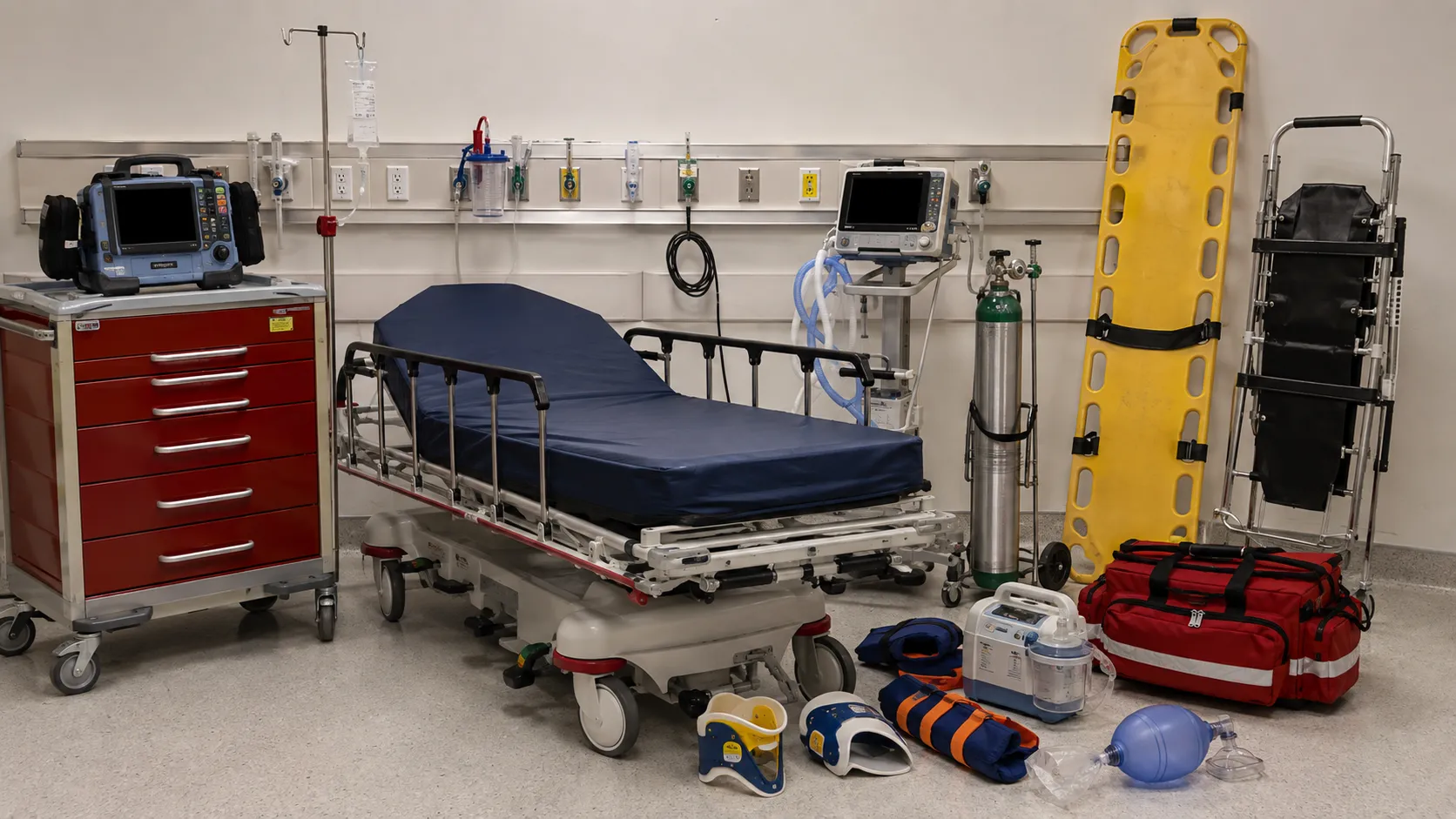
When every second matters, the right emergency and trauma equipment must be ready, working and easy to use. Emergency care spans resuscitation and defibrillation, airway and ventilation, monitoring and vascular access, and the immobilisation and transfer equipment that moves patients safely. Understanding those groups helps any emergency service plan, compare options and budget sensibly.
This guide walks through the main types of emergency and trauma equipment used worldwide, what each does, where it fits, and how to choose — with notes on approval across the UK, the EU, the US, the Gulf (GCC) states, and South Africa.
The short version — emergency equipment in three groups
Most emergency and trauma equipment falls into one of three groups — resuscitation and life support, monitoring and vascular access, and immobilisation and transfer.
-
Resuscitation & life support — defibrillators, airway devices and ventilators that restart and support life.
-
Monitoring & vascular access — emergency monitors, oximeters and IV equipment that assess and treat rapidly.
-
Immobilisation & transfer — spinal boards, cervical collars, stretchers and trolleys that move patients safely.
Types of emergency and trauma equipment
-
Defibrillators. Manual and automated external defibrillators (AEDs) for cardiac arrest, plus AEDs for public access.
-
Resuscitation equipment. Bag-valve masks, oxygen systems, suction units and resuscitation boards for cardiac and respiratory arrest.
-
Airway management. Laryngoscopes, supraglottic airways, endotracheal tubes and video laryngoscopes for securing the airway.
-
Emergency ventilators. Portable and transport ventilators for patients who cannot breathe independently in or out of hospital.
-
Emergency monitoring. Portable multi-parameter monitors, defibrillator-monitors and pulse oximeters giving fast vital-sign data.
-
Vascular access & infusion. IV cannulae, intraosseous devices, pressure infusers and fluid-warming equipment for rapid volume replacement.
-
Immobilisation. Cervical collars, spinal boards, vacuum mattresses and limb splints for suspected spinal and fracture injuries.
-
Patient transfer. Emergency trolleys, scoop stretchers, ambulance cots and carry chairs for safe patient movement.
What each type does
|
Category |
Examples |
Used for |
|
Defibrillators |
Manual defib, AEDs |
Cardiac arrest management |
|
Resuscitation |
BVM, oxygen, suction, boards |
CPR and respiratory support |
|
Airway |
Laryngoscopes, airways, video laryngoscopy |
Securing the airway |
|
Emergency ventilators |
Portable, transport ventilators |
Breathing support |
|
Monitoring |
Portable monitors, defib-monitors, oximeters |
Fast vital-sign assessment |
|
Vascular access |
Cannulae, IO devices, fluid warmers |
Rapid fluid and drug access |
|
Immobilisation |
Collars, spinal boards, splints |
Protecting the spine and fractures |
|
Transfer |
Trolleys, stretchers, cots |
Moving patients safely |
Defibrillator types compared
Defibrillators come in several forms, each suited to a different care setting and operator.
|
Type |
Who uses it |
Best for |
Consider |
|
Manual defib |
Clinicians |
Hospital arrest, cardioversion |
Training required |
|
AED |
Anyone |
Public access cardiac arrest |
Automated; limited to VF/VT |
|
Defib-monitor |
Clinicians |
Hospital emergency, monitoring and defib |
Combined; more costly |
|
Wearable defib |
Patient |
High-risk patients out of hospital |
Single-patient use |
Most emergency departments need both a manual defibrillator-monitor for clinical use and AEDs for wider deployment, matched to the operator and setting.
Equipping an emergency service?
We'll help you choose the right kit. Tell us the care setting, your budget and your market — we'll help you pick emergency and trauma equipment that's ready when it's needed and approved for use where you'll use it.
No pressure, no obligation. → Talk to the team
Emergency equipment by setting
-
Emergency departments - the full range — defibrillator-monitors, airway, resuscitation, portable imaging and trauma immobilisation.
-
Ambulance & pre-hospital - portable defib-monitors, ventilators, airway kits, immobilisation and stretchers for mobile emergency care.
-
Resuscitation rooms - advanced airway, monitoring, rapid infusion and imaging close to the patient.
-
Wards & public spaces - AEDs and basic resuscitation kits for cardiac arrest response beyond the emergency department.
-
Low-resource settings - manual defibrillators, BVMs, oxygen and basic airway kits where infrastructure is limited.
Choosing emergency and trauma equipment
-
Define the emergencies and patient volumes the equipment must handle.
-
Match defibrillators, airway kits and monitoring to the care level and operators.
-
Ensure equipment is ready to use without complicated setup in a crisis.
-
Confirm market approval, the device class and maintenance requirements.
-
Plan training, consumables and inspection schedules into the running programme.
Emergency equipment must be maintained and ready at all times — plan regular inspection, consumable replacement and staff training alongside the purchase, and confirm each device's risk class before buying.
Emerging emergency and trauma technology
-
Video laryngoscopy. Camera-assisted airway devices improve first-pass success in difficult airways.
-
Point-of-care ultrasound. Handheld ultrasound gives fast assessment of cardiac, abdominal and thoracic injuries at the bedside.
-
Connected AEDs. AEDs that alert emergency services and report data automatically.
-
Resuscitation data. CPR feedback devices and data capture improve performance and audit.
-
Haemostatic technology. Advanced wound-packing agents and tourniquets cut blood loss in trauma.
Approval by region
|
Region |
Regulator |
Requirement |
|
United Kingdom |
UKCA mark (CE accepted to 2028–2030) |
|
|
European Union |
CE marking under the EU MDR |
|
|
United States |
510(k) clearance or PMA approval |
|
|
Gulf (GCC) |
SFDA & GCC bodies |
National registration / GCC conformity |
|
South Africa |
Medical device licensing |
Emergency medical devices are strictly regulated, and defibrillators and ventilators sit at the highest-risk level. For clinical and quality guidance, the NICE and World Health Organisation resources are useful references. Our buyer hub sets out how to purchase with confidence.
More from Business
-
Buyers — source defibrillators, resuscitation and emergency equipment for your service.
-
Suppliers — list your emergency and trauma equipment and reach buyers worldwide.
-
Advertise — promote your products and services to a clinical audience.
-
Business overview — explore everything MediGear offers healthcare organisations.
Disclaimer
This article is for general information only and does not constitute clinical, emergency, medical, procurement or regulatory advice. Emergency equipment, requirements and regulations vary by country, setting and need, and change over time. Always confirm that equipment suits the intended clinical use and is approved for your market (for example, UKCA, CE under the EU MDR, FDA, SFDA/GCC or SAHPRA), follow maintenance and inspection schedules, and consult qualified emergency medicine, biomedical engineering and procurement professionals for decisions specific to your organisation. medigear.uk accepts no liability for actions taken based on this content.
The right kit for your emergency service.
From defibrillators, resuscitation and airway equipment to trauma monitoring, immobilisation and patient transfer, we supply emergency and trauma equipment to hospitals, ambulance services and clinics across the UK, Europe, the US, the Gulf and South Africa.
Frequently Asked Questions
Emergency and trauma equipment covers defibrillators including manual units, AEDs and combined defibrillator-monitors, resuscitation equipment such as bag-valve masks, oxygen and suction, airway management devices, emergency ventilators, portable monitoring, vascular access equipment, immobilisation for spinal and fracture injuries, and patient transfer such as scoop stretchers and ambulance trolleys.
A manual defibrillator requires a trained clinician to interpret the rhythm and decide to shock, and also provides monitoring. An automated external defibrillator analyses the rhythm automatically and only advises a shock for shockable rhythms, making it safe for lay responders. Emergency departments use both — AEDs for wider deployment and manual units for clinical care.
Airway management equipment includes bag-valve masks for ventilation, oropharyngeal and nasopharyngeal airways, laryngoscopes with intubation tubes for definitive airway, supraglottic airways as alternatives to intubation, and video laryngoscopes that assist difficult airways. Suction and oxygen are essential alongside these devices.
Some emergency equipment such as trolleys and immobilisation devices can be bought refurbished, though defibrillators and ventilators are often bought new given their critical role. Confirm certified refurbishment, a warranty, calibration and service support, check the device is approved for your market, and test all equipment before deployment.
Emergency devices including defibrillators and ventilators sit at the highest-risk level of regulation and must be approved — UKCA or CE under the EU MDR in the UK and EU, FDA clearance in the US, and SFDA or SAHPRA registration in the Gulf and South Africa. Regular inspection, calibration and maintenance are mandatory, so build those into the programme.
Defibrillators and AEDs need daily functional checks and regular planned maintenance. Consumables including pads, electrodes and oxygen must be in date and stocked. Airway kits and resuscitation equipment should be checked after every use and on a regular schedule, with records kept. Staff training and equipment drills are as important as the maintenance itself.