
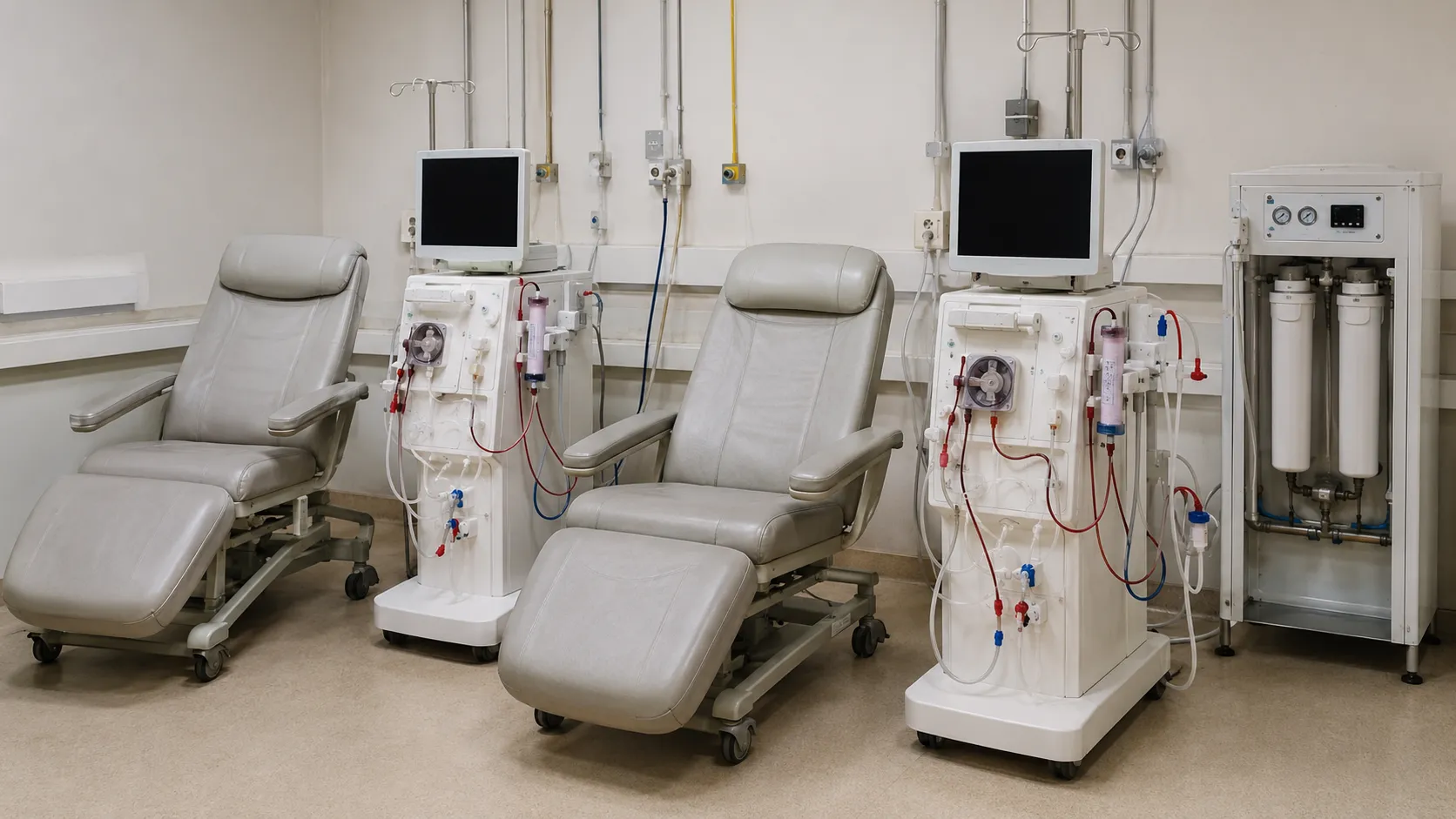
Introduction
Dialysis replaces the work of the kidneys when they fail, and the equipment needed depends on which technique is used — haemodialysis, peritoneal dialysis or continuous renal replacement. Each technique requires its own machines, consumables and supporting systems, and the choice is matched to the patient's condition, setting and lifestyle. Understanding those groups helps any renal service plan, compare options and budget sensibly.
This guide walks through the main types of dialysis equipment used in renal centres worldwide, what each does, where it fits, and how to choose — with notes on approval across the UK, the EU, the US, the Gulf (GCC) states, and South Africa.
The short version — dialysis equipment in three groups
Most dialysis equipment falls into one of three groups — haemodialysis and its water systems, peritoneal dialysis, and intensive-care renal replacement therapy.
-
Haemodialysis — HD machines, dialysers and the water-treatment systems that every haemodialysis unit depends on.
-
Peritoneal dialysis — automated and manual PD systems for home-based continuous dialysis.
-
CRRT — continuous renal replacement systems for acute kidney injury in critical care.
Types of dialysis equipment
-
Haemodialysis machines. HD machines that pump blood through a dialyser to remove waste and excess fluid over 3–4 hours.
-
Water treatment systems. Reverse osmosis and deionisation systems that produce the purified water that haemodialysis requires.
-
Dialysers & bloodlines. Single-use hollow-fibre dialysers and bloodlines through which blood flows during HD.
-
Peritoneal dialysis machines. Automated PD cyclers that run overnight exchanges of fluid in the peritoneal cavity at home.
-
Home haemodialysis machines. Smaller, user-friendly HD machines for patients who dialyse at home more frequently.
-
CRRT machines. Continuous renal replacement therapy systems for acute kidney injury in intensive care.
-
Vascular access equipment. Fistula needles, tunnelled catheters and PD catheters providing access for dialysis.
-
Dialysis monitoring. Blood pressure, fluid management, and online monitoring systems for safe HD sessions.
What each type does
|
Category |
Examples |
Used for |
|
HD machine |
Haemodialysis machines |
Clearing waste via blood filtration |
|
Water treatment |
RO and DI systems |
Producing ultrapure dialysis water |
|
Dialysers/bloodlines |
Single-use hollow-fibre dialysers |
The filtration membrane |
|
PD machines |
Automated PD cyclers |
Overnight peritoneal exchanges |
|
Home HD |
Home haemodialysis machines |
More frequent home dialysis |
|
CRRT |
Continuous RRT systems |
ICU acute kidney injury |
|
Vascular access |
Needles, catheters, PD catheters |
Access to the circulation |
|
Monitoring |
BP, fluid, online monitors |
Safe session management |
Dialysis modalities compared
The three main dialysis techniques serve different patient groups and clinical settings.
|
Modality |
How it works |
Best for |
Consider |
|
In-centre HD |
Blood filtered via machine, 3x/week |
Most ESRD patients |
Centre visits; travel |
|
Home HD |
Same as HD, done at home |
Independence; more frequent |
Training; space; support |
|
Peritoneal (PD) |
Fluid exchanges in peritoneal cavity |
Home use; remote areas |
Peritonitis risk; storage |
|
CRRT |
Continuous slow filtration |
ICU acute kidney injury |
ICU only; complex |
In-centre HD is the most common globally, with peritoneal dialysis and home HD growing as home-therapy options, and CRRT reserved for critical care.
Equipping a renal dialysis service?
We'll help you choose the right kit. Tell us the dialysis modality, your patient numbers and your market — we'll help you pick dialysis equipment that fits your service and is approved for use where you'll use it.
No pressure, no obligation. → Talk to the team
Dialysis equipment by setting
-
Renal dialysis centres - HD machines, water treatment, dialysers and monitoring for scheduled in-centre haemodialysis.
-
Hospital renal units - HD machines and water treatment for inpatient dialysis alongside a nephrology service.
-
Intensive care units - CRRT machines for acute kidney injury in critically ill patients.
-
Satellite dialysis units - HD machines and RO systems in community or outpatient settings closer to patients.
-
Home dialysis - Home HD and automated PD cyclers, with support and consumable supply for home-based patients.
Choosing dialysis equipment
-
Define the dialysis modality and number of patients the service must support.
-
Match HD machine capacity, CRRT and PD equipment to that patient population.
-
Plan water-treatment sizing, purification quality and monitoring around the HD machines.
-
Confirm market approval, device class and water-quality standards.
-
Plan consumables — dialysers, bloodlines and PD fluid — into the running cost.
Consumables — dialysers, bloodlines and PD fluid — dominate a dialysis service's running cost, and water-treatment maintenance is critical to patient safety. Plan all of these alongside equipment purchase.
Emerging dialysis technology
-
Wearable and portable HD. Compact and wearable devices are being developed to allow dialysis with greater freedom.
-
High-flux and HDF. Haemodiafiltration removes larger uraemic toxins than standard HD, improving outcomes.
-
Remote monitoring. Connected HD machines allow remote session oversight and safety alerts.
-
Expanded home HD. Simpler home HD machines and training programmes are growing home use.
-
Bioartificial kidney research. Research into implantable bioartificial kidneys aims to replace dialysis in future.
Approval by region
|
Region |
Regulator |
Requirement |
|
United Kingdom |
UKCA mark (CE accepted to 2028–2030) |
|
|
European Union |
CE marking under the EU MDR |
|
|
United States |
510(k) clearance or PMA approval |
|
|
Gulf (GCC) |
SFDA & GCC bodies |
National registration / GCC conformity |
|
South Africa |
Medical device licensing |
Dialysis machines and water-treatment systems are regulated as higher-risk medical devices, alongside water-quality standards for dialysis fluid. For clinical and quality guidance, the NICE and World Health Organisation resources are useful references. Our buyer hub sets out how to purchase with confidence.
More from Business
-
Buyers — source HD machines, water treatment and dialysis consumables for your renal service.
-
Suppliers — list your dialysis equipment and consumables and reach buyers worldwide.
-
Advertise — promote your products and services to a clinical audience.
-
Business overview — explore everything MediGear offers healthcare organisations.
Disclaimer
This article is for general information only and does not constitute clinical, renal, medical, procurement or regulatory advice. Dialysis equipment, techniques, requirements and regulations vary by country, setting and need, and change over time. Always confirm that equipment suits the intended clinical use and is approved for your market (for example, UKCA, CE under the EU MDR, FDA, SFDA/GCC or SAHPRA), follow water-quality and decontamination standards, and consult qualified nephrology, biomedical engineering and procurement professionals for decisions specific to your organisation. medigear.uk accepts no liability for actions taken based on this content.
The right dialysis equipment for your renal service.
From haemodialysis machines and water treatment to peritoneal dialysis, CRRT and home haemodialysis, we supply dialysis equipment to renal centres and hospitals across the UK, Europe, the US, the Gulf and South Africa.
Frequently Asked Questions
Dialysis equipment covers haemodialysis machines and their single-use dialysers and bloodlines, reverse-osmosis and deionisation water-treatment systems, automated peritoneal dialysis cyclers, home haemodialysis machines, continuous renal replacement therapy systems for ICU use, vascular access equipment including fistula needles and tunnelled catheters, and blood pressure and fluid-management monitoring for safe sessions.
Haemodialysis pumps blood through an external dialyser machine to filter waste, typically in a centre three times a week. Peritoneal dialysis uses the patient's own peritoneal membrane as a filter, with dialysis fluid cycled in and out of the abdomen — usually overnight at home by an automated cycler. PD offers more independence, while HD is more widely available and suitable for most patients.
Continuous renal replacement therapy is used in intensive care for patients with acute kidney injury who are too haemodynamically unstable for conventional haemodialysis. It runs slowly and continuously, 24 hours a day, removing waste and fluid gradually. It requires a dedicated CRRT machine and vascular access, and is managed by ICU staff rather than dialysis nurses.
Yes. HD machines and CRRT systems are available as certified refurbished units and can significantly reduce capital costs. Confirm certified refurbishment, a warranty, calibration and parts and service support, and check the device is approved for your market and compatible with your water-treatment and consumable supply. Machines must be fully tested and validated before patient use.
Dialysis machines are higher-risk medical devices and must be approved for the market — UKCA or CE under the EU MDR in the UK and EU, FDA clearance in the US, and SFDA or SAHPRA registration in the Gulf and South Africa. Water-treatment systems must meet dialysis fluid quality standards, so plan for ongoing water testing, machine servicing and consumable quality management.
Haemodialysis requires ultrapure water meeting strict microbiological and chemical standards. A water-treatment plant typically includes pre-filtration, a softener, carbon filters to remove chlorine, and a reverse-osmosis unit producing the primary purified water, sometimes with a final deionisation or endotoxin-removal stage. The system must be regularly monitored, maintained and validated to protect patients from water-related harm.