
Introduction
A hospital estates director in 2019 planning an infection control refit would have been thinking about a specific ward refurbishment, a handful of side rooms, and updates to the sluice arrangements. The same director in 2025 is thinking about how many negative pressure rooms the trust actually has (not what the plan on the wall says), whether the ventilation system in the wider ward areas is fit for the airborne-transmission conversation that the pandemic reopened, what PPE stock the trust is holding after the supply chain shocks of 2020, and what the trust's plan is if a novel high-consequence infectious disease presents at the front door tomorrow. The infection prevention and control equipment conversation is not the conversation it was six years ago. Nor should it be.
Infection prevention and control (IPC) equipment sits across surveillance, PPE, isolation, decontamination, and therapeutic categories, each with its own vendor landscape, regulatory framework, and post-pandemic reset. What follows walks through the picture organised by IPC function, because that framing captures how the equipment gets specified and used in the wider IPC service structure. The picture is broader than the historical conception of IPC as principally about hand hygiene and standard precautions, though those remain central.
Surveillance and rapid diagnosis
The equipment that detects infection has expanded and accelerated substantially over recent decades. PCR platforms in the laboratory (Roche cobas 6800/8800, Cepheid Infinity, Thermo QuantStudio, BD MAX) provide the diagnostic backbone for viral and bacterial pathogens, with turnaround now typically hours rather than the days that older culture-based methods required for many organisms. Rapid molecular platforms (Cepheid GeneXpert, BioFire FilmArray, Roche cobas Liat) support point-of-care and near-patient molecular testing with turnaround measured in minutes to an hour, transforming decisions in emergency departments and admissions areas.
MALDI-TOF mass spectrometers (Bruker Biotyper, bioMerieux VITEK MS) have transformed bacterial identification in microbiology laboratories, providing accurate species-level identification within minutes of a colony being available rather than the biochemical panel testing that took overnight. Combined with automated antibiotic susceptibility testing platforms (BD Phoenix, bioMerieux VITEK 2), this has substantially compressed the timeline from sample receipt to targeted antimicrobial treatment.
Wastewater surveillance and syndromic surveillance covered in the population health piece extend infection surveillance beyond individual patient testing. Sequencing for pathogen typing and outbreak investigation (Illumina and Oxford Nanopore platforms) increasingly supports both clinical and public health decisions about specific outbreaks. What was once specialist reference laboratory work is now available in many acute trust laboratories.
Personal protective equipment
The category that received the most public attention during COVID and the most systemic reset. Filtering facepiece respirators (FFP3 in UK usage, N95 in US usage) protect against airborne infectious particles when correctly fitted. Products from 3M (Aura, 1873V, various models), MSA (Advantage), Moldex, and Uvex cover the FFP3 market. Fit testing (using specific quantitative or qualitative protocols with equipment like TSI PortaCount for quantitative fit testing) is essential because a respirator that doesn't fit the specific individual doesn't provide the protection claimed on the packet, and this is one of the areas where practice has tightened significantly since COVID.
Powered air-purifying respirators (PAPRs) from 3M Versaflo, Dräger X-plore, and MSA OptimAir provide alternative respiratory protection for staff who cannot achieve an adequate FFP3 fit, or for procedures that generate high aerosol loads (aerosol-generating procedures in dentistry, ENT, respiratory medicine). PAPR usage expanded substantially during Covid and has largely persisted in specific clinical contexts.
The wider PPE picture includes surgical masks (Type IIR for splash protection), fluid-resistant gowns (compliant with EN 13795), gloves (nitrile increasingly dominant over latex due to allergy concerns), eye protection (goggles or visors), and increasingly the coordinated donning and doffing infrastructure that treats PPE use as a system rather than as individual pieces of equipment. PPE stockholding, supply chain resilience, and rotation of stock to prevent expiry have all received renewed attention post-Covid.
Isolation infrastructure
The specific equipment category where negative pressure rooms sit is covered in more technical detail in the HVAC piece. Every UK acute hospital now recognises the specific numbers of functionally-compliant negative pressure isolation rooms it has rather than what the plans on the wall say. Positive pressure protective isolation rooms serve the different purpose of protecting immunocompromised patients from external contamination. Anteroom design, pressure monitoring, and audible alarms for pressure loss are the specific technical elements.
Cohort management equipment supports isolation nursing at scale when single rooms are exhausted. This includes physical barriers within ward areas, dedicated equipment for the cohort area to prevent cross-contamination, and clear signage and workflow arrangements that reduce inadvertent contamination pathways. During Covid many trusts learnt what worked and what didn't in cohort management at scale, and equipment provision continues to develop.
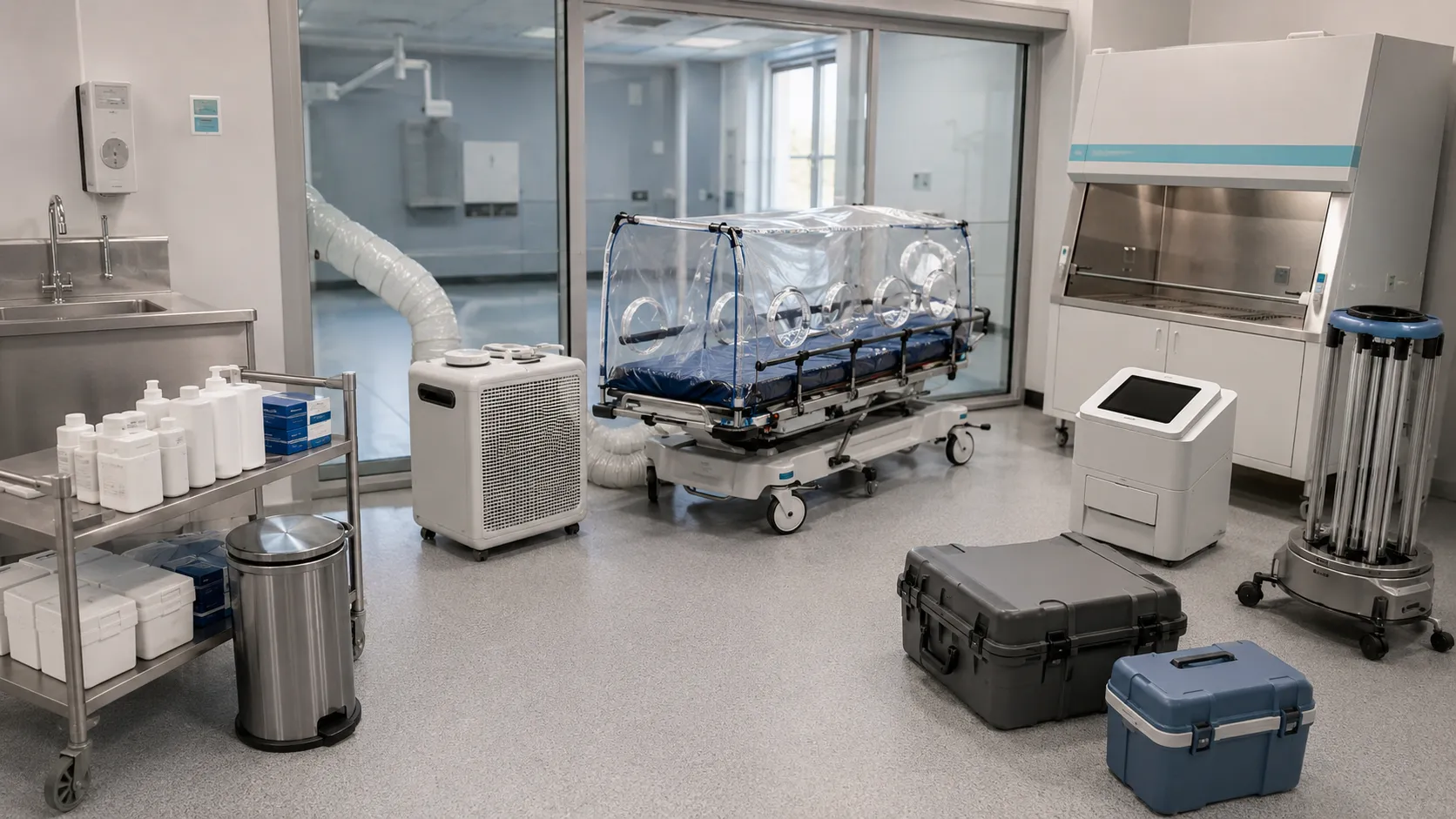
High-consequence infectious disease (HCID) capability requires specific facility and equipment provision beyond standard isolation. UK HCID care is concentrated in specific centres (Royal Free London, Newcastle upon Tyne, Royal Liverpool, and specialist paediatric units), with dedicated Trexler bed isolators, negative-pressure ambulance transfer capability, and specific PPE and treatment protocols. This is a specialist capability rather than a general acute hospital one.
Decontamination and sterilisation
The equipment that reprocesses reusable medical devices between patients. Autoclave sterilisation using saturated steam under pressure covers most surgical instruments, with equipment from Getinge, Belimed, MMM, and Steelco supporting central sterile services departments. Automated washer-disinfectors precede autoclave sterilisation for instruments requiring both cleaning and disinfection. HTM 01-01 (decontamination of surgical instruments) is the UK reference framework.
Endoscope decontamination is a specific subcategory with its own equipment (Olympus ETD, Getinge WD Endo, Wassenburg WD440 endoscope reprocessors) and specific decontamination protocols that reflect the difficulty of cleaning long, narrow-lumen equipment thoroughly. HTM 01-06 covers endoscope decontamination specifically, and this is a specific area where audit and compliance receive continuing attention because failures have historically led to outbreak events.
Environmental decontamination equipment for room and surface disinfection includes automated systems like Xenex LightStrike UV-C disinfection robots, Bioquell hydrogen peroxide vapour systems, and various fogging systems. These are used specifically for terminal cleaning of high-risk areas (isolation rooms after infectious patient discharge, theatres after specific procedures, decontamination of shared equipment). Evidence supports specific applications; the wider marketing of these systems is ahead of the evidence for routine use in general clinical areas.
Therapeutic equipment for severe infection
Specific therapeutic equipment supports management of severe infectious disease. Class III biological safety isolators (BSL isolators) for laboratory handling of high-consequence pathogens sit within specialist reference laboratories. Ventilators and ICU equipment for severe respiratory infection (COVID demonstrated both the demand for and the capability of modern ICU equipment at national scale). ECMO capability for the sickest respiratory failure patients (Getinge Cardiohelp, LivaNova) is available at specialist centres.
Antimicrobial stewardship equipment includes point-of-care biomarker testing (procalcitonin, CRP) that supports appropriate antibiotic decisions and reduces inappropriate prescribing. Therapeutic drug monitoring equipment for specific antibiotics (vancomycin, aminoglycosides) supports safe dosing in critical illness. Blood culture systems (BD BACTEC FX, bioMerieux BacT/ALERT VIRTUO) with rapid identification workflows accelerate targeted treatment in bloodstream infection.
The post-Covid IPC equipment landscape
Covid transformed the IPC equipment conversation in ways that are still working through UK NHS practice. Ventilation is now recognised as central to IPC, not incidental (see the wider discussion in the HVAC piece). PPE supply chains have been re-examined with more emphasis on domestic manufacturing capacity and stockholding. Isolation room capacity has been more honestly counted and, in many trusts, expanded. Point-of-care molecular testing has become part of routine emergency department infection triage rather than a specialist capability. Wastewater surveillance has moved from research curiosity to established public health infrastructure.
What has not fully worked through is the workforce and culture side of IPC. Equipment on its own doesn't create the practice change that IPC requires; specific training, appropriate staffing, and cultural support for good practice all have to accompany the equipment investment. Trusts that invested in equipment without the wider IPC infrastructure did not necessarily see the outcomes that better-integrated approaches achieved. See UKHSA's infection prevention guidance for the current UK framework across the field.
Infection prevention and control is a specialist domain with specific regulatory, clinical, and public health considerations that this article touches on rather than fully covers. Specific procurement should involve IPC teams, infection specialists, microbiology, decontamination services, and clinical engineering appropriate to the application. Named products reflect current UK NHS practice and are not endorsements. The post-COVID IPC landscape continues to develop; current guidance from UKHSA and NHS England should be checked for the most recent specifications.
IPC equipment across specialisms and regulatory frameworks
Post-Covid IPC equipment review, isolation capacity expansion, PPE stockholding strategy, or specific decontamination service refresh? Infection prevention and control equipment procurement crosses multiple regulatory frameworks and requires specialist input across IPC, microbiology, decontamination services, and clinical engineering. We can point you toward suppliers and consultants who work in the specific IPC subspecialisms. Get in touch about what you're reviewing.
Frequently Asked Questions
FFP3 (in UK usage; N95 in US usage) is a class of filtering facepiece respirator that protects against airborne infectious particles when correctly fitted. Products include 3M Aura, 3M 1873V, MSA Advantage, and Moldex models. Fit testing using specific quantitative or qualitative protocols (equipment like TSI PortaCount for quantitative fit testing) is essential because a respirator that doesn't fit the specific individual doesn't provide the protection claimed on the packet. Fit-testing practice has tightened significantly since Covid.
Health Technical Memorandum 01-01 is the UK reference framework for decontamination of surgical instruments. It covers cleaning, disinfection, sterilisation, tracking, quality management, and the physical facilities of central sterile services departments. HTM 01-06 specifically covers endoscope decontamination, which is a subcategory with its own particular challenges around cleaning long narrow lumen equipment. Both are actively enforced through Care Quality Commission inspections and adverse events have led to outbreak investigations.
UV-C disinfection systems (Xenex LightStrike and similar) and hydrogen peroxide vapour systems (Bioquell) have evidence supporting specific applications, particularly terminal cleaning of isolation rooms after infectious patient discharge, theatres after specific procedures, and decontamination of shared equipment. The wider marketing of these systems for routine use in general clinical areas is ahead of the evidence. They complement rather than replace manual cleaning and traditional disinfection, and effectiveness depends heavily on appropriate use.
High-consequence infectious disease capability in the UK is concentrated in specific centres including Royal Free London, Newcastle upon Tyne, Royal Liverpool, and specialist paediatric units, with dedicated Trexler bed isolators, negative-pressure ambulance transfer capability, and specific PPE and treatment protocols. This is a specialist capability rather than a general acute hospital one. HCID pathogens include Ebola, Lassa, Marburg, and other high-mortality highly-transmissible infections requiring specific isolation and treatment infrastructure.
Covid drove significant reset across PPE practice: expanded fit-testing of FFP3 respirators including for staff who hadn't previously required them, wider use of powered air-purifying respirators (PAPRs) for aerosol-generating procedures, more emphasis on donning and doffing infrastructure and training, PPE supply chain re-examination with more emphasis on domestic manufacturing capacity and stockholding, and rotation of stock to prevent expiry. Many practice changes have persisted; some have relaxed as the acute phase receded.
Rapid molecular platforms (Cepheid GeneXpert, BioFire FilmArray, Roche cobas Liat) support point-of-care and near-patient molecular testing with turnaround measured in minutes to an hour, rather than the days that older culture-based methods required. This transforms decisions in emergency departments and admissions areas, supporting immediate patient placement decisions, targeted antibiotic prescribing, and IPC decisions. Point-of-care molecular testing has moved from specialist capability to routine infection triage in many UK emergency departments.
A functionally-compliant negative pressure isolation room requires appropriate ventilation (typically 10 to 12 air changes per hour with negative pressure to corridor, with a pressure-controlled anteroom), continuous pressure monitoring with audible alarms for pressure loss, appropriate HEPA filtration on extract where pathogen risk warrants it, ensuite bathroom facilities, and the wider clinical environment to support isolation nursing. HTM 03-01 covers the ventilation technical specification; HBN 04-01 covers wider inpatient facility design; both have been substantially reviewed post-Covid.