
Introduction
During the Covid pandemic, one of the earlier warning signals of the Omicron variant's arrival in the UK came not from an ill patient in a hospital but from a wastewater sample tested for SARS-CoV-2 genetic material. The Environmental Monitoring for Health Protection programme, run by the UK Health Security Agency, had by that point built an infrastructure of wastewater sample collection from treatment plants covering roughly two-thirds of the English population. Concentrations of viral RNA, and later the specific variants present, could be tracked at community and regional levels with a lead time of days over clinical case reporting. This is one specific example of what medical equipment supporting population health looks like at scale. The equipment is not at any patient's bedside. It is nowhere near a hospital. But it feeds directly into public health decisions that affect millions of people.
Population health work uses medical equipment differently from clinical care. Where clinical equipment supports decisions about individual patients, population health equipment supports decisions about groups, communities, regions, and nations. The equipment itself sometimes overlaps with clinical equipment; often it doesn't. What follows walks through the population health equipment picture organised by function — surveillance, screening at scale, intervention delivery at scale, outcome measurement — because that framing captures how the equipment actually gets used in population health rather than in individual care.
Surveillance: detecting disease and risk factors at population level
The most distinctive category of population health equipment. Disease surveillance in the UK relies on multiple parallel systems. Laboratory reporting from NHS microbiology labs feeds notifiable disease surveillance through automated systems that flag specific pathogens as they are identified. This depends on the equipment at the receiving laboratory (MALDI-TOF mass spectrometers from Bruker Biotyper and bioMerieux VITEK MS for bacterial identification, various PCR platforms for viral detection, blood culture systems from BD BACTEC and bioMerieux BacT/ALERT), all connected to hospital information systems that route results into surveillance data streams.
Sentinel surveillance systems capture population-level disease trends through structured samples of practice. GP-based surveillance for influenza-like illness, using data from a network of participating practices, provides real-time information on respiratory illness burden. Point-of-care testing in surveillance sentinel practices provides confirmatory microbiology on samples of these presentations. The equipment picture here is not exotic — standard PCR platforms and rapid antigen tests — but the infrastructure to systematically sample, test, and report at scale is what makes population-level insight possible.
Wastewater surveillance, developed rapidly during COVID but with roots in polio and other disease programmes, uses standard laboratory PCR and next-generation sequencing infrastructure applied to a novel sample matrix. The equipment (real-time PCR platforms, NGS sequencers, sample preparation automation) is not different from what a routine microbiology lab uses; what is different is the sample collection, extraction protocols for the specific matrix, and the interpretation frameworks for turning viral RNA concentrations into population-level signal.
Health survey and monitoring programmes (the Health Survey for England, the Adult Psychiatric Morbidity Survey, various UK biobank projects) use standardised measurement equipment (validated BP monitors, portable spirometry, actigraphy, various biomonitoring) to generate population-level data on risk factor prevalence, physiological measurements, and lifestyle patterns. These are not designed around individual patient care but around population statistics.
Screening at scale: infrastructure for mass programmes
The equipment picture behind screening programmes is not just the screening test itself but the whole population-scale infrastructure. Call-and-recall systems that identify eligible populations, generate invitations, track responses, coordinate follow-up, and produce management data all sit at the population-health end of the equipment spectrum. IT infrastructure rather than clinical device infrastructure, but essential for the screening programmes covered separately.
Laboratory automation supports the throughput required for screening at scale. The move from cytology to HPV-primary cervical screening was as much about the automation capabilities of the HPV assay platforms (Roche cobas, Hologic Aptima, Abbott Alinity) as about the underlying biology — running millions of samples per year requires equipment engineered for high-volume automated processing, not just accurate results. Similar considerations apply to newborn blood spot screening laboratories, which process the Guthrie card samples from every UK newborn through automated tandem mass spectrometry.
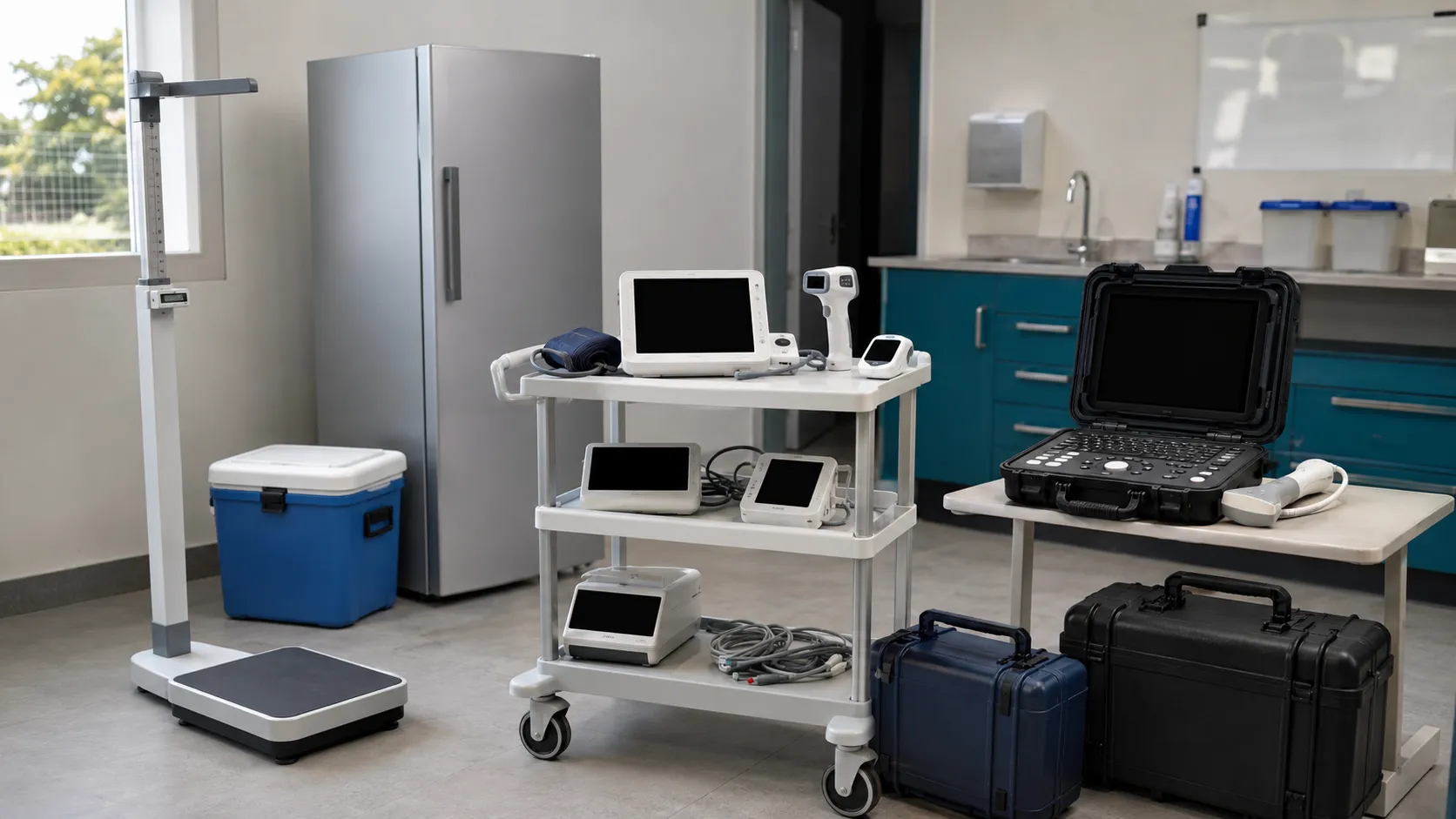
Mobile screening units for AAA screening, breast screening in some settings, and various community-based screening initiatives use portable equipment configured for the population-level workflow rather than the individual patient. Ultrasound systems, mammography units, and diagnostic kits that live on a truck rather than in a hospital bay illustrate how population-scale delivery shapes equipment specification.
Intervention delivery at population scale
Mass vaccination programmes are the archetypal population-scale intervention. The equipment supporting them includes vaccine cold chain (already discussed in the preventive healthcare piece), mass immunisation clinics with appropriate patient flow infrastructure, and increasingly the digital scheduling and record systems that make offering millions of appointments manageable. The Covid vaccination programme demonstrated what mass immunisation infrastructure looks like at genuine national scale.
Public health outbreak response uses equipment configured for scale: mass testing sites that ran during Covid used automated PCR and lateral flow platforms configured for throughputs of thousands of samples per day per site. Contact tracing systems (partly equipment, mostly information systems) sit alongside laboratory testing to support intervention decisions at scale. Where these systems have been retained beyond the acute pandemic phase, they form part of ongoing population health infrastructure.
Outcome measurement: aggregating individual data into population signal
National clinical audits (MINAP for cardiac care, SSNAP for stroke, TARN for trauma, NNAP for neonatal intensive care, and dozens of others) represent the aggregation of individual patient data into population-level outcome measurement. The equipment side of this is largely about connectivity — medical devices and EPRs that can export data into the required audit formats without excessive manual entry. Where this works, audit submission is manageable; where it doesn't, audit quality degrades because the manual effort becomes prohibitive.
Cancer registries (National Cancer Registration and Analysis Service in England, and equivalents in the devolved nations) aggregate diagnostic and treatment data across the UK cancer patient population, feeding into cancer survival statistics and services planning. The equipment side is diagnostic pathology equipment producing structured reports, imaging systems producing DICOM-compliant records, and various treatment systems producing data that flows into the registry. Population-level cancer outcome statistics depend on this chain working across every trust delivering cancer care.
Mortality surveillance uses death certification and coroner data flowing into central systems that track patterns and identify unexpected clusters. The equipment here is administrative and IT rather than clinical, but again it depends on the underlying clinical equipment producing the information that eventually flows through the certification chain. Where clinical equipment integration with EPRs is poor, mortality attribution suffers.
The wider infrastructure question
Population health equipment doesn't sit neatly in individual trust procurement cycles. Much of it is commissioned nationally (UKHSA surveillance systems, national screening programme laboratory infrastructure), regionally (some laboratory consolidation programmes), or through specific project structures rather than through general healthcare procurement. Trust-level equipment nevertheless feeds into population health infrastructure through connectivity and audit submission, so decisions made at trust level have implications beyond the individual trust and its own patient population, right across the wider health system that participates in the surveillance.
The UK Health Security Agency (UKHSA), created in 2021 from parts of Public Health England and the National Institute for Health Protection, is the main national body for population-level disease surveillance and response. The Office for Health Improvement and Disparities (OHID) covers wider health improvement work. NHS England commissions the screening programmes and national audits. Local authority public health teams cover community-based prevention. This is a distributed responsibility structure, and population health equipment procurement happens across these bodies rather than as a single unified programme. See UKHSA's remit and current work for the specific UK framework.
Population health equipment procurement is a specialist domain that sits partly outside general healthcare procurement and involves national bodies (UKHSA, OHID), NHS England national commissioning, and local trust and authority-level provision. This article is an orientation for those approaching the field from a general healthcare equipment background; specific procurement or contribution to population health infrastructure should be led by public health expertise appropriate to the specific area. Named products reflect current UK practice and are not endorsements.
Population health as distributed equipment infrastructure
Contributing to population health infrastructure, engaging with UKHSA or NHS England national programme equipment questions, or thinking about how trust-level equipment procurement feeds into wider surveillance and audit capabilities? Population health equipment sits partly outside general healthcare procurement and involves distributed responsibility across multiple national and local bodies. We can point you toward specialists who work at the interface of population health and equipment infrastructure. Talk to us about what you're working on.
Frequently Asked Questions
Wastewater surveillance analyses sewage samples for pathogen genetic material to track disease circulation at community and regional level. Developed rapidly during Covid but with roots in polio and other disease programmes, it uses standard laboratory PCR and next-generation sequencing infrastructure applied to a novel sample matrix. The UK Environmental Monitoring for Health Protection programme covers roughly two-thirds of the English population and provides population-level signal with lead time of days over clinical case reporting.
Sentinel surveillance systems capture population-level disease trends through structured samples of clinical practice. GP-based surveillance for influenza-like illness, using data from a network of participating practices, provides real-time information on respiratory illness burden. Point-of-care testing in surveillance sentinel practices provides confirmatory microbiology on samples of these presentations. The equipment is not exotic — standard PCR platforms and rapid antigen tests — but the systematic sampling infrastructure is what makes population-level insight possible.
The UK Health Security Agency was created in 2021 from parts of Public Health England and the National Institute for Health Protection, and is the main national body for population-level disease surveillance and response in the UK. The Office for Health Improvement and Disparities (OHID) covers wider health improvement work. NHS England commissions the screening programmes and national audits. Local authority public health teams cover community-based prevention. Population health equipment procurement happens across this distributed responsibility structure.
Laboratory reporting from NHS microbiology labs feeds notifiable disease surveillance through automated systems that flag specific pathogens as they are identified. This depends on equipment at receiving laboratories: MALDI-TOF mass spectrometers from Bruker Biotyper and bioMerieux VITEK MS for bacterial identification, various PCR platforms for viral detection, blood culture systems from BD BACTEC and bioMerieux BacT/ALERT, all connected to hospital information systems that route results into surveillance data streams. Automation matters as much as accuracy at population scale.
National clinical audits (MINAP for cardiac care, SSNAP for stroke, TARN for trauma, NNAP for neonatal intensive care, and dozens of others) aggregate individual patient data into population-level outcome measurement. The equipment side is largely about connectivity — medical devices and EPRs that can export data into the required audit formats without excessive manual entry. Where this works audit submission is manageable; where it doesn't, audit quality degrades because manual effort becomes prohibitive.
Cancer registries (National Cancer Registration and Analysis Service in England, and equivalents in the devolved nations) aggregate diagnostic and treatment data across the UK cancer patient population, feeding into cancer survival statistics and services planning. The equipment side is diagnostic pathology equipment producing structured reports, imaging systems producing DICOM-compliant records, and treatment systems producing data that flows into the registry. Population-level cancer outcome statistics depend on this chain working across every trust delivering cancer care.
Mass vaccination programmes require infrastructure configured for population-scale delivery: vaccine cold chain at scale, mass immunisation clinics with appropriate patient flow infrastructure, and increasingly the digital scheduling and record systems that make offering millions of appointments manageable. The Covid vaccination programme demonstrated what mass immunisation infrastructure looks like at genuine national scale, with tens of thousands of daily doses delivered across the country. Routine primary care vaccination uses similar but smaller-scale equipment.