
Introduction
A 58-year-old collapses on a train station platform in central Manchester. A bystander recognises cardiac arrest and starts CPR while another sprints to the public-access AED mounted on the platform wall. Within two minutes, the AED is delivering its first shock; within four, the ambulance service has arrived (dispatched from the 999 call routed through the medical priority dispatch algorithm); within twenty minutes, the patient is in the catheter lab at Wythenshawe Hospital where a stent is placed in the occluded coronary artery. Six days later he goes home. This kind of outcome, which would have been vanishingly rare 20 years ago, now happens routinely in UK cities because a chain of equipment and services has been engineered to support each link in the emergency response pathway. Not one piece of equipment did it. All of them working together, at the right moment, made it possible.
Emergency response as a system is bigger than any of the individual settings it covers. Public spaces, ambulance services, emergency departments, catheter labs, operating theatres, and intensive care units all form links in the chain, and the equipment picture in each is shaped by its position in the wider system. This piece walks through emergency response chronologically, from the moment of collapse or injury through to arrival at definitive care, focusing on how equipment across the pathway supports the system rather than looking at any one component in isolation. Two other pieces on this site cover ambulance equipment specifically and disaster response equipment; this one looks at everyday emergency response as a system.
Public access equipment: the first link
The strongest evidence base in emergency response equipment is for public access automated external defibrillators (AEDs). Every minute of delay in defibrillation for shockable-rhythm cardiac arrest reduces survival probability by roughly 10 percentage points; bystander defibrillation before ambulance arrival substantially improves survival in the specific rhythms that respond to it. UK public access AED deployment has expanded significantly over the past two decades through initiatives from the British Heart Foundation, community defibrillator programmes, Premier League community grants, and Ministry of Defence contributions.
Public access AEDs are typically Zoll AED Plus, Philips HeartStart FRx and HS1, LIFEPAK CR2 Plus, or iPAD Cardiac Science units, engineered for use by untrained bystanders with voice-prompted operation and automated rhythm analysis. Location registration through the national defibrillator network (managed by the British Heart Foundation and available to ambulance services) allows 999 dispatchers to direct bystanders to the nearest AED during a cardiac arrest call. Bleeding control kits (typically containing CAT tourniquets and haemostatic dressings) are increasingly being deployed in public locations after significant incidents, drawing on lessons from tactical combat casualty care.
The specific equipment issue with public access provision is not the individual device but the distribution and maintenance. An AED that isn't there, isn't accessible (locked cabinet in a shut building), or has a flat battery doesn't help anyone. Community defibrillator registration and periodic maintenance checks are what make the equipment provision translate into actual survival benefit. The UK Circuit is the national defibrillator database that supports this.
999 call handling: dispatch equipment
The infrastructure behind ambulance dispatch is less visible than the ambulance itself but shapes response substantially. UK ambulance services use Medical Priority Dispatch System (MPDS) or NHS Pathways algorithms in their computer-aided dispatch (CAD) systems, allowing 999 call handlers to systematically triage the call, categorise the response priority, provide pre-arrival instructions (chest compression prompting, choking manoeuvres, birth guidance), and dispatch the appropriate resource. CAD systems from vendors including Motorola VESTA, Northrop Grumman, and specific ambulance service platforms coordinate real-time vehicle location and dispatch across the service area.
Digital pre-alerting from ambulance to receiving hospital is now a standard part of the equipment chain. STEMI patients have their 12-lead ECG transmitted from the ambulance monitor to the primary PCI centre, allowing catheter lab activation before the patient arrives. Major trauma patients trigger trauma team activation. Stroke patients trigger stroke pathway preparation. What the ambulance monitor transmits shapes what the receiving hospital has ready when the trolley wheels through the door, and this integration is now inseparable from the emergency response equipment picture.
Emergency department reception and resuscitation
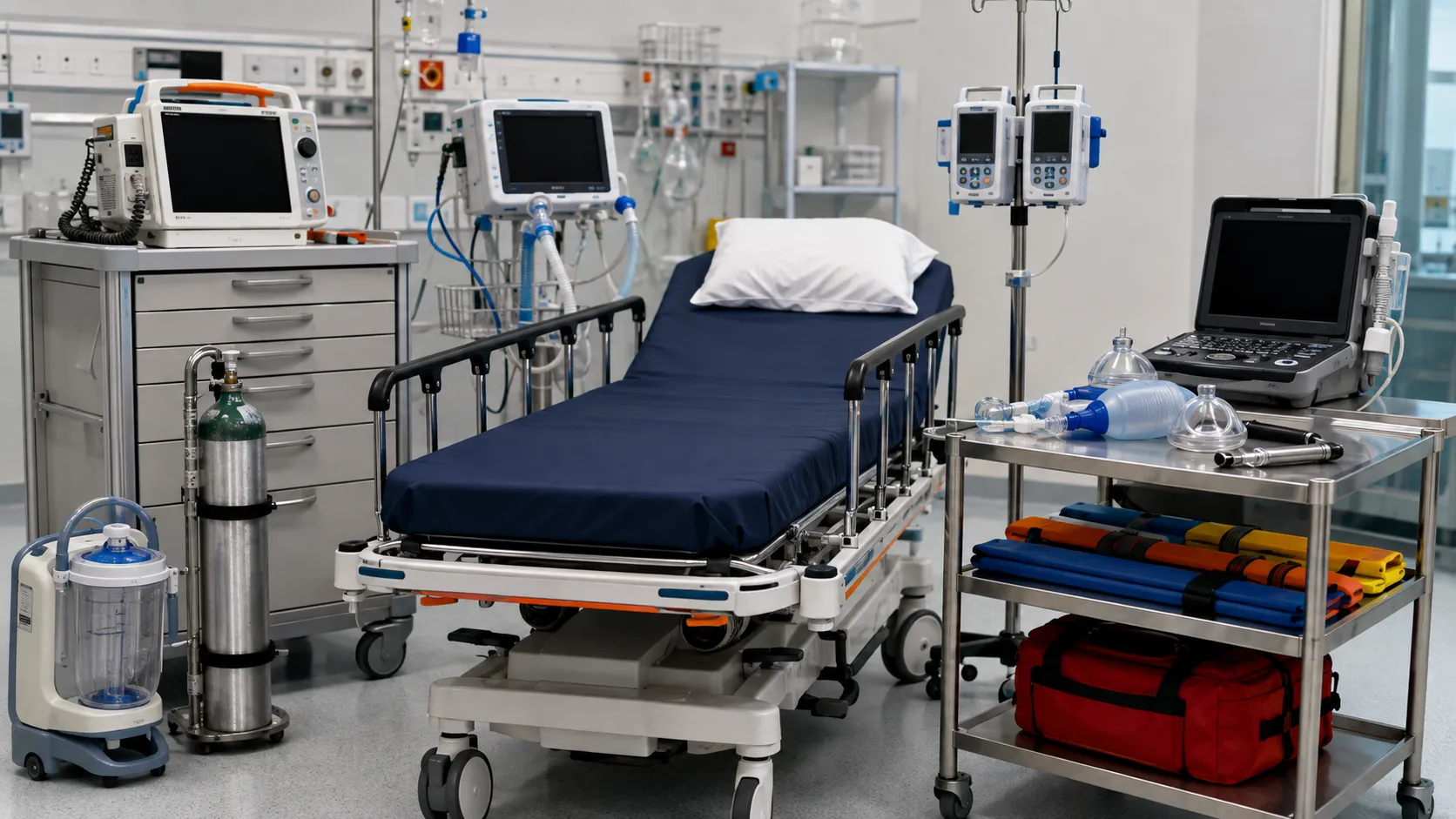
The resus room of a modern UK emergency department has a specific equipment specification driven by what patients arriving from prehospital need immediately. Monitored bay capable of continuous ECG, invasive and non-invasive BP, SpO2, capnography, and rapid ultrasound; airway management equipment including video laryngoscopes (McGrath, Glidescope, King Vision) that have substantially improved intubation success in the difficult airways that trauma and cardiac arrest often present; rapid transfusion equipment (Belmont, Level 1) for major haemorrhage; point-of-care laboratory including ABG, lactate, INR, and troponin; and specific major trauma equipment including pelvic binders, tourniquets, and haemostatic packing supplies.
Point-of-care ultrasound is now a routine part of resus equipment rather than a specialist add-on. Focused assessment with sonography for trauma (FAST), echocardiography in shocked patients, and lung ultrasound for pneumothorax and effusion all support rapid decisions in the resus room. Equipment includes Butterfly IQ, GE Vscan Air, and specialist emergency ultrasound systems from Mindray, Samsung, and others.
The trauma team activation process is itself supported by equipment: mass notification systems that page the relevant clinicians, structured trauma team roles with equipment allocated to each role, and clear team communication protocols. Major trauma centres in the UK network (23 in England plus centres in the devolved nations) have equipment specification standards that are more demanding than trauma units or local emergency departments, reflecting the case complexity they handle.
Definitive intervention: cath lab, IR, theatre, ICU
Emergency response often leads directly to a specific intervention setting: catheter lab for STEMI and stroke thrombectomy, interventional radiology suite for haemorrhage control, operating theatre for damage control surgery in trauma, and intensive care unit for organ support. Each has its own equipment picture optimised for the specific interventions, but all share the requirement to be ready quickly when the pre-alerted patient arrives.
Primary PCI centres for STEMI have cath lab equipment (biplane fluoroscopy, IVUS, FFR wire measurement, various stent platforms) ready to receive patients within short timeframes. Stroke thrombectomy centres have similar rapid-response capability for large-vessel occlusion stroke, with equipment platforms including Medtronic Solitaire, Stryker Trevo, and Penumbra stent-retriever systems. Major trauma centres have operating theatres with damage control surgical capability, imaging including CT scanners immediately available (some MTCs have CT in the resus area itself), and blood bank capability for massive transfusion.
Intensive care unit equipment for post-resuscitation care includes ventilators, invasive monitoring, targeted temperature management systems for post-cardiac-arrest care, continuous renal replacement therapy for acute kidney injury, and increasingly extracorporeal membrane oxygenation (ECMO) for the sickest patients. The wider ICU equipment picture is a substantial topic in its own right.
Handover, continuity, and the whole-system view
The chain doesn't end at the resus bay or the cath lab. Handover to inpatient teams, transfer to specialist centres if the receiving hospital cannot deliver definitive care, and continuity of information across the whole emergency journey depend on equipment integration that spans systems. Electronic patient records shared between ambulance services and hospitals, direct transmission of ECGs and other data, and structured electronic handover tools all shape whether information moves smoothly through the pathway or gets lost at each transition.
The UK major trauma network is a specific example of a system-wide equipment and service arrangement designed around emergency response. Patients meeting major trauma criteria are taken directly to a major trauma centre, bypassing nearer hospitals, based on defined criteria and coordinated by the ambulance service. This requires equipment (helicopter emergency medical services with airborne critical care capability, ground ambulance equipment sized for extended transfers, communications equipment linking the field to the receiving centre) and infrastructure (defined major trauma centres with 24/7 specialist capability) working together as a system.
Where the system works, individual patient outcomes reflect the accumulated benefit of every link. Where any link is weak, the outcome is compromised regardless of how good the other links are. This is why emergency response equipment procurement needs system-level thinking rather than device-level optimisation. See NHS England's urgent and emergency care programme for the wider policy framework in which UK emergency response operates.
Emergency response equipment procurement operates within a system-wide framework spanning ambulance services, hospital emergency departments, specialist intervention centres, and intensive care. This article is an orientation for those looking at the system as a whole; specific procurement decisions should be led by appropriate speciality and operational leads working with the wider emergency response network they participate in. Named products reflect current UK practice and are not endorsements.
Emergency response as a system, not a set of devices
Reviewing your position in the emergency response system, refreshing resus room equipment against major trauma centre specifications, building the case for stroke thrombectomy or primary PCI capability, or supporting an ambulance service equipment refresh? Emergency response is one of the clearest examples of where system-level thinking matters more than device-by-device optimisation. We can put you in touch with specialists who work on emergency response equipment at the system rather than device level. Get in touch about what you're building.
Frequently Asked Questions
Every minute of delay in defibrillation for shockable-rhythm cardiac arrest reduces survival probability by roughly 10 percentage points. Bystander defibrillation before ambulance arrival substantially improves survival in the specific rhythms that respond to it. UK public access AED deployment has expanded significantly through initiatives from the British Heart Foundation, community defibrillator programmes, Premier League community grants, and others. The Circuit is the national defibrillator database that supports 999 dispatchers directing bystanders to the nearest AED.
The Medical Priority Dispatch System is a structured triage protocol used by 999 call handlers to systematically categorise ambulance calls, provide pre-arrival instructions (chest compression prompting, choking manoeuvres, birth guidance), and dispatch the appropriate resource. UK ambulance services use either MPDS or NHS Pathways in their computer-aided dispatch (CAD) systems, coordinating real-time vehicle location and dispatch across the service area. The dispatch decision shapes the equipment and skill mix that responds.
Pre-alerting is the digital transmission of clinical information from ambulance to receiving hospital before the patient arrives. STEMI patients have their 12-lead ECG transmitted to the primary PCI centre, allowing catheter lab activation before arrival. Major trauma patients trigger trauma team activation. Stroke patients trigger stroke pathway preparation. What the ambulance transmits shapes what the receiving hospital has ready, and this integration is inseparable from modern emergency response equipment specification.
A modern UK resus bay has continuous monitoring capability (ECG, invasive and non-invasive BP, SpO2, capnography), video laryngoscopes for difficult airway management (McGrath, Glidescope, King Vision), rapid transfusion equipment (Belmont, Level 1) for major haemorrhage, point-of-care laboratory (ABG, lactate, INR, troponin), major trauma equipment (pelvic binders, tourniquets, haemostatic packing), and point-of-care ultrasound (Butterfly IQ, GE Vscan Air, Mindray or Samsung specialist systems). Specification varies with MTC vs trauma unit vs local ED status.
The UK major trauma network is a system-wide arrangement where patients meeting major trauma criteria are taken directly to a major trauma centre (23 in England plus centres in the devolved nations) bypassing nearer hospitals. This requires equipment (helicopter emergency medical services with airborne critical care, ground ambulance equipment for extended transfers, communications equipment linking field to receiving centre) and infrastructure (defined MTCs with 24/7 specialist capability) working together. Trauma outcomes have improved substantially since the network was established.
Primary percutaneous coronary intervention (primary PCI or PPCI) is the standard treatment for ST-elevation myocardial infarction (STEMI) — catheter-based opening of the blocked coronary artery, typically with stent placement. UK primary PCI centres have cath lab equipment (biplane fluoroscopy, IVUS, FFR wire measurement, various stent platforms) ready to receive STEMI patients within short timeframes. Pre-alerts from ambulance ECG transmission allow catheter lab activation before patient arrival, reducing door-to-balloon time.
Mechanical thrombectomy is the catheter-based removal of a clot from a blocked large brain artery in ischaemic stroke, effective in specific patient groups within specific time windows. UK stroke thrombectomy centres have rapid-response capability similar to primary PCI centres, with equipment platforms including Medtronic Solitaire, Stryker Trevo, and Penumbra stent-retriever systems. Access is not yet universal across the UK, and network arrangements for time-critical transfer from local hospitals to thrombectomy centres are a specific ongoing equipment and service question.