Troponin testing quantifies a structural protein that leaks from heart-muscle cells when they are injured, and it is the reference blood marker for assessing a suspected heart attack. Contemporary high-sensitivity assays pick up minute concentrations and, by tracking how the figure moves across serial draws, separate acute injury from a chronically raised baseline. If you are specifying a platform, the decisive factors are low-end sensitivity and precision, the turnaround your chest-pain pathway demands, whether the assay reports sex-specific limits, and whether analysis happens centrally or beside the patient.
Troponin feeds an algorithm; it does not pronounce a diagnosis. The analyser supplies a concentration and its trajectory, and the clinical team weighs that against the history, the electrocardiogram and the wider picture.
Why injured heart muscle releases troponin
Troponin is part of the contractile apparatus of striated muscle. Two isoforms, cardiac troponin I (hs-cTnI) and cardiac troponin T (hs-cTnT), are unique to the myocardium, so their arrival in the circulation points specifically at heart-muscle damage. After a meaningful injury, the level climbs over several hours, peaks, then recedes across days. Modern assays are sensitive enough to detect a background level in most healthy people, so the meaningful finding is not merely a detectable result but a value above the reference limit accompanied by a genuine rise or fall between samples. That dynamic pattern, read with the ECG and presentation, is what argues for or against an acute coronary event.
How a troponin assay generates its result
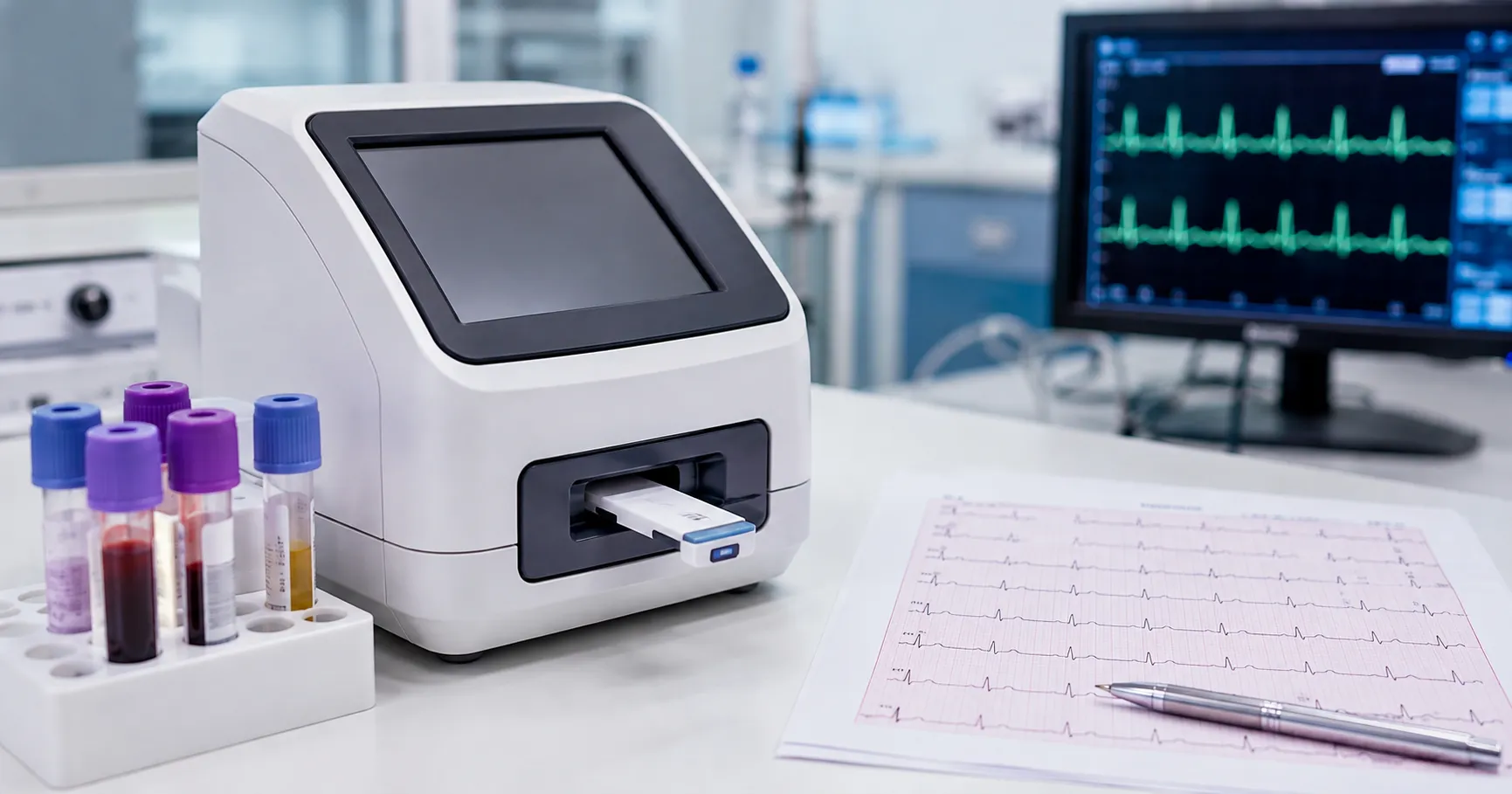
Troponin is measured by sandwich immunoassay. A capture antibody binds cardiac troponin I or T, a labelled detection antibody attaches to a second site, and the signal scales with concentration. Core laboratory analysers use chemiluminescent or electrochemiluminescent labels read as emitted light, which delivers the very low detection limits and tight precision the pathway relies on. Near-patient analysers pack the chemistry into a cartridge with a fluorescent or electrochemical readout, returning a figure from a small blood volume in minutes. The property that matters most is analytical sensitivity: only an assay that measures dependably at the bottom of its range can support the accelerated protocols that hinge on small movements close to the reference limit.
High-sensitivity assays and the rise-and-fall signal
High-sensitivity troponin rewrote the chest-pain pathway. Because these assays quantify precisely at very low concentrations, services can run 0/1-hour or 0/2-hour protocols that compare a presentation sample with one drawn a short time later. A baseline beneath a low threshold, or only a trivial change between the two draws, supports early rule-out; a clear upward movement flags injury that needs escalation through the acute coronary syndrome pathway. For procurement, the practical consequence is that the exact assay is not fungible: the absolute delta thresholds and rule-out cut-offs are specific to each manufacturer's method and cannot be carried across platforms. Insist on the precision, expressed as a coefficient of variation, at the low decision concentrations, because a rapid protocol is only as safe as the assay's reproducibility there.
The 99th percentile and sex-specific limits
The upper reference limit for high-sensitivity troponin is set at the 99th percentile of a healthy reference population, and because that value differs between men and women, many assays publish sex-specific limits. Check that the platform can store and report those separate limits and that the cut-offs and delta criteria your pathway uses match the assay's own validation. Troponin also rises outside acute coronary syndrome, in renal impairment, heart failure, tachyarrhythmia, sepsis, myocarditis and after endurance exercise, so a lone value over the limit is not a verdict. It is the movement across serial samples, not any single number, that distinguishes an acute event from a stable elevation, which is why the reporting screen must lay serial results out clearly.
Where troponin testing should sit
Location tracks the bottleneck. A core laboratory analyser delivers the best low-end precision, high throughput and the keenest price per test, and it fits hospitals where samples reach the bench promptly. A cartridge analyser in the emergency department removes the transport leg and returns a result in minutes, which shortens the decision wherever laboratory turnaround is the limiting step. Near-patient devices give up a little analytical performance and batch economy for that proximity, and they demand governance, training and quality control proportionate to a result that decides admission. If you intend to run an accelerated rule-out, confirm the specific device and its thresholds are validated for that protocol before you commit.
Specifications worth scrutinising
Lead with the limit of detection and the coefficient of variation at the low decision concentrations, because accelerated protocols stand on low-end precision. Review the measuring range, sample type and volume, time to result and throughput, and confirm sex-specific 99th-percentile limits are supported. Examine how the analyser handles results beyond range, interferences such as haemolysis, biotin or heterophile antibodies, and control failures, and whether it locks out when controls lapse. For a cartridge system, weigh storage conditions and competency-based operator lockout. Above all, confirm bidirectional interfacing to the laboratory information system and electronic record so serial values trend without anyone retyping them.
Conformity, safety standards and oversight
A troponin analyser is an in-vitro diagnostic and needs UKCA or CE marking, a declaration of conformity and Great Britain registration of its maker with the MHRA. It should satisfy IEC 61010 on electrical safety and IEC 61326 on electromagnetic compatibility. Laboratory operation falls under ISO 15189 and near-patient use under ISO 22870, each with recorded operator competency and clinical governance. The role of troponin in assessing chest pain and acute coronary syndromes is set by NICE and local cardiology protocol, never by the box itself. Ask for the conformity dossier and confirm the registration directly instead of trusting a datasheet.
Quality control when the result guides admission
Since the number steers admission and treatment, quality control is non-negotiable. Analyse two or more control levels, one close to the decision threshold, at the manufacturer's intervals and after each reagent-lot change, record every value and investigate drift before it touches a report. Apply traceable calibrators at the stated cadence; cartridge systems scan lot calibration from a barcode. Join an external quality assessment scheme for cardiac markers so your performance is benchmarked against peers. Retain control and maintenance records for accreditation, and set aside recurring budget for controls, calibrators and the probe and module servicing that laboratory analysers require.
Running costs and the case for adding troponin
Cost per reportable result anchors the decision. A cartridge device consumes one cartridge per test plus collection items; a laboratory analyser works through bulk reagent, calibrators and control sera at a lower unit cost that keeps falling with volume. Blood-contacting parts are single-use and go to clinical waste, and the instrument is wiped with an infection-control-approved disinfectant. Model the genuine cost per result at your true volume with controls and external quality assessment folded in, because a low cartridge price can hide short dating or cold-chain demands. Question suppliers on warranty, first-year service, loan cover and the cost of common faults. Frequently the cheapest route is to add the troponin assay to an immunoassay analyser you already run; the MediGear buyers team can help weigh that, or contact us for availability.
Procurement checklist
-
Insist on a high-sensitivity assay with precision quantified at the low decision levels.
-
Confirm sex-specific 99th-percentile limits are stored and reported.
-
Check the delta thresholds and cut-offs match your accelerated chest-pain protocol.
-
Place the analyser centrally or near-patient according to where turnaround is lost.
-
Obtain the UKCA or CE conformity file, IEC 61010 evidence and MHRA registration documentation.
-
Run a control near the threshold, with calibrators and external quality assessment.
-
Confirm serial results interface both ways to the laboratory system and record.
-
Cost the reportable result and weigh adding troponin to an existing analyser.
Conclusion
Troponin testing carries the assessment of suspected heart attack, and its usefulness rests on low-end sensitivity, dependable serial measurement and reference limits matched to your pathway. Site it where your chest-pain turnaround is decided, demand documented precision at the decision levels, and hold quality control tight because the figure directs admission and treatment. Reviewing documented performance data alongside MediGear helps your service choose a troponin platform that backs prompt, safe cardiac decisions.
Disclaimer
This article is for informational purposes only. It is published by MediGear (medigear.uk) for general information and procurement guidance, and is not clinical, diagnostic, treatment, technical, engineering, legal or regulatory advice, nor a product endorsement, guarantee or substitute for professional assessment. MediGear does not provide medical consultations. Buyers should consult their clinical, biomedical, estates and regulatory contacts, and the manufacturer's documentation, and independently verify all specifications, certifications, compatibility and suitability before purchase. Specifications, certifications and availability are correct at the time of publication and may change without notice. MediGear is a medical-equipment distributor and does not sell medicines or pharmaceutical products.