
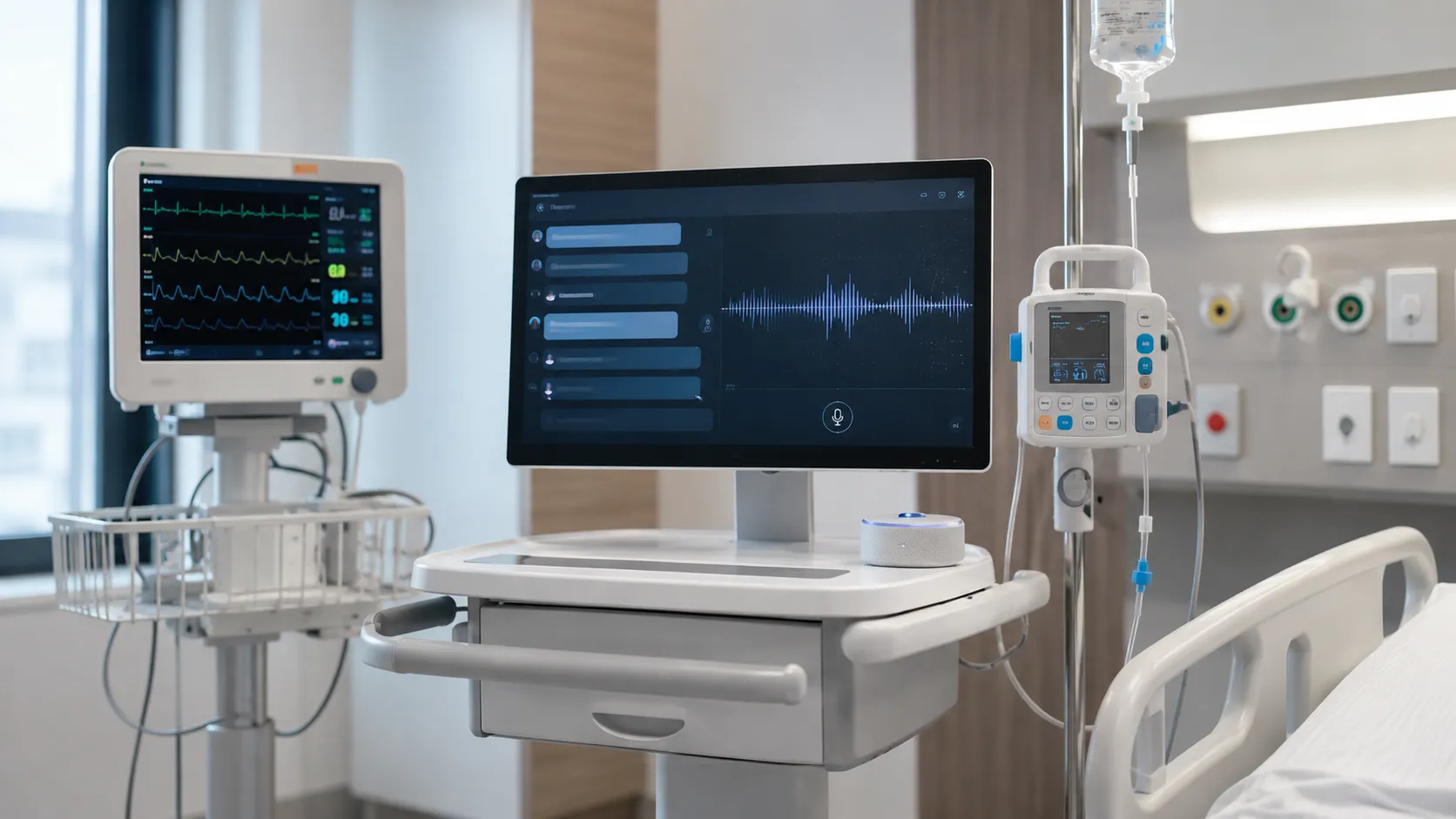
Introduction
So much of medicine lives in words — the notes a clinician writes, the report a radiologist dictates, the instruction a nurse speaks aloud. Natural language processing, the branch of artificial intelligence that lets software make sense of human language, is quietly building a bridge between all that text and speech and the devices that surround the patient.
This article explains how natural language processing supports clinical devices — from turning speech into records to letting staff work hands-free, and connecting the written word to the machines of care. It is written for clinical, procurement and information-governance teams across the UK, Europe, the US, the Gulf and South Africa who want to understand where language technology genuinely helps.
The short version
-
Natural language processing lets software understand and produce human language.
-
It turns speech into documentation and pulls structured facts from free text.
-
It lets staff control and query devices hands-free via voice.
-
Because it handles sensitive words, data protection is central to using it well.
Teaching software to read and listen
Natural language processing, usually shortened to NLP, is the field of artificial intelligence concerned with human language — understanding what is written or said, and generating language in return. In healthcare, where a great deal of vital information exists only as free text or the spoken word, this ability to work with language rather than just numbers opens up possibilities that other kinds of AI cannot reach.
The reason it matters for devices is that machines deal in structured data, while people deal in words. NLP sits between the two, translating the messy, human language of the clinic into something a device or system can use, and turning a device's data back into language a person can act on. It is, in effect, an interpreter between people and machines.
From speech to record, instantly
The most established use is documentation. Clinicians spend a great deal of time writing up what they have done, and NLP-powered dictation can turn the spoken word directly into a written record, quickly and with increasing accuracy. For fields like radiology, where reports are often dictated, this has become a familiar part of the working day.
The benefit is not just speed but attention. Time spent typing is time not spent with the patient, so anything that shortens the documentation burden gives that time back. When the record can be created by speaking naturally, the technology fades into the background, allowing the clinician to concentrate on care.
Finding the facts hidden in the text
A subtler but powerful role is extraction. Enormous amounts of clinical information sit locked inside free-text notes, in a form that computers have traditionally been unable to use. NLP can read that text and pull out the structured facts within it — a diagnosis mentioned, a measurement recorded, a symptom described — making information usable that would otherwise stay buried.
This quietly feeds the rest of the digital hospital. A predictive tool, a safety check, or a device that needs a piece of information can have it drawn automatically from the notes, rather than relying on someone to re-enter it. By unlocking the written record, NLP helps the other machinery of care work with a fuller picture.
What NLP does for clinical work
|
Task |
What NLP does |
The benefit |
|
Documentation |
Turns speech into records |
Time back for patients |
|
Extraction |
Pulls facts from free text |
Buried information made usable |
|
Voice control |
Hands-free device use |
Cleaner, faster interaction |
|
Summarising |
Condenses long records |
The key points, faster |
Working hands-free
As voice interaction matures, it also begins to feel natural rather than novel, which is when it truly helps. A clinician who can ask for what they need and trust that the request is understood, works with the technology instead of around it — and that ease, multiplied over the course of a day, is where the real benefit lies.
Increasingly, NLP lets staff interact with devices and systems by voice. In settings where hands are busy or must stay sterile, being able to ask a question, call up a result or note a finding by speaking is more than a convenience — it can help keep a workflow clean and uninterrupted. The voice becomes a natural, hands-free way to work with the technology in the room.
The same ability helps busy clinicians get to information quickly. Rather than navigating menus, a spoken question can retrieve what is needed, and a long record can be summarised to its key points on request. These are small efficiencies individually, but over the course of a working day, they add up to real time saved and friction removed.
The words are sensitive.
Because natural language processing works with the actual words of clinical care, it handles some of the most sensitive information, making data protection central rather than incidental. Patient information, spoken or written, must be kept secure and private and used lawfully, which squarely falls within the territory the Information Commissioner's Office addresses in its guidance on AI and data protection.
The other cautions apply as they do to any clinical AI. When NLP software serves a medical purpose, it can be a regulated medical device, and in Great Britain the MHRA sets out how such software is classified. And because language is subtle and easily misread, a human should check anything that matters — a dictated report, an extracted fact — before it is relied upon. The FDA frames the same expectations in the United States.
Questions before adopting a clinical NLP tool
-
How accurate is it on the language and accents of your actual speciality and staff?
-
Is a human clearly kept in the loop to check anything that matters?
-
How does it store and protect patient data, and on what lawful basis?
-
Does it integrate cleanly with your records and the devices it must serve?
-
If it serves a medical purpose, what is its approved intended use?
Language that fits your speciality
It is worth allowing time for this fit rather than expecting it out of the box. Even a capable tool usually needs a period of tuning and getting used to before it feels natural in a given service. Teams that plan for that settling-in period tend to end up far happier than those that expect a language tool to work flawlessly from the first day.
There is also a question of trust to be earned over time. Staff will lean on a language tool only once it has proved dependable in their hands, so a measured introduction, with room to build confidence and give feedback, tends to work far better than switching everything over at once and hoping it holds.
One practical point decides much of an NLP tool's value: how well it understands the particular language of your work. Medicine is full of specialised vocabulary, abbreviations and turns of phrase that vary by speciality and even by hospital, and a tool that copes well with one setting may stumble in another. The only real test is how it performs on the actual language your staff use.
This is why piloting matters more than a demonstration. A polished demo on tidy, standard phrasing tells you little about how a tool handles the rushed, abbreviated, accented reality of the clinic. Trying it on your own material, with your own people, is the surest way to know whether it will genuinely help or quietly frustrate.
An interpreter between people and machines
Natural language processing does not diagnose or treat; it does something quieter and broadly useful, connecting the human world of words to the machine world of data. By turning speech into records, unlocking the facts hidden in notes, and letting staff work hands-free, it helps clinical devices and the people who use them work together more smoothly — provided the sensitive words it handles are always protected with care.
More from Business
-
Buyers — source approved, well-documented equipment.
-
Suppliers — list your equipment and reach buyers worldwide.
-
Advertise — promote your products and services to a clinical audience.
-
Business overview — explore everything MediGear offers healthcare organisations.
Disclaimer
This article is general information, not clinical, procurement or data-protection advice. Clinical NLP tools must be used within any approved intended use, with appropriate human checking and lawful handling of personal data; confirm current requirements with the relevant authority. medigear.uk accepts no liability for actions taken based on this content.
The devices NLP connects to
Genuine, approved, well-documented clinical equipment — the dependable foundation that language technology connects to, wherever you work.
Frequently Asked Questions
Natural language processing (NLP) is the branch of AI concerned with human language — understanding what is written or said and generating language in return. In healthcare, where much vital information exists only as free text or speech, it can work with language rather than just numbers, acting as an interpreter between the human world of words and the machine world of data.
NLP-powered dictation turns the spoken word directly into a written record, quickly and increasingly accurately — a feature familiar in fields like radiology, where reports are dictated. The benefit is not just speed but attention: time spent typing is time not spent with the patient, so creating the record by speaking naturally gives that time back.
Yes. Enormous amounts of clinical information sit locked inside free-text notes. NLP can read that text and extract the structured facts within it — a diagnosis mentioned, a measurement recorded, a symptom described — making buried information usable and feeding it to predictive tools, safety checks, or devices that need it, rather than relying on manual re-entry.
NLP enables staff to interact with devices and systems via voice. Where hands are busy or must stay sterile, asking a question, calling up a result or noting a finding by speaking helps keep a workflow clean and uninterrupted. Spoken queries can also retrieve information quickly and summarise long records to their key points on request.
Because NLP works with the actual words of care, it handles some of the most sensitive information, so data protection is central. Patient information, spoken or written, must be kept secure and private and used lawfully — the territory the ICO addresses in its guidance on AI and data protection — with appropriate governance for any tool that processes it.
Yes. Language is subtle and easily misread, so a human should check anything that matters — a dictated report, an extracted fact — before it is relied upon. And when NLP software serves a medical purpose,se it can be a regulated medical device, subject to the appropriate approval and oversight for its intended use.