
Introduction
Dermatology is, above all, a visual speciality. So much of diagnosing skin comes down to looking — at a mark, a mole, a rash — and recognising what it means, a skill built over years of trained observation. Because it relies so heavily on images, dermatology is a natural home for artificial intelligence, which is very good at learning to see.
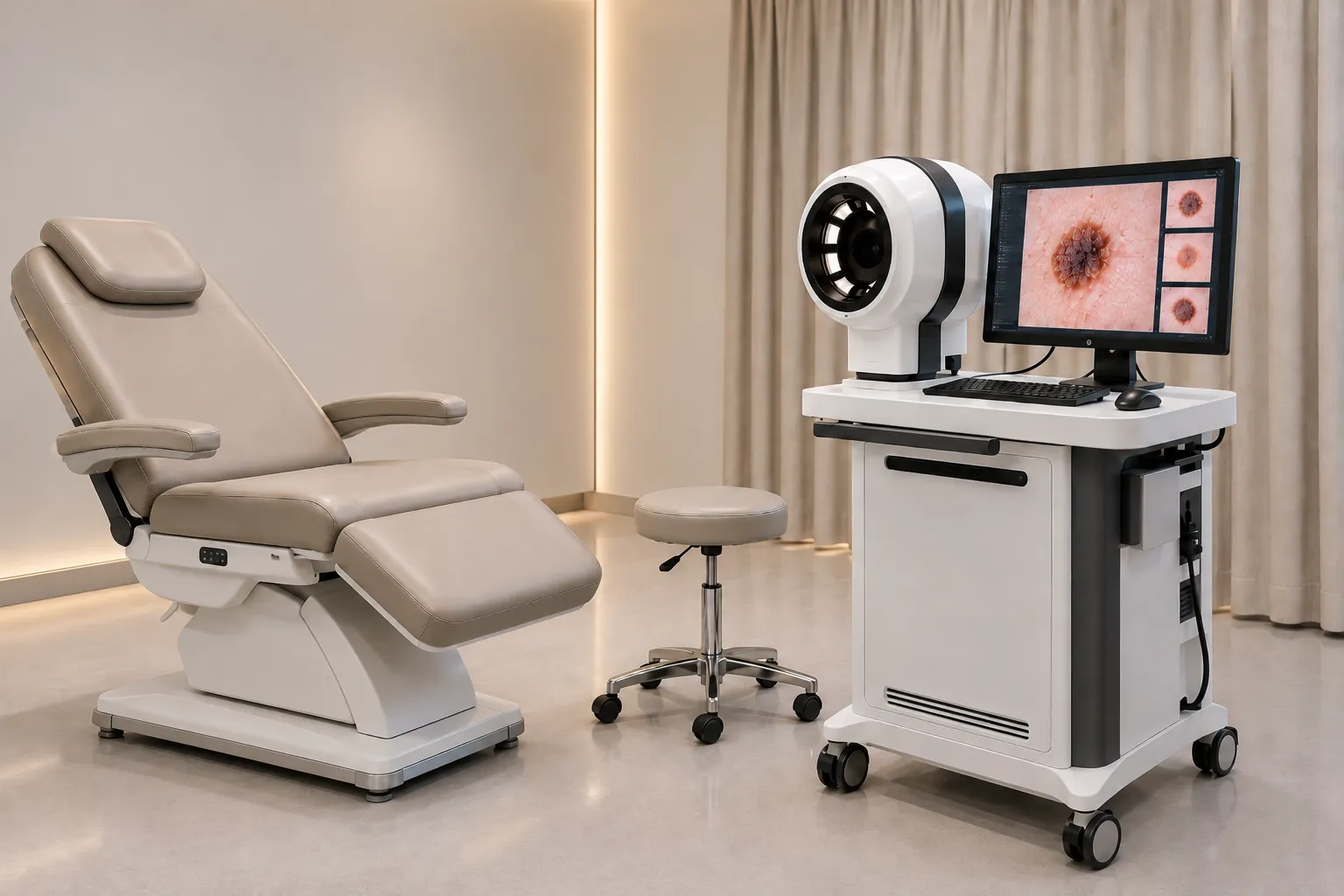
This article explains how AI is improving dermatology diagnostic devices—analysing skin images, flagging what may be dangerous, and helping bring expert-level assessment to more people. It is written for dermatology, primary care, and procurement teams across the UK, Europe, the US, the Gulf, and South Africa who want to understand where AI genuinely helps in diagnosing skin conditions.
The short version
-
Dermatology diagnosis leans heavily on visual assessment of the skin.
-
AI can analyse skin images and flag potentially dangerous lesions.
-
It can bring a measure of expert assessment to non-specialists and at a distance.
-
It supports the clinician's judgement rather than replacing it.
Diagnosis by the trained eye
What makes dermatology distinctive is how much rests on the appearance of the skin. Distinguishing a harmless mole from an early melanoma, a benign rash from something serious, depends on a dermatologist's pattern recognition, honed over a career of seeing countless cases. It is expert visual judgement, and it is precisely the kind of skill that has proved hard to spread widely, because it takes so long to build.
This is exactly where artificial intelligence fits. Trained on large numbers of skin images, a model can learn to recognise the visual patterns associated with different conditions much as a clinician does, though by a different route. It offers a way to capture some of that hard-won visual expertise in software and make it more widely available — not to replace the dermatologist, but to extend the reach of expert-level assessment.
Flagging what may be dangerous
The most important application is helping catch skin cancer early. Skin cancer is among the most common of all cancers, and it is highly treatable when caught early, so spotting a suspicious lesion in time matters enormously. AI can analyse a lesion image and flag those that look concerning and warrant a closer look or referral, acting as a consistent second opinion on every mark it sees.
This matters because worrying lesions must first be noticed to be acted on, and subtle early cancer can be easy to overlook. A tool that reliably flags concerning lesions helps ensure they reach expert attention, which in skin cancer can be the difference between a simple treatment and a serious one. Global efforts to reduce the toll of cancer, framed by the World Health Organisation, rest heavily on exactly this kind of early detection.
Bringing expertise to more people
One of the most promising things about dermatology AI is its potential to widen access. Specialist dermatologists are relatively scarce, and many people first see a general practitioner who is not a skin expert. AI that can help assess a lesion offers a way to support those non-specialists, helping them decide with more confidence which concerns need urgent referral and which can be reassured.
Because skin assessment is image-based, it also travels well. A photograph of a lesion can be analysed or shared for a second opinion, which underpins teledermatology—assessing skin remotely. For people far from a specialist, or in places where dermatologists are few, this ability to bring expert-supported assessment to where the patient is could make a real difference to how quickly skin cancer and other conditions are caught.
Where AI helps in dermatology
|
Task |
What AI adds |
Why it matters |
|
Lesion assessment |
Analyses skin images |
A consistent second look |
|
Cancer flagging |
Highlights concerning marks |
Skin cancer caught sooner |
|
Access |
Supports non-specialists |
Expertise reaches further |
|
Teledermatology |
Assesses skin remotely |
Care beyond the clinic |
The problem of skin tone and fairness
Dermatology AI carries a fairness concern that deserves particular attention. Skin conditions can look very different on different skin tones. If a model has learned mostly from images of one range of tones, it may perform worse on others — potentially missing disease in the very groups already less well served. This is not a hypothetical worry but a documented risk in skin-image AI.
The response is to insist on evidence across the full range of skin tones a tool will encounter. A dermatology tool should be shown to work well for all the patients it will serve, not just those most represented in its training data. In a field where appearance matters, and skin varies so widely, checking for fair performance across skin tones isn't optional; it is central to whether a tool is safe to use.
Getting dermatology AI right
For a service adopting AI in skin diagnosis, a few principles keep it safe and useful:
-
It performs well across the full range of skin tones you will see.
-
It was validated on lesions and conditions like those you assess.
-
It supports a clinician's decision rather than replacing it.
-
It handles skin images, which are personal, securely and respectfully.
-
Its approved intended use matches how and by whom it will be used.
Held to diagnostic standards
Because these tools inform decisions about potentially serious disease, they are held to genuine standards. When such software serves a medical purpose, it is a regulated medical device; in Great Britain, the MHRA sets out how AI as a medical device is classified, and the FDA takes a similar approach in the United States, having authorised AI-enabled skin tools. As always, the crucial questions are what a tool was validated on, how it performs on the patients you see, and how its performance is monitored over time.
Not a replacement for the biopsy
It is worth being clear about what dermatology AI does and does not do. Analysing an image can flag a lesion as concerning. However, the definite diagnosis of skin cancer still rests on examination by a specialist and, where needed, a biopsy of the tissue. AI helps decide which lesions deserve that closer look; it does not settle the diagnosis by itself, and should never be treated as if it does.
Understanding this keeps the tool in its proper place. Its great value is in triage — helping ensure the worrying lesion is noticed and referred, and helping reassure where reassurance is warranted — not in replacing the expert assessment and, ultimately, the pathology that confirms what a lesion truly is. Used that way, it strengthens the path to diagnosis without pretending to be its end.
Reassurance as well as detection
There is another, quieter benefit worth naming. Many skin concerns turn out to be harmless, but people cannot know that without assessment, and the worry in the meantime is real. A tool that helps a clinician confidently reassure someone that a mark is benign spares needless anxiety and needless referrals, freeing specialist time for the cases that truly need it.
This works in both directions: catching the dangerous lesion and confidently clearing the harmless one are two sides of the same useful coin. A dermatology service supported by reliable AI can be more vigilant about real threats and more reassuring about false alarms, serving patients and stretched services alike — provided, always, that the tool has earned that confidence through evidence.
A trained eye, made more widely available.
AI is improving dermatology diagnostic devices by capturing something of the trained eye in software — analysing skin images, flagging what may be dangerous, and helping bring expert-level assessment to non-specialists and distant patients. Handled with real care for fairness across skin tones, and kept firmly in support of clinical judgement, it offers a way to catch skin cancer and other conditions earlier, for more people — which is exactly where its promise lies.
More from Business
-
Buyers — source approved, well-documented equipment.
-
Suppliers — list your equipment and reach buyers worldwide.
-
Advertise — promote your products and services to a clinical audience.
-
Business overview — explore everything MediGear offers healthcare organisations.
Disclaimer
This article is general information, not clinical or procurement advice. Dermatology AI should be used within its approved intended use and under qualified clinical supervision; confirm current requirements with the relevant authority. medigear.uk accepts no liability for actions taken based on this content.
Dermatology equipment you can build on
Genuine, approved, well-documented dermatology and imaging equipment — the dependable foundation good skin AI reads from, wherever you diagnose.
Frequently Asked Questions
Dermatology leans heavily on visual assessment of the skin, and AI is very good at learning to see. Trained on large numbers of skin images, it can analyse a lesion, flag concerning cases, and bring expert-level assessment to non-specialists and patients in remote areas. It supports the clinician's judgement rather than replacing it.
It can help. Skin cancer is among the most common cancers and highly treatable when caught early, so spotting a suspicious lesion in time matters enormously. AI can analyse an image and flag lesions that look concerning and warrant a closer look or referral, acting as a consistent second opinion that helps ensure a worrying mark reaches expert attention.
Yes, and this is one of its most promising uses. Specialist dermatologists are scarce, and many people first see a general practitioner for a skin concern. AI that helps assess a lesion can support those non-specialists, helping them decide with more confidence which concerns need urgent referral and which can be reassured — widening access to expertise.
It is assessing skin remotely. Because skin assessment is image-based, a photograph of a lesion can be analysed or shared for a distant opinion. For people far from a specialist, or where dermatologists are few, this ability to bring expert-supported assessment to where the patient is can make a real difference to how quickly conditions are caught.
Yes, and it is a serious fairness concern. Skin conditions look different on different skin tones, and a model trained mostly on one range of tones may perform worse on others — potentially missing disease in groups already less well served. A dermatology tool should be shown to work well across the full range of skin tones it will encounter, not just those most represented in its data.
Yes. When such software serves a medical purpose, it is a regulated medical device, classified and overseen by its intended use, and regulators have authorised AI-enabled skin tools. The crucial questions are what a tool was validated on, how it performs on the patients you see — across skin tones — and how its performance is monitored over time.